0
0

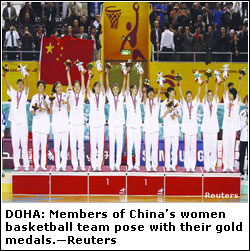 DOHA, Dec 15: No new Chinese super stars were unearthed. There was no 'next' Liu Xiang or Yao Ming. There was no need.
China's athletes dominated the medal count at the Asian Games, their last major test before the 2008 Beijing Olympics.
In so many events, it was China first, daylight second – if it wasn't China, China.
But as the Chinese look ahead to hosting Summer Games, coaches are repeating one message to their athletes: don't get too confident.
Despite the medal haul, Chinese sports officials say they got only what they expected from the young athletes who will form the core of the team they're honing with the aim of replacing the United States atop the Olympic medal standings.
“Their achievements impressed me but the athletes should be aware of the fact that Asian Games are not the same as Olympic Games,'' said Duan Shijie, a top sports official and deputy head of the Chinese delegation.
“In the Olympics, they will be faced with more pressure, stronger opponents and fiercer competition.''It was a sentiment shared by Liu, who has became a celebrity in China since emerging from relative obscurity to win the men's 110-meter hurdles at the Athens Olympics in a world record-equaling time.
“China may be the big brother in Asia and hard for other Asian countries to catch, but there are lots of countries that are better at Olympic sports such as swimming,'' Liu said.
Until Liu, China had never won an Olympic gold medal in a men's track sprint event.
Now he owns the world record _ his 12.88 seconds at Lausanne, Switzerland in July, and is the world champion.
Liu was the highest-profile athlete at Doha and cruised to a comfortable win in his only event, setting a meet record 13:15 seconds for good measure after admitted the ''shadow'' of an encroaching team-mate forced him to pick up his speed.
China was second to the United States on the medal standings at Athens, with 32 gold medals to 36 for the Americans.
Finishing atop the table at home is almost a national obsession, which is why it surprised some observers that the team for Doha contained so many raw, young athletes.
With only two medals events left Friday – out of 428 for the games – China had 164 gold medals and 315 overall. South Korea was next with 58 gold medals, eight ahead of Japan.
China has topped the Asian Games medal tallies in every edition since 1982 and took care to ensure this year was no different, bringing the largest team at 647 athletes.
Of those, almost 64 percent were participating in their first major multi-sport games, part of a strategy of tempering China's deep pool of talent with greater competition experience.
Some officials have been critical of the younger athletes, saying that even when they shined, their golds were what Duan called of ''low quality'' _ won with results well below the top international level.
Among the top young performers were 20-year-old Zhang Wenxiu, who set an Asian record in the women's hammer throw, Xue Fei who impressed with gold in the 5,000-meters and He Ning, 16, who emerged as all-around champion in women's gymnastics.
In swimming, Chen Zuo set an Asian record in the men's 100 freestyle and Wu Peng boosted his reputation in the 200 free.
China maintained its traditional strength in sports like table tennis, badminton and diving _ it has not lost a diving final at the Asian Games in three decades _ while also surprising some in field hockey by winning the women's title and upsetting traditional powers India and Pakistan in the men's competition.
Struggling against the Chinese onslaught, South Korean diver Kwon Kyung-min Kwon summed up the competition: “I don't think anyone can beat the Chinese at this stage.''
Qi Hui, 21, a triple gold medal-winning swimmer, said the athletes could not have asked for a better testing ground.
“I don't dare say whether we'll be able to replicate this success in 2008, but we will have lots more competition under our belts, and lots more depth, particularly among these young ones that are now just starting to get experience,'' Qi said.
“This meet is an excellent way of summing up where we are,'' added swimmer Ouyang Kunpeng. “I think we still really need to boost our levels, because 2008 isn't that far away.''Chinese officials aren't likely to reveal what additional measures they may take ahead of 2008. More than most nations, China is highly secretive about its athletic preparations.
Results aside, the concept of giving young athletes a chance to compete has been applauded by Chinese media, who say the country's notoriously results-obsessed sports officials seem to be taking a longer view.
“In the overall significance of things, the Chinese received a good tempering from their individual performances,'' the government's Xinhua News Agency said in an editorial.
“But of greatest value of all is that the attitude of our sports officials has begun to change,'' it added. ''Sending young athletes means being able to face defeat, so this attitude and the experience gained far exceed the value of a few gold medals.''—AP