0
0

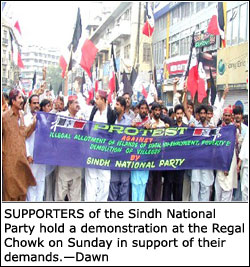 KARACHI, Dec 3: Chief of the Sindh Taraqqi Pasand Party Dr Qadir Magsi has accused the Muttahida Qaumi Movement leadership of working against the interests of Sindh in collaboration with the rulers in Islamabad. He also alleged that the MQM was involved in urban terrorism.
He was addressing a big rally in Sachal Goth, Gulshan-i-Iqbal Town, on Saturday night. The rally was held by the STPP to pay tributes to Sindhi martyrs who had sacrificed their lives to defend their motherland. Leaders of various other political and nationalist parties, including Sardar Mumtaz Ali Bhutto of the Sindh National Front, Imran Khan of the Pakistan Tehrik-i-Insaaf, Dr Abdul Hayee Baloch of the National Party and Amin Khan Khattak of the Awami National Party, besides Ali Hasan Chandio of STPP, addressed the rally.
Dr Magsi claimed that the MQM had been formed by the military dictator, General Ziaul Haq, to subjugate Sindhi people. He warned the MQM leadership against pursuing its anti-Sindh policies, adding: “Sindhis have now gained much political awareness and are determined to protect their land and rights.”
Dr Magsi said his party had decided to observe ‘Sindh Martyrs Day’ in October every year.
He also lambasted the Centre’s support to the MQM and its anti-Sindh moves, and held the party responsible for the miseries of Sindhis. In this context, he pointed out that Sindhis were being denied of the right on their lands, resources and due share in employment.
Sardar Mumtaz Ali Bhutto urged the Sindh people to get united on one platform, saying that without forging unity and launching a joint struggle, they would not be able to achieve their rights.
Imran Khan stressed the need for real democracy which, he said, could come and flourish only when judiciary and election commission were independent. He said autonomy and democracy were interlinked.
Dr Hayee Baloch said the problems of Sindh and Balochistan were the identical as peoples of both the provinces were struggling for their due political and economic rights.
He condemned the ongoing military operation in Balochistan.
Amin Khan Khattak regretted that the rulers had not learnt any lesson from the East Pakistan debacle, and said that the federation could be strengthened only when all federating units were granted equal rights.
The leaders paid rich tributes to the Sindh martyrs and vowed to carry forward the mission for which they had laid down their lives.
Several resolutions were passed at the public meeting in support of the demand for the sovereign rights of provinces as envisaged in the 1940 Resolution. One of the resolutions demanded that the right of rule on Sindh be granted to Sindhis only. It also opposed division of Sindh on a linguistic basis.
Condemning the military operation in Balochistan, a resolution called for an immediate halt to the action and release of BNP leader Sardar Akhtar Mengal, as well as all other political leaders and activists of that province.
Yet another resolution called for sending back all those settled in Sindh after1954 to their country/province of origin and stripping them of their undue right to vote.
The meeting demanded that Sindhi be recognised as official language of Sindh province and introduced as a compulsory subject at primary level across Sindh, including Karachi.