0
0

KARACHI, Dec 3: Renowned economist Dr Akbar Zaidi has claimed that the large fiscal space gained due to the 9/11 incident has been used by the military government to enrich the unscrupulous upper class and to widen the income gap in Pakistan.
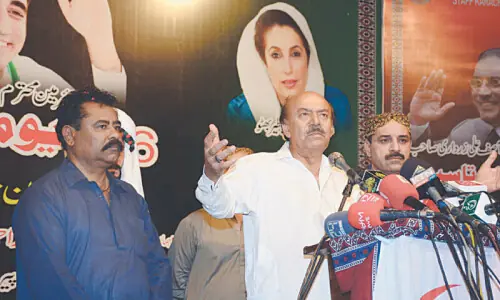
He was delivering a lecture on ‘Fiscal Policy and Development’ on Sunday as part of the weekly lecture series organised by the Pakistan People’s Party at its central secretariat here. Coordinator of PPP’s Karachi Coordination Committee Aftab Shaaban Mirani, a former federal minister, presided over the sitting.
Dr Zaidi lamented that while the opportunity to investment in education, health, water and power sectors had been lost, Loans had been got rescheduled by successive governments. Through foreign remittances alone, more than $20 billion had been accumulated but instead of enhancing trade and industry and creating employment for jobless people, the money was spent in plots and stock exchange. As a result, property prices went up and were now beyond the affordability of even the upper middle class.
The stock exchange, Dr Zaidi said, was more or less a gambling den where savings of the middle class were regularly siphoned off by unscrupulous elements. The billions earned in this way also go tax-free in order to boost the so-called “investors’ confidence”.
By far, the highest expenditures as percentages of GDP had been made by the government of Zulfikar Ali Bhutto on social sectors and infrastructure, and on consolidating the steel, machinery manufacturing and heavy industrial base of the country. This had been done in spite of the break up of the country, financial problems, the need to rebuild the defence from scratch, the nuclear programme and so many other heavy expenditures necessitated by the situation Pakistan had found itself in after the long period of military dictatorships.
He claimed that these facts had been hidden from the public eye, and asked the PPP to reopen the subject of services to the country and its people rendered by the late Bhutto. He felt that such a discussion would also be a great help to the present PPP leadership in adopting a progressive course.
Dr Zaidi said that the bulk of the tax income in the country consisted of indirect taxes on every item of use. This was a regressive system where the poorest and the 50 per cent population living below the poverty line were paying indirect taxes on the smallest consumer item at the same rate at which the richest were paying it.
The sales tax, which brought in the highest tax revenue, was the most unjust and the most regressive tax that had been levied at a high rate by the federal government.
He suggested that taxes should be progressive in which incomes should be taxed directly. The bulk of taxes should consist of direct taxes levied on the rich in proportion of their incomes.
“Our record shows that the democracies in the West and the international financial institutions had always extended their full financial support to military dictators in Pakistan and had withdrawn their support and even imposed sanctions when elected democratic government took over. Foreign loans had been accumulated in the era of General Ziaul Haq and had been wasted through and through,” he observed.
The succeeding democratic governments had to pay around $6 billion every year only as interest on these loans, he said. The interim care-taker government also got the IMF conditionality imposed on the first elected government of Ms Benazir Bhutto leaving her democratic government with a little manoeuvring space.
Mr Zaidi was of the view that the present military rulers after the first two economically disastrous years were favoured in the post-9/11 period in the shape of withdrawal of sanctions imposed after Pakistan’s nuclear test and the military takeover, debt rescheduling, debt write offs and massive aid from the western democracies and their financial institutions.
Dr Zaidi strongly advocated institution of an inquiry under a civilian NAB to determine who took the foreign loans and where these were spent. He also severely criticised the huge expenditure on defence. “Getting involved in an arms race with India will only hasten our economic collapse. It is being propagated that a new phase of best relations with India has been opened. It is good news, but if it is correct, then where is the justification for spending more on defence and much less on development?” As measures for the future Dr Zaidi called for cutting down defence expenditure and stressed on increasing allocations for social sectors and water & power. He also suggested steps like taxing incomes uniformly in all sectors, gradually doing away with regressive forms of indirect taxes, land reforms, devolving taxation powers to the level of union councils and evolving a people-friendly economic policy.
Mr Aftab Shaaban Mirani, in his presidential comments, said that the development process would not go off track if the continuity of democracy was ensured. All political parties are answerable to their electorates. Thus, in spite of pursuing different policies, their main direction has to be public welfare.