0
0

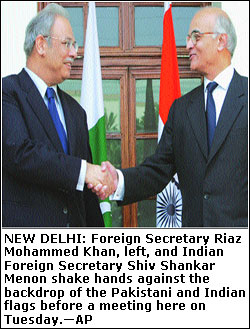 NEW DELHI, Nov 14: There was a whiff of mild optimism on the first day of the revived foreign secretary-level talks between India and Pakistan on Tuesday with both sides reporting a good discussion on all key issues in a constructive and positive atmosphere. The Siachen issue, speculated to be poised for a solution, will be discussed in more detail on Wednesday.
Both sides appeared to be pleased that the talks were infused with the "Havana spirit", euphemism for an agreement between their leaders on Sept 16, that enjoins them "to build on convergences and narrow down divergences" in their bilateral disputes, not the least over Kashmir.
Pakistani officials said the main topic of discussion had centred on Kashmir, which took nearly half the allotted three hours of talks on Tuesday that went on from 11am to 2pm at the heavily protected Hyderabad House. The Indian side, briefing the media, stressed on terrorism as the key issue that was discussed.
Pakistan's spokesperson Tasneem Aslam agreed that a personal rapport between Foreign Secretary Riaz Mohammed Khan and his Indian counterpart Shiv Shankar Menon, strengthened by the latter's stint as high commissioner in Islamabad, had helped. Both sides were tight-lipped about a joint statement if one is to be issued on Wednesday. But according to indications on Tuesday, the foreign secretaries would meet the media separately after the talks.
Ms Aslam said Mr Khan's call on Indian Foreign Minister Pranab Mukherjee, their first official encounter, was a good meeting. "The foreign minister said both countries were victims of terrorism, which makes it incumbent on us to work together to combat the threat." She said Mr Mukherjee had also expressed important ideas on the Siachen dispute. Ms Aslam declined to give details.
Pakistani officials acknowledged that the Indian side had handed them a 12-page dossier of terror crimes but declined to give details. Indian news reports on Tuesday had claimed that New Delhi would hand over details of a recent arrest of an alleged Pakistani terrorist in Mysore. But going by the overall reluctance to discuss the details the dossier could be anything -- a first beginning in the bilateral quest to jointly combat terror or it could mean nothing at all.
However, both sides agreed in principle to set up a two-way joint mechanism to fight terrorism and to investigate related crimes. The teams would be headed by a senior official from the foreign ministry, possibly an additional secretary. His team-mates would vary from case to case. For example, Pakistan's FIA and India's CBI, the main investigating agencies would be brought in to track money laundering and human trafficking cases. In terror probes, police and intelligence officials from both sides would be taken on board. It was not clear when the mechanism would become operational.
An Indian foreign ministry spokesman cautioned against expecting too many details as the talks were still underway.
"Part of the discussions naturally were focused on the declaration that was agreed to between Prime Minister Dr Manmohan Singh and President Musharraf in Havana, the follow-up action being taken thereafter. The two sides also discussed the menace of terrorism and the proposed anti-terror mechanism under the declaration," he said.
The delegations also discussed Jammu and Kashmir "which is normally discussed when Foreign Secretaries meet as part of the composite dialogue," he said. As part of that, they discussed the confidence-building measures, in particular the cross-LoC confidence-building measures that had been proposed and were partially implemented.
The status of several other confidence-building measures which have been on the table was reviewed with the objective of pushing them forward to an early implementation, the spokesman said.
Other issues of bilateral relations which have been implemented in part or been constantly under review such as travel, the situation regarding civilian prisoners, fishermen, other CBMs dealing with non-conventional and conventional security issues, were discussed.
In his meeting with Mr Khan, the Indian foreign minister "welcomed the resumption of the dialogue process and underlined the need to address all issues as part of this process," the Indian spokesman said.
Mr Mukherjee also recalled some of the achievements of this dialogue process which had already borne fruit. He also stressed the delegations "the need to take further action" so that the expectation of the people of both countries can be fulfilled.
The last word on Tuesday's talks came from the Indian spokesperson. "As I said, it was a very detailed meeting; it was held in a very constructive and positive atmosphere; and it is not over yet."