0
0

 LAHORE, Nov 3: Violating its own ban and one imposed by a court earlier on, the Punjab government — now the custodian of the Lahore Fort and the Shalamar Gardens, two Lahore monuments listed by Unesco as world heritage sites — has allowed a cellular phone company to hold a music function inside the historical fort on Nov 7. Chief Minister Pervaiz Elahi had in August 2004 formally banned the holding of all private functions at the two monuments. .
Unfortunately, the fort now also has the dubious distinction of making it to Unesco’s another list — one of endangered monuments. The latest decision to allow the holding of the function at the fort comes on the heels of the provincial culture and information secretary Taimur Azmat Osman having reiterated only the other day that the ban imposed on holding such events at historical sites would continue..
According to details, the cell phone company has reportedly paid two million rupees to the Punjab government for allowing it to hold the function not too far from the now fast fading but once majestic ‘picture’ wall. Earlier, too, despite the ban, the government had allowed a number of TV channels, including PTV, to shoot programmes on the premises of the fort this year; no fee was charged for the favours extended.
Besides, some private companies have also shot commercials there in recent months. Last year the government had also flouted the ban by allowing a private company to stage a sound and light show for five days inside the fort. It was reportedly paid more than eight million rupees for allowing the five-day programme to run.
The federal archaeology department, the erstwhile custodian of the monuments in question, used to charge a minimum of Rs150,000 per day for the use of the fort (or the Shalamar) for the holding of an activity on the premises, and the money used to be deposited with the National Fund for Cultural Heritage. This was before the two monuments were transferred to Punjab in
July 2004.
Official sources privy to cultural affairs further informed Dawn that last year the Punjab government had refused the Japanese Embassy the permission to arrange a show at the fort when it had requested that a Japanese cultural troupe be allowed to perform there. The ban in question was cited as an excuse.
“We are at a loss to understand as to why the government does not have a uniform policy in this respect. It allows some parties to hold functions while barring others, making a mockery of the ban. The message thus being conveyed is that doors may be thrown open to hold functions at the fort only for those who can negotiate the terms for flouting the ban,” confided a couple of senior archaeologists — now retired.
They said though the monuments couldn’t be closed to all such activities as they represented the country and its culture to the world, there should be a clear policy to address the issue at hand. They proposed that the government form a committee of experts to make recommendation in this regard.
However, there are others in the profession who disagree, insisting that given the state of the decay threatening the monuments in question, there should be a permanent ban on holding functions, whether by a private company or a government department, on the premises of protected monuments.
“Both (excess) light and sound, and even the use of animals and props, be they horses or heavy machinery, used in such functions pose a serious challenge to the safety of the monuments. Under the Antiquity Act of 1975 and Unesco guidelines, no private or public events are allowed inside historical monuments because these are considered a threat to their conservation,” they conclude.
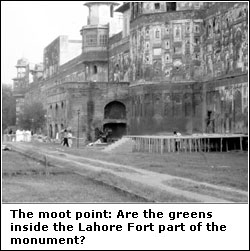
Secretary culture Taimur Azmat Osman told Dawn that the government had allowed the cell phone company to hold the function at the place which was not a part of the fort, as built by the Mughals.
“Technically it is not a part of the monument.” He said the British had developed the area in question, and explained that the particular place had been developed to hold such functions.
“Basically, the government cannot stop all types of commercial activities inside the monuments as they are the face (identity) of the country. Besides, money for their conservation is also required, which can be thus generated.” He said the amount charged for the Nov 7 function was a donation, and it would be deposited in the account of the Punjab Heritage Foundation to be spent on the restoration of the monument.
Answering questions, Mr Osman said that TV channels were allowed to shoot the programmes in the fort so that the world could know about such imposing historical monuments which were the pride of the country. He said that Unesco had asked not to hold functions in sensitive parts of the fort only, like the Shish Mahal, the Jehangir Quadrangle, the Diwan-i-Aam, etc.