0
0

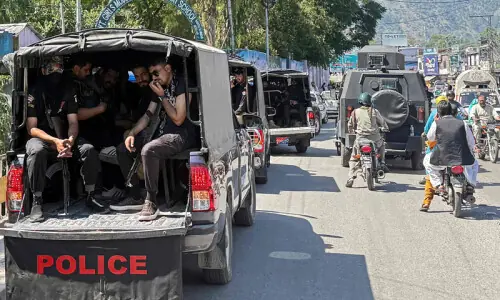
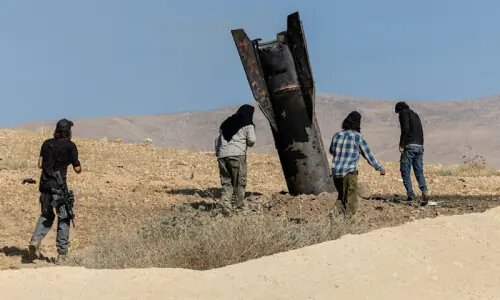
 PESHAWAR, Nov 1: The killing of 82 people in Bajaur Agency by security forces was without any legal sanction and against various provisions of the Constitution, say legal circles here.
The act of killing these people without giving opportunity of being heard is against the principle of natural justice and amounted to extra judicial killing on the part of the security forces, claimed some lawyers dealing with cases of terrorism here.
They informed that under the existing law maximum sentence available for imparting or acquiring terrorism training was up to 10 years imprisonment and that too could only be awarded by a competent court.
Under no law the law-enforcement agencies could bomb a premises on suspicion of it being a terrorism training facility. “The law does not empower the armed forces to carry out preemptive strikes. They have to act in the limits of law and the constitution which guarantees safety of life and liberty of an individual,” said advocate Noor Alam, who deals with cases under the Anti Terrorism Act.
He added that it was the principle of natural justice that nobody should be condemned unheard. “In our case 83 persons have not only been condemned unheard rather they have been killed without giving them opportunity to clarify their position,” Mr Khan said.
Article 4(1) of the constitution envisages that to enjoy the protection of law and to be treated in accordance with law is the inalienable right of every citizen wherever he may be, and of every other person for the time being within Pakistan.
“No action detrimental to the life, liberty, body, reputation or property of any person shall be taken except in accordance with the law,” says Article 4(2)(a) of the Constitution.
An NGO worker pointed out that the killed persons also included various children which was violation of the Convention on the Rights of the Child, to which Pakistan is a signatory.
He added that the Juvenile Justice System Ordinance, 2000, had been extended to FATA in 2004 and the children in any sort of crimes had to be tried by the juvenile court. Instead of bringing these children before the concerned court the security forces consider it more convenient to kill all of them.
Moreover, the government has yet to declare Bajaur Agency a conflict zone where it could use force. Under the International Humanitarian law once these areas are declared conflict zone the international humanitarian agencies have to be provided access to all these areas.
As the area where the seminary was attacked is accessible area, therefore the government could not offer any justification for resorting to the extreme option of killing the inmates there. Witnesses in the area believed that the security forces could have easily reached there and tried to arrest the inmates instead of killing them without any warning.
Training in terrorism has been declared an offence in 2001 when amendments were made in the Anti-Terrorism Act, 1997. Through those amendments. Section 21C (1) turned the act of weapons training an offence punishable up to 10 years imprisonment.
Sub-section 7 of the same section declares that providing or receiving any instruction or training in acts of terrorism is an offence punishable up to 10 years imprisonment.
Legal experts claimed that although the ATA had yet not been extended to the Federally Administered Tribal Areas, there were other laws in those areas to tackle the issue.