DATELINE ISLAMABAD: From nuclear power to space-faring nation
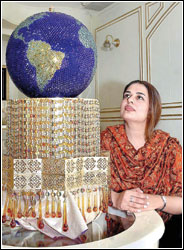 NUCLEAR hero Dr A.Q. Khan is out and space heroine Namira Salim is in. Well, at least this is what our government seems to be trying to project.
Last week, Karachi-born Dubai resident Namira Salim was named as honorary ambassador for Pakistan by the federal tourism ministry. Namira was selected in March this year as one of the first 100 space tourists in 2008 when the spaceline Virgin Galactic will begin its first commercial space flight operations from a spaceport in California in the US.
At the same time last week, our President, who had already been critical of Dr A.Q. Khan’s alleged nuclear proliferation activities in his book In the Line of Fire, emphasised in Islamabad at an iftar party for senior media representatives that Dr A.Q. Khan was no longer his hero anymore.
If the 1980s and 1990s were the heydays of research in the nuclear and missile fields with KRL and PAEC being the star institutions, the past few years has seen our leadership consciously trying to shift the nation’s focus in top scientific research from nuclear science to space science, with an energised Suparco and the newly-established Institute of Space Technology in Islamabad being the focal institutions of training, research and development.
Our aim apparently is to become a space-faring nation, i.e., a country capable of launching its own satellites into orbit and which also launches satellites for others who do not possess the capability. The commercial satellite launch service market is now a multi-billion dollar industry which initially was dominated by the US, but now is being shared by other countries which have also developed indigenous space launch facilities.
Some 10 countries in total have the capability to launch satellites, beginning with Russia (1957), followed by the US (1958), France (1965), Japan (1970), China (1970), UK (1971), Europe (1979), India (1980), Israel (1988) and Iraq (1989). Brazil and North Korea are also known to have tried to develop indigenous satellite launch facilities but so far have apparently failed.
Pakistan is now vying with Iran to be the next country to launch its own communications satellite into orbit. Pakistan first disclosed that it was going to develop its own space launch vehicle (SLV) in November 1999 when the then chairman of Suparco announced that we would develop our own SLV within a period of about three years. He further said that we were also planning to develop our own indigenous earth observation satellite in about the same timeframe.
Ironically, it was Dr A.Q. Khan who, before he fell from grace, had announced in March 2001 that Pakistani scientists were in the process of building the country’s first SLV and that the project had been assigned to Suparco, which had earlier built our two Badr weather forecast satellites which were put into orbit by Chinese and Russian launchers in 1990 and 2001, respectively.
Then in March 2005, after Pakistan successfully test-fired its Shaheen II missile (which is designed to carry conventional and nuclear weapons but is said to be powerful enough to launch a satellite into orbit), President Musharraf reportedly authorised the building of our very own space launch vehicle (SLV) so that we can indigenously launch and orbit a planned domestically built communication and surveillance satellite, the Paksat-1R.
Space technology is now of critical importance to any nation, both in peacetime as well as in times of conflict. Satellites are now a part of daily life as they have become essential not only for weather forecasting, navigation, television broadcasting and telecommunications including global internet and mobile phone service, but also in remote sensing, surveillance, reconnaissance, early warning and missile defence.
Apart from these tangible advantages, space technology, especially indigenous space technology, also serves to build national pride. One of the main objectives of our leadership in seeking to develop a space programme is probably to improve national pride, which has been hurt by the downfall of Dr A.Q. Khan.
Successfully testing an indigenous space launch vehicle and launching our first communications satellite on it would allow the current leadership to boast that Pakistan is a space power, and thus enhance the chances of another term in office, both in the case of the ruling party as well as the president.
But then the pursuit of such an ambitious indigenous space programme runs the risk of unnerving some countries who will probably be afraid of two things: firstly that such a civil space programme may be a cover for the clandestine manufacture of longer range missiles to safeguard national security, and second, that it could enable us to manufacture satellites that can find and accurately guide missiles to their targets.
In this respect, one of the objectives of the book In the Line of Fire was probably to reassure the appropriate quarters abroad that Pakistan under President Musharraf does not pose any security threat, and thus it should be allowed to pursue its civil and peaceful space programme without hindrance.
However, one major non-security apprehension about an ambitious space programme is its costliness. It is an expensive proposition to develop, maintain and operate a new indigenous launch facility or a spaceport.
Our people have already experienced the disastrous socio- economic impact of our nuclear weapons programme. It is a well known fact that poverty had increased over the 1990s when we were relentlessly pursuing our nuclear weapons programme. Can we really afford another ambitiously expensive undertaking like the indigenous space programme without making our people bear the brunt of lesser funding in the socio-economic sector?
DATELINE NEW DELHI: Divide and rule, but for how long?
It was colonial perfidy, or so our elders said. They said divide and rule was a British way to pit Indian against Indian. That’s how they created Pakistan. That’s what we were told. So the British were bad, evil people who drove a wedge in our otherwise fabulously well-knit society. But for their Machiavellian policies we would be one strong nation today, a land of milk and honey. Whatever the merits of the maudlin claim, if divide and rule worked then it works even now.
Before we consider how the state has gently sought to subvert a Kashmiri death row convict’s case for clemency with an insidious campaign against his lawyer thus driving a big wedge between the two, let’s look at the big picture of this supposedly colonial perfidy as it obtains in India today.
The original Machiavelli from ancient India named Chanakaya is idolised by today’s ruling elite. The government has named two major roads in the heart of the diplomatic enclave in Delhi— Chanakyapuri and Kautilya Marg— after this ancient Brahmin of statecraft. His leitmotif rested on the four key principles : “Saam, daam, dand, bhed”. Join the foe, bribe him, punish him, and not least divide his ranks. Didn’t our colonial rulers look like they were applying Chanakya’s doctrine of divide and rule on us? Far from being British in origins, divide and rule was essentially a very Indian doctrine.
The Kashmir uprising against unpopular Indian administrations was thus sought to be quelled by a talented but vicious bard called Kuka Parrey. This former folk singer was a dreaded man in Srinagar in the early 1990s. As the head of a private militia, sponsored by the state of course, Parrey led an entire army of “surrendered militants” to stamp out armed resistance. Since officially his men were non-state actors, the opprobrium of human rights violations would not stick easily on them. Or so it was thought. Moreover they were cheaper and often more effective in hunting down rebellious quarries.
Thus Kashmiris were set against Kashmiris, till the day someone got even with the portly gun-toting singer. He was killed by a bomb at a stadium. But surrendered militants continue to play a hand in Kashmir’s violent tryst with Indian rule.
Mohammed Afzal Guru, sentenced to be executed anytime now, was himself a surrendered militant. And thereby hangs a tale. Lawyers and human rights activists are seeking to press the government to probe the nexus between Guru and his “official handlers” prior to the attack on the Indian parliament in December 2001, and immediately after it.
Not all attempts to divide and rule are successful. On the contrary they carry a kernel of further devastation in their belly and the chances for such a calamity are never dim. Indira Gandhi was killed by her Sikh bodyguards not too long after her strategists set up Sant Bhindranwale, a rabid Sikh preacher, as a foil to the more moderate Akalis. It was Bhinranwale’s sermons that fuelled the bloody standoff between the state and the Sikhs.
Similarly, the Indian state has tried but not quite succeeded in pitting tribal rebels in Assam headed by ULFA with the state-sponsored SULFA. One is worse than the other and there is no end to the brutal methods employed by both sides to keep the pot of human rights abuses boiling.
There is no dearth of examples to illustrate the widespread use of the supposedly colonial doctrine of dividing the enemy, in this case the Indian people themselves, by underhand methods.
In the coming days we are going to hear a lot about the successes and failures of Selwa Judam, a state-sponsored scheme to divide and arm the outrageously poor Dalits and tribal peoples across the heartland of India. The mission here is to use Dalits and tribesmen against their own groups know as Naxalites. There’s no space here to explain the essentially nefarious nature of the Selwa Judam movement.
But the idea is to use people against people for the benefit of the state. Whether it’s a lesson learnt from the Brahminised strategists or the British masters is beside the point.
Divide and rule is also a method used by investigators to crack terror cases. Part of the successful admission to a London court by an alleged accomplice in the bizarre plot to use liquids to blow up planes has been ascribed to this method.
In Delhi, Kashmiri Mohammed Afzal Guru, was falsely informed by someone that his lawyer instead of defending him at the High Court had in fact pleaded for him to be put to death by a lethal injection. We do not know how Guru came to that conclusion since he was not present during the proceedings at the high court.
The lawyer, Colin Gonsalves, is one of the highly ranked human rights legal brains in the country. He took up Guru’s case when nobody was coming forward to defend him. He had defended Guru in the only way a good lawyer should. So how did the message go to Afzal that Gonsalves had ruined his case by pleading for his death. Was there a plot to remove Gonsalves from representing Afzal at the Supreme Court because there was a fear that he would persuade the court of his client’s right to live?
The mysterious campaign against Guru’s only decent lawyer till then got so vicious that some of the good people in the legal fraternity found themselves buying the story. This divide-and-rule campaign must be a rare one of its kind to adversely impact on a highly sensitive case. But let’s leave it to Ram Jethmalani, the senior lawyer credited with saving S.A.R. Geelani’s life after he too was sentenced to death, to say whether Gonsalves deserved to be suspected by Afzal Guru at all.
“I watched with admiration the manner in which you defended your client. It is all the more creditable that you agreed to appear for him in the first instance and in the second place you did an honorary job. It was a very unpopular cause and many stalwarts had refused to represent him,” Jethmalani wrote to Gonsalves in an attempt to clear the air last week.
Jethmalani described the claim that Gonsalves had pleaded for Afzal’s death as “totally and recklessly false”.
“I remember your argument that the provision of our criminal law which sanctions death by hanging is a cruel and unusual punishment and is constitutionally impermissible. If this argument had succeeded there was no provision left for executing the death sentence. You were only suggesting to the court that there are more humane methods of carrying out the death sentence and a lethal injection is one of them. You never suggested to the court that your client is guilty, but he should be given such an injection.”
Who then misinformed Afzal Guru inside the high security prison about his lawyer’s petition at the high court? Was it someone who didn’t want Afzal to have a decent lawyer at the Supreme Court? The finger of suspicion, according to human rights activists, points to the state agencies involved. As Chanakya had ordained, sowing the seed of discord in the enemy camp rarely fails to bring its rewards. The one flaw in this thesis though is that despite its duplicity British rule did end in India.
Growing street crime
This megacity is no stranger to street crime, which has assumed alarming proportions over the past few weeks.
Last Monday morning, a trader and his son were gunned down by bandits in Landhi when the victims resisted a robbery attempt. Another man was also wounded in the shooting. Reports said that two men came to a shop in Babar Market, held the father and son at gunpoint and demanded cash they had in their shop. When they refused to part with their hard-earned money, the bandits opened fire on them, critically wounding Arshadullah, the father.
The victim's son, Amirullah, in a fit of anger chased the robbers. The fleeing robbers turned to him and fired at him the chest. Then they fired at and wounded another shopkeeper, Rizwan, who had also joined in the chase.
Both the father and son were rushed to the Jinnah Hospital, where they were pronounced dead on arrival.
In another incident the next day, Tuesday, a man was shot dead while resisting a robbery attempt in the New Karachi Industrial Area.
Reports said that, an employee of a garment factory, 37-year-old Syed Aziz Zaidi had withdrawn Rs50,000 from a Habib Bank branch. As he returned to his factory, a couple of armed men intercepted him at the gate.
When the robbers demanded the cash they knew he was carrying, Mr Zaidi resisted. They shot him and made off with the cash. The victim was rushed to the Abbasi Shaheed Hospital but died on his way to the hospital.
Newspapers are daily filled with reports of crime side by side with official claims of having overcome the menace. For instance, look at the Metropolitan section of Friday's Dawn. A six-year-old girl is sexually assaulted and killed before her body is thrown into bushes at a desolate place in Gulistan-i-Jauhar. Imagine the agony of her parents who desperately looked for their baby and finally found her corpse.
The same day's newspaper says that bandits deprived 115 people of their cars, motorcycles and cellphones. Many more cellphone robberies are not reported as the owners think it is no use reporting the matter to police as they rarely recover these phones.
And read Saturday's newspaper. Two policemen patrolling on their motorcycle are ambushed near Cattle Colony. They are taken to hospital but one of them dies on the way while the other succumbs to his injuries in the hospital. The city's police chief announces that the dead were not the victim of target killing but had fallen prey to bandits who were planning a hold-up in the vicinity.
It is also amazing to note who the victims of these gangs of robbers are. The story of women legislators robbed midway between the Governor's House and Nine-Zero, the MQM headquarters, is well known. Last Monday it was veteran politician Mairaj Mohammad Khan and his deputy Azhar Jameel who were robed of their cash and cellphones as they stopped their car at a traffic signal in the Korangi Industrial Area. The next day a car in which some police officers were travelling was also waylaid. But, as the police claimed, their bodyguard acted swiftly and shot dead one of the robbers.
Street crime is a phenomenon that even the United States, the superpower, cannot handle. We often hear how dangerous New York is. Muggers and robbers prowl the streets which might also be infested with secret agents. Robberies and physical attacks are reportedly so common there that it is not safe to move about even during the day.
Such types of crimes are common in other big cities also. But here, the recent events show, the situation has become too grim, prompting the prime minister to give the police a 15-day deadline to turn it around.
The chief minister and the governor of Sindh have already been holding high-level meetings and issuing directives to the police to stem the surging tide of street crime.
Directives are all the authorities think can solve the problem. The governor, the chief minister, the home minister and even the chief secretary issue directives to their respective subordinates advising them to curb crime.
In America mostly black people, who are believed to be discriminated against in jobs and amentities, are involved in street crime. Here, though no particular ethnic group can be blamed for street crime, it is joblessness and increasing cost of living that pushes people to resort to such criminal acts. Despite the risks associated with it, robberies and hold-ups are a shortcut to collecting big moneys.
Besides the administrative steps necessary to curb crime, the authorities should also try to improve the economic conditions of the people. Mere reshuffle of the town police officers and station house officers will not yield the desired results. The prime minister's approval for the recruitment of 5,000 policemen will help improve the situation.
Deportees from Oman
About 600 more Pakistanis deported from Oman arrived here on Thursday. They had been languishing in Omani jails before they were released and sent home.
A report on Sunday says that that was not the end of their plight. Two hundred of them escaped from police custody in Karachi, 111 of them thrown behind bars in Sukkar whereas the rest are to suffer jail terms in their respective areas for illegally entering Oman.
It is amazing that similar numbers of Pakistanis are deported from that country every now and then.
On arrival, their condition is miserable. Many of them are barefoot, look famished, with their clothes soiled and torn.
It is not that Pakistanis are not deported from other countries. But the mass-scale deportation from such a small country is not understandable. How the authorities allow them to slip through in such great numbers is difficult to comprehend.
These desperate workers easily fall into the clutches of unscrupulous agents who abandon them once they enter their desired country, where the local immigration people pounce upon them, put them into prisons and later deport them wholesale.
It is also reported that people hiring them pay only part of the promised salaries and when they protest the employers have them declared illegal migrants, first opening prison doors to them and then ferrying them to their country.
What the government authorities in Pakistan and our diplomats in Oman are doing, or not doing, is deplorable.
Dr Adib on TV
Returning home from work well past midnight the other day, when I switched on TV, I heard Dr Adibul Hassan saying: "This is not the time for 'sharif' (decent) people to stay awake." Indeed, it was the time to be awake for newsmen, robbers and other criminals among humans.
The head of the Sindh Institute of Urology and Transplantation (SIUT) was speaking on an awareness and fund-raising programme on a PTV channel. Tired, I too could barely watch parts of the programme.
Seated beside the legendary doctor was Zubeida Mustafa, a senior journalist who must also have been exhausted by then because she had spent a long day working in office till 6pm. Even the host, Anwar Maqsood, was not his witty self though he did try to humour the doctor saying that people would be awake because he (Dr Adib) was on air.
Anyhow, Dr Adib explained the working of the Sindh Institute of Urology and Transplantation and how people are treated there free. He said millions of rupees needed for the costly surgeries, treatment and rehabilitation of poor patients were contributed by individuals, institutions as well as the government.
He said since the number of people suffering from renal diseases was overwhelming, he wished he could treat more people. The SIUT, for instance, he said, had the capacity for six transplant surgeries in a week but he could carry out only two to three. The reason: the shortage of funds.
There was an encouraging response from the audience as they called in to offer their donations. The doctor also heard patiently a caller's complaint about her mother who had trouble at the gate while visiting the SIUT. He assured her that he would do his best to remove the hurdles wherever they were. Generally people praised the working of the SIUT and the dedication of its staff.
One wishes that the programme had been given an earlier segment when 'sharif' people are not asleep.
— Karachian
Email: naseer.awan@dawn.com