0
0

KARACHI, Oct 3: Leaders of textile industry, political leaders and bureaucrats are taking up a difficult task to draw up a strategy for Textile Vision-2015.
The strategy should ensure an investment of $7 to 10 billion in relevant sub-sectors of textiles, production of 20 million bales plus cotton with substantial quantity of contamination-free and clean cotton, push up textile exports to beyond $15 billion and above all generate employment.
This task is being taken up at a time when Pakistan’s domestic market is flooded with cheap textile products — mainly clothing and apparels from China, Thailand and Malaysia and Pakistan finds itself hard pressed in competition with China, Bangladesh, India and other countries.
In the first two months of the current fiscal year Pakistan’s textile exports are showing a downward trend even after having been given drawback concession in the name of Research and Development (R&D) subsidy, in export refinance and on bank loans.
A first meeting of the leaders of textile industry and officials is to be held on Thursday, October 5, in Lahore to give a hard look at the targets set in textile vision 2015.
“An analysis of achievements and failures of the vision should make us realistic and prudent to draw up a fresh strategy under the vision,” a top leader of the textile industry in Lahore said.
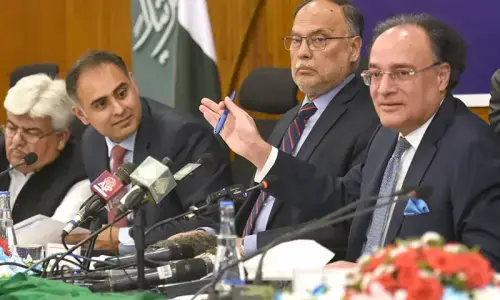
A National Textile Strategy Committee headed by Prime Minister Shaukat Aziz has been formed that includes several federal ministers and top bureaucrats with many leaders of the textile industry.
The committee held its first meeting on last Friday in Islamabad with the prime minister in the chair that decided to finalise recommendations for the textile vision by end of this year.
“The Thursday meeting is more of a backroom office exercise to do some ground work for building up a strategy rather than a high-profile session that should be given media projection,” Shafqat Elahi, the newly elected chairman of All Pakistan Textile Mills Association (Aptma) told Dawn by telephone from Lahore.
But then he added that the “growing regional disparity in textile trade” will be the focus of the strategy that will eventually be building up after assessing achievements and failures of the textile vision.
He explained that the growing regional disparities in textile trade emerge from the hidden and visible subsidies, concessions and benefits being offered to textile business in India, Bangladesh and China.
Without saying directly in plane words, the Aptma chief made it clear that Pakistan’s textile industry was under severe strain because of expansion in production capacities of textile industry in India, Bangladesh and China and the policies of these neighbouring countries that deny Pakistan an even-playing field in international textile trade.
“India has added 14 million spindles in last two years and five million spindles have been installed in Bangladesh where not a single bale of cotton is grown,” he pointed out and added that expansion of the Chinese spinning capacity is more than twice of India.
“Pakistan’s strategy for future of textile business cannot be divorced from these emerging realities in the region,” he asserted.
Pakistan’s former commerce minister Razzak Dawood took up the initiative to draw up a textile vision soon after he took over the responsibility in General Musharraf’s Cabinet when he found that Pakistan’s textile exports in last four or five years are stagnated at around $4.5 to 5 billion a year.
The idea was to gear up Pakistan’s textile industry to meet the challenges and grab opportunities that would emerge in EU and USA after the collapse of Multi Fibre Agreement (MFA).
“Over 10,000 man-hours were spent by officials of the related ministries, textile industry stakeholders and Smeda experts to produce a holistic roadmap for future of Pakistan’s cotton and textile value chains,” wrote Iqbal Mustafa about two years ago in 2004 while pointing out that the “textile vision is going foggy.”
The textile vision 2015 set three scenarios. One was a high-road scenario, which envisaged Pakistan’s textile exports to go up to $13.8 billion in the year 2005 and rank 5th among the Asian countries.
The second was a low-road scenario that projected $7.4 billion exports by the year 2005 and that Pakistan continues to hold 8th position among the Asian textile exporting countries.
The third projection was doable, which expected Pakistan to achieve $10.1 billion exports by the year 2005. The difference between the high road and doable was that of probable and possible.
As the facts are Pakistan just managed to get close to doable target and the high-road projection remains a dream. Pakistan just managed to get close to $10 billion exports in 2005-06 but finds it difficult to retain this position in the current fiscal year.
A textile board was formed in compliance with the recommendations of the textile vision--2015 but it was found “too bureaucratic heavy” to quote Iqbal Mustafa.
The change in complexion of the government after 2002 elections, according to a few textile industry leaders, was also a factor that impeded the growth of textile business. Textile leaders say that incentives and concessions were not given to them in time. “A delay in addressing the issue cost heavily,” remarked a local textile dealer.
After the budget, the government has given an incentive package of Rs25 to 30 billion to the textile industry that does not seem to be working effectively. The tax concessions and banks loans incentives being offered to the textile industry are causing a lot of heart burning to other sectors of the industry. “Textile industry is being run by seths and families,” remarked a leader of the engineering industry, who is convinced that with a primitive management outlook, outdated and obsolete business practices, textile industry will always walk on crutches. “It will be never on its own,” he grudgingly remarked.
But the Aptma chief Shafqat Elahi said that “new generation of textile tycoons” is well-equipped with knowledge and modern outlook.