0
0

The stock market slump
A REPORT carried in Wednesday’s Dawn says that a hefty amount of Rs600 billion has been wiped out by plummeting share prices and falling KSE-100 index between April 17 and May 30. The market players, who are as much guided by the economic fundamentals as by speculation, are always nervous on the eve of the budget. But this time the fall is steep, a second time after the manipulated March 2005 market crash whose beneficiaries were the manipulators themselves. In the uneasy SECP-sock market relationship that followed, the former SECP chief tried to show his teeth and was shown the door. The main reason for the present market slump is rumours that capital value tax may be raised from 0.01 per cent to 0.02 per cent for which pressure is mounting from various quarters which believe that the market players have made fabulous profits and are undertaxed. On the sidelines is the speculation that exemption on capital gains tax valid up to June 30, 2007, may be withdrawn. Other factors include reports that foreign investors are pulling out of the equity market as global interest rate hikes make bonds more attractive for them, though some suspect that it is case of flight of capital because of heating up to the political situation much before the 2007 general elections. This is difficult to substantiate.
Apart from the rumours, growing imbalances in the economy are also a source of market concern. Though premature, such apprehensions are based on fast widening current account deficit with implications for the stability of exchange and interest rates, impacting on cost of doing business, corporate profitability and equity investment. But apparently, the sharp fall in stock prices have been triggered by pre-budget rumours and speculations that always, somehow, end up benefiting the dozen or so leading brokerage houses and institutional investors, making the bourses on exclusive club of the rich. The opportunity for speculation is provided by trading basically focused on 30 or so shares in the KSE-Index 100. Going by the numbers of listed companies and actively traded shares, the market is really shallow. Private companies are reluctant to get themselves listed on the stock market and many quoted on the exchanges have preferred de-listing themselves because of the hassles brought about by reforms. Attracted by the recent flotation of shares of profit-making state enterprises, many small investors have ventured into the market and only a few by the listing of new private firms.
A positive development, however, has been that the money made from speculative trading has also gone into productive investment — in buying privatized units like Pakistan Steel Mill and a fertilizer plant. The integration of the financial system, as a result of reforms, has brought buoyancy to the market, but not much of a healthy outlook. Without the participation of small investors, the stock market cannot acquire much depth which can come only from mutual fund industry, more so, by launching of private pension funds and real estate investment trusts. Given the risks of a speculative market, the government has been cautious about finalising rules for setting up the two most attractive schemes for small investors. Unless the market acquires sufficient depth through much larger equity and bond trading, it would be folly to treat it as a barometer of the economy and continue to under-tax incomes generated in the bourses.
Reversing the drop-out trend
JUST how elusive the goal of achieving universal primary education by 2015 proved to be for Pakistan was underscored by Education Minister Javed Ashraf Qazi the other day when he admitted that 45 per cent of students drop out of school at some stage. The National Education Census, due to be completed by the middle of this month, will turn up detailed statistics on this sorry state of affairs. But the basic reasons for a high drop-out rate are well-known and are embedded in poverty and the low priority that successive governments have attached to education. The latter is borne out by figures showing that only 2.3 per cent of the GDP is reserved for public education while the regional average for such spending is 3.6 per cent. Much has been made of the government’s recent steps to remedy things by increasing the focus on education, especially higher education, but it is unfortunate that while the school enrolment rates are up, the drop-out trend has yet to be reversed.
The problem cannot be isolated from the larger social picture. Poverty often forces children to leave school and find work to supplement the family income. Besides, most government schools are in a shambles lacking even basic facilities. In rural areas, this problem is particularly acute and compounded by the long distances between home and school which many children, especially girls, find difficult to traverse. Another major reason why children quit school is the harsh corporal punishment meted out by teachers who are themselves the products of a perfunctory education system. All these factors must be taken into account by the team of experts currently reviewing the educational policy 1998-2010 so that lapses can be identified and corrected in accordance with the ground realities. Even as it seeks to bring improvements in the education sector, the government must implement the wide-ranging poverty alleviation measures that it promised to do, but of which there are few signs. Along with higher budgetary allocations for education, poverty alleviation measures are important for lowering the drop-out figure.
Circular trains for cities
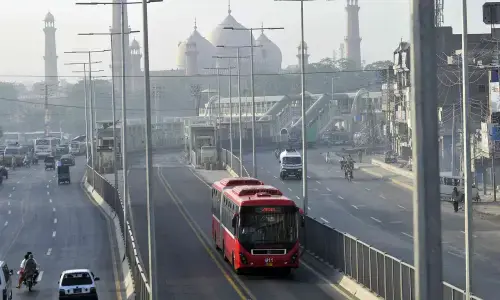
IT IS hard not to view with some misgivings federal railway minister Shaikh Rashid’s statement that circular train services will soon be started in eight major cities. While it shows that the government is finally ready to tackle the worsening transport problems not just in Karachi and Lahore but in six other cities, one hopes that the move is not meant to be another eyewash by a government that promises a lot but achieves little. The Karachi Circular Railway is a typical example of the inordinate delays that often come in the way of implementation of major projects. The revival of the KCR has been held up so far by very many studies or feasibility reports that are unending. In November 2005, the Punjab chief minister too promised to build a light rail transit system in Lahore —the original idea was proposed in 1997 — but nothing has been heard of it since. Meanwhile, the traffic situation in major cities has become incredibly worse, with no mass transit system in the immediate offing. The situation will deteriorate unless the issue is tackled on an emergency footing. Over the years, the authorities virtually abandoned the transport sector which paved the way for transport mafias to step in, leaving hapless commuters at their mercy. As things stand, commuters rely on recklessly driven buses and rickshaws, whose fares keep rising while their services continue to deteriorate.
A circular railway system will resolve much of the commuters’ problem provided it is supplemented by reliable feeder bus services. The KCR was shut down in 2001 in part because there was no integrated bus service that could shuttle commuters to and from railway stations. Feeder bus services are an important part of the integral system that the KCR is meant to be. For this, the ministry would do well to seek the advice of NGOs and local experts in the transport sector.
An unrealistic deadline for Indus dams
THE ground-breaking of the Diamer-Basha dam performed by President General Pervez Musharraf on April 26 caused my memory to recall the ground-breaking for the construction of the Tarbela Dam performed nearly 38 years ago on November 4, 1968 by the then President, Field Marshall Muhammad Ayub Khan.
But, despite the obvious similarities of the political and military status of the two personalities, there was a significant difference between the two events.
The ground-breaking performed by Ayub Khan had signalled the commencement of the work on the construction of the Tarbela dam for which the essential preliminary works (road and rail access to site, staff camps, exploratory works) had already been completed by Wapda and the necessary mobilisation of plant, equipment and labour for the initial stage of construction activities had been accomplished by the contractor, who had arrived on the site some six months earlier, in May 1968.
In contrast, on April 26, 2006, blast detonated by General Musharraf at the present site of the proposed Diamer-Basha dam was not a signal to start the construction of the dam. No one, not even the government, knows at this time when the proposed Diamer-Basha dam will reach the stage when actual ground-breaking signalling the start of construction of the dam might take place. Therefore, the event could at best be described as indicating the start of the launching of the preliminary or pre-construction works and activities.
The general thus set the target of 2016 for the completion of the project and declared that all dams, including Kalabagh, would be built under his ‘2016 Water Vision’, besides these mega dams on the main Indus River, the vision envisages the construction of Akori, Munda and Kuram Tangi dams by 2016. As such the ‘2016 Water Vision’ appears to be totally unrealistic if not an absolute fantasy.
There is no precedent to match this fantastic ‘vision’ in the history of the Indus Basin water resource development, in which the construction of the two of the world’s largest dams — the Mangla and the Tarbela dams — over a period of about two decades (1957-1976) was internationally acknowledged as the most remarkable achievement of civil engineering. Leaving aside the other three dams included in the ‘2016 Water Vision’, the present discussions will examine whether the 2016 target for the completion of the Diamer-Basha and Kalabagh dams is achievable in the face of the known constraints.
Let us first consider the prospects of the Diamer-Basha dam achieving the 2016 target. Back in 1988, an international panel of experts, organized by the government with the assistance of the World Bank, to review the report of the preliminary feasibility study prepared a few years earlier. Following the review the panel identified a number of technical issues which needed to be resolved for establishing the feasibility of the proposed dam.
Some of those issues were characterized by the panel as being the matters of concern. One such concern was the existence of large masses of moraine material (earth and rock material carried and finally deposited by the glacier) in the reservoir area upstream of Chilas town which could slide once they were subjected to saturation by the fluctuating reservoir levels and by seismic action. This phenomenon, the panel pointed out, could affect not only the dam but also the population downstream.
As to the question whether this and all other issues have been addressed by Wapda and its consultants and whether the government has satisfied itself regarding the technical feasibility of the construction of the proposed 270-meter high dam at the Diamer-Basha site providing a reservoir capacity of 7.4 million acre-feet and power generation capacity of 4,500 MW. The answer from the relevant government quarters cannot but be affirmative because the ground-breaking, no matter if it was premature, had already been performed by the president.
Lately, however, some uncertainty about the dam site has been introduced by a press report on May 4 — a week after the ground-breaking — that a German engineering firm in collaboration with a Pakistani firm had asked to the government to change the dam site to a site ‘30 kilometers away from the Chilas city’ and that, according to its proponents the new site, besides saving the Chilas city, will have other technical and financial advantages outlined in its report handed over to Wapda and which is expected to be ‘officially’ submitted to the government in June.
Regardless of its merits or demerits, the proposal has clearly opened up the question as to whether the Diamer-Basha site represents the least cost and least environmentally detrimental alternative. It is hard to guess whether Wapda will choose to ignore or brush aside the proposal thinking that this would jeopardize the programme of meeting the 2016 target for commissioning of the dam. The danger is that a good proposal might be sacrificed at the alter of what appears to be an arbitrarily set target.
In seeking an answer to the question whether the 2016 target for commissioning of the dam is achievable, assuming that the government decides to go ahead with the programme of building the dam on the present site, a crucially important point which needs to be taken into account is that the improvement of the access to the site is critical to the schedule for commencement of the construction of the dam since one of the matters of concern identified by the 1988 panel of experts related to the access to the site.
The panel had noted that the dam site was situated 330 miles from the nearest railhead at Havelian and referring to the needed transportation of large quantities of cement besides heavy equipment, the panel had advised that major work of upgrading of the Karakoram Highway must be completed before the construction of the dam was undertaken. This means that the execution of the Karakorum Highway upgrading work is going to be one critical factor that would determine the commencement of construction and commissioning of the dam.
Now, since this essential and time-consuming work would be carried out as part of the pre-construction activities for Diamer-Basha dam one may look at the past experience with Mangla and Tarbela dams to see whether 2016 target for Daimer-Basha dam commissioning is achievable.
The Diamer-Basha dam will need to overcome the following two hurdles affecting the timeline of its implementation. First, there are the concerns in Sindh and Balochistan regarding any storage reservoir on the Indus River which might cause reduction in water supplies to their canal systems and also cause negative ecological impact on the Indus delta region downstream of Kotri. Second, so far there is no commitment of funds from international donors for financing part of the project costs of $6.5 billion.
As for Tarbela dam project, its implementation also did not face the hurdles as in the case of Mangla although some time was spent during early years of 1960s on arranging additional funds to meet the cost overrun on the Indus Basin Settlement Plan works. Tarbela took as long as 16 years to reach the commissioning stage in 1976 despite the fact that the dam site was easily accessible from Lawrencepur on Grand Trunk Road. Given that the timeline for the implementation of Diamer-Basha dam will be addressing Sindh’s concerns, securing funds and executing major work of upgrading the Karakorum Highway, there appears to be little likelihood that the dam could be commissioned within a period of less than 16 years taken by Tarbela.
On the other hand, the proposed Kalabagh dam, for which much of the preparatory activities had been completed by 1987 can still be commissioned by 2016 provided the government meets the concerns of Sindh, Balochistan and the NWFP and promises to take concrete remedial steps as a precondition for achieving the consensus on the project.
The technical committee on water resources, which was constituted by the government and which deliberated on the matter in 2005, failed to resolve the differences even on the quantum of water available for storage in the Indus system. Similarly, a consensus cannot be achieved through rhetorical expressions of the resolve to build the dam which are occasionally made by those at the helm of affairs. Such pronouncements tend to politicise the project as badly as the anti-Kalabagh declarations and statements do. In the circumstances a more appropriate course to untie the Gordian knot would require the induction of independent experts of international repute.
First, the government should address the non-technical issues, such as, the apprehension of Sindh that water would be taken away by the upper riparian or the concerns of the MWFP regarding the resettlement of the people displaced from the reservoir area, through the relevant mechanisms and institutions, particularly the Council of Common Interest and the parliament.
Second, to resolve the technical issues, including the environmental and social issues, the government should take the following steps: (a) organize an independent international panel of experts, selected with the assistance of the World Bank and Asian Development Bank, to clearly identify and analyse the issues and to propose mitigating measures in a well documented and comprehensive report; (b) provide the panel of experts all the relevant documents, including the report of the 2005 technical committee on water resources, (c) organise a representative group of stakeholders to interact with the panel of experts; (d) place the report of the panel before the Council of Common Interest for a review and evolving a common understanding on the findings of the panel and on the measures recommended by the panel to mitigate the negative impacts of the dam; and finally (e) arrange the implementation of the recommendations or decisions of the Council of Common Interest through the passage of appropriate acts by the parliament.
The writer participated in the construction of Mangla and Tarbela dams and in the project planning activities for Kalabagh dam as Wapda’s senior engineering and management officer.