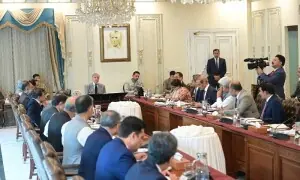
Sindh coalition intact
NOW that the differences between the MQM and the PML have been settled — to quote the prime minister — “amicably”, one hopes that no new tension will develop between the two, and the coalition will stay intact and work as a team for Sindh’s betterment in all fields till fresh elections are held next year. That the two coalition partners failed to solve the differences on their own and had to go to Islamabad seeking the intervention of the president and the prime minister is a reflection of the kind of politics they practise. Details of the differences between the two sides were never revealed officially, nor did Prime Minister Shaukat Aziz feel the need at his Saturday’s press conference for going into details about how the compromise was worked out. Nevertheless, the split — reported to be about recruitment policy and the relationship between the chief minister and the governor — was grave enough, threatening the coalition’s survival.
The amazing situation about Sindh’s politics is that the party with the highest number of seats in the provincial assembly — the PPP — sits on the opposition benches. To keep the party with a plurality out of power, a coalition of the PML, MQM, PML (Functional), some PPP turncoats and others had to be contrived. Since then the multi-party coalition has more or less managed to work, notwithstanding periodic talk of tensions between the two of the coalition’s major components. For the ISI and others who worked overtime to cobble a coalition together, the experiment has been a success, because the era of the MQM’s “wheel jam” strikes seems to be behind us. However, to put the record straight, the MQM does not have a very enviable record as a member of coalition governments. It was a coalition partner with both the PPP and the PML-N, but it broke with both blaming the other side. It was during the PML-led government that Mr Altaf Hussain chose to go into exile in October 1991 and the army launched the crackdown in June 1992 to demolish MQM-built gates and walls as the Haqeeqi celebrated its pyrrhic victory. Within four years, the MQM was back on its feet and was again part of the PML government following the 1997 elections. This experiment too ended in a fiasco following Hakim Said’s murder.
The PML-MQM coalition now owes it to its voters and to the province as a whole to make a success of the remaining term of the provincial government. The MQM’s inclusion in any Sindh government gives it balance. With the other parties representing rural Sindh and the MQM the urban areas, a coalition of this kind can serve Sindh well if all parties forming the coalition put petty political differences aside and concentrate on the province’s economic development. It is a province with both enormous resources and even more enormous problems. Its capital itself needs a continuation of the infrastructure development programmes of the kind that have recently been completed or are under execution. The same is true of the rural areas where issues like Sindh’s agricultural interests, “ghost” schools, the extension of health facilities and outdated customs like karo kari that target women need a concerted effort for solutions. As head of the coalition, Chief Minister Arbab Rahim should see to it that he carries his coalition partners along and does not adopt a “go it alone” spirit that had aroused the MQM’s dissatisfaction.
Another calamity strikes
THE number of dead (over 5,000) in Saturday’s powerful temblor that struck Yogyakarta in southern Indonesia might seem insignificant compared to the tally of at least 75,000 fatalities in the Pakistan earthquake of last October. But, in view of the series of natural disasters that have brought immense suffering to the populous archipelago over the last one year and a half, there should be no close-fistedness about helping the afflicted Indonesian people in their hour of need. Pakistan has already responded by dispatching emergency relief to Indonesia that was the worst hit in the Asian tsunami of 2004. Approximately 200,000 Indonesians were killed or missing in that disaster which struck 11 countries. In March 2005, more than 1,000 people died in a powerful earthquake that rocked areas near the coast of Sumatra. Besides the mounting casualty toll in Saturday’s quake, the disaster has other dangerous implications as well. For the past few weeks, Mount Merapi, situated close to the site of the quake, has been showing signs of volcanic activity that has led thousands of people to be evacuated. It is feared that seismic aftershocks in the area could increase chances of a major eruption. This would mean that in addition to the immediate task of rescue, relief and rehabilitation, the Indonesian government has also to step up efforts for further evacuations from the affected zone.
In all this, the response of the Indonesian government has been slow, even though it is heartening to note that rescue missions and aid from all over the world have been reaching Yogyakarta, raising the hope of the homeless and injured whose miseries have been compounded by heavy rains. No doubt, the Indonesian government, having had to deal with a series of similar disasters in the recent past, has been under a great deal of pressure. But instead of slackening its efforts now, it must coordinate with international rescue teams to ensure that relief operations are effective. It would also do well to evaluate its present disaster management measures and make these more workable in view of the archipelago’s location in an area that is prone to natural calamities.
Banning sale of farmland
THE National Assembly’s Standing Committee on Agriculture’s demand to ban the sale of farmland to housing societies raises some valid questions. It addresses the problem of housing societies increasingly poaching on valuable agricultural lands so as to build mega housing schemes. Naturally, this practice is detrimental to agriculture but this does not seem to deter those in the housing sector. As the committee noted on Thursday, the land mafia has control of thousands of acres of farmland from Rawalpindi to Multan and there seems to be no way of stopping them; hence the demand for a ban. However, the ban will leave out the question of housing for the urban poor and squatters, especially as rural migration brings hundreds of thousands to cities in search of a livelihood. As a city’s population grows, and katchi abadis spring up at every nook and corner, it will prove difficult for any city administration to cope with the growing housing demand. At some point, farmland will have to be converted into residential areas to accommodate the burgeoning population. The solution lies in judging each housing scheme demand strictly rather than banning the sale of farmland altogether. One sector cannot suffer for the sake of another’s gain.
A law enacted during Mr Bhutto’s time banned the sale of farmland to housing schemes but it was never implemented. The standing committee would be well advised to review this law — as it has said it will — and make modifications keeping the current needs and demands in mind. But the bigger issue at stake, and one which is never properly addressed, is the land mafia itself. The government needs to show a steely will in taking on this powerful group whose sole purpose is profiteering and exploitation — and not caring for the housing needs of the common people.
The bitter truth of our politics
WHILE the world moves on to pursue its socioeconomic and other loftier goals in the new millennium, the debate on the state of democracy continues in Pakistan. In the last forty years, since the time of Ayub Khan, the only progress we have made in the field is to stop denying that democracy suits the genius of our people.
The march towards a ‘real’ democracy now is the new fad espoused by another ill-advised general, who, in turn, has become part of a system over which he is told he has absolute control. Megalomania, especially of the variety found in our popularly elected or imposed rulers, comes at a price. The sad part is that the bill has to be footed by the polity, and, inevitably, by the people.
Palace intrigues abound. The so-called charter of democracy signed in London by two ousted prime ministers is no less self-righteous a document than the unwritten charter of ‘real’ democracy that the Musharraf regime is pursuing. While the former aims at reinstalling the fallen leaders on the throne in Islamabad, the latter is tailored to keep the soldier president in the saddle for the next five years, when his current tenure completes its term next year.
Both are as self-serving schemes as any that were adopted in the past by a succession of rulers. On the one hand, there has always been the ‘doctrine of necessity’ as the defining feature of the polity in disarray, while on the other there is the struggle for restoration of democracy. It is unnerving how the cliches continue to retain currency among the wheeler-dealers of power.
One constant feature of the polity has been the collaboration of the feudal elite with the powers that be to safeguard their vested interests. Others in the fray vying for a control over the people’s minds are the religious, ethnocentric and nationalist parties and groupings. These take turns in siding with or opposing a given government as and when it suits their exigencies. Meanwhile, the gap left behind in the polity by the absence of a mainstream political party that could command popular support is increasing by the day.
The PPP and the PML-N did fit the role for some time, but the subsequent lack of interest shown by their leaders in keeping their respective houses in order, and by resisting the emergence of a second-tier leadership from within their parties, has taken that advantage away from them. The defections suffered by the two parties in the aftermath of the 1999 coup point to this reality. Here, a pertinent question to ask is whether the top, exiled leaders of the two parties have shown any realisation of this reality, as they happily affixed their signatures on the Charter of Democracy in London the other day. The answer, unfortunately, is in the negative.
The feudal-minded deputies of Ms Bhutto and Mr Sharif are playing a cat and mouse game with the government and the civil and military establishments back home, and biding time. At no point has the need been felt to engage the people and voice their problems and concerns. The disdain shown towards the electorate by the so-called mainstream parties is no less incriminating than that reserved for the people by the ruling politicians and their backers in the military.
If the Chaudhries and others like them in the ruling establishment have succeeded in making Gen Musharraf believe that through them he can continue to rule this country for as long as he likes, the Bhutto and Sharif deputies have also convinced their leaders that they alone are the exiled leaders’ best bets.
It is time the two leaders woke up and smelled the coffee, for a lot of water has flown under the bridge since they were last here. The people, the ultimate deciding force in a democratic dispensation to which the two parties have committed themselves, are equally wary of the PPP and the PML-N. This, without necessarily owning the allegations of corruption and wrongdoing levelled against Ms Bhutto and Mr Sharif by the Musharraf regime.
The sentiment is based on the fact that many committed to the two parties’ commitment to democracy and development now feel alienated, because there has not been a strong party presence on the political or social fronts vis-a-vis the party workers’ concerns and aspirations after the two leaders left the country. Their feudal proxies continue to view the party workers with disdain.
The once committed party loyalists that had a strong presence at the grassroots level have been left feeling cheated. Others have joined the band of opportunists by switching loyalties. The two parties’ political activism has thus been confined to drawing rooms or to the press clubs where they hold conferences to vent their anger at the regime. In the end, what the public at large witnesses is a mudslinging match between what appear to be two equally tarnished sides: the government and the two main opposition parties. If this is what democracy is all about, then we may well have a working democracy, so to speak. Then why bother about a written or an unwritten charter?
Public accountability has to be part of any democratic order; this holds true at all times regardless of whether a given party is in power or out of it. It is this key ingredient that has been found lacking in our polity. Part of the reason is that the political process has not been allowed to run its logical course over a long period of time.
Supra-constitutional interventions into the system and then meddling with the Basic Law to seek indemnity for illegal actions have done irreparable damage to the polity. Every man in the khaki who seized power from a civilian government on one pretext or another has been guilty of it.
The problem has been that every strong man, Ayub and Zia in the past, and now Gen Musharraf, naively believed that the system they were putting in place would bring political maturity and stability to the process. We know from the two previous experiments that the opposite was the result of the manoeuvrings and distortions done to the Constitution.
Another constant in the process has been the unabashed backing of the US behind every dictator in this country. Our unelected leaders somehow are more popular with the superpower that champions the cause of democracy from Cuba to Syria and Iran, and from China to North Korea. Pakistan, perhaps, is lumped together with other ‘friendly’ dictatorial regimes, stretching from Mexico to North Africa and from the Middle East to Central Asia, which pose no immediate threat to US interests.
Meanwhile, the Bhuttos, the Sharifs and the Altaf Hussains of the developing countries are given safe pads in a democracy as centrally and conveniently located as the UK, from where they can travel across the Atlantic to address seminars, give talks, or simply to mingle with the Pakistani community in diaspora as well as “to exchange views on matters of mutual interest” with those who matter in Washington. The ‘rescue’ of Mr Sharif from an apolitical Jeddah to the Hyde Park Corner in London should be seen in that context.
There is a serious dearth of leadership in the country. It cannot be brought home from the incubators of London where it is being nursed under controlled conditions and kept out of harm’s way, until such time that it may be able to breathe again in the stifled political environment back home. Even if that were to happen, the existing leaders in exile can only fill the political vacuum as a transitory arrangement. In the years they have been away from the country, the electorate, too, has grown in a different direction. It will be hard for both Ms Bhutto and Mr Sharif to totally shrug off the baggage of the past — the stigma that they carry as failed elected leaders who were incapable of delivering the goods twice over if they worked hard and kept their hands clean.
A new leadership will have to take root in this stifled environment for it to effectively take stock of matters past, and steer the polity in the right direction. This may not seem possible under the existing dispensation, as the general continues to grapple and experiment with a system based on the exigencies of those with vested interests and their avowed loyalty to him. But this is one hope we must all live by.
Giving blood
FEW things are as unambiguously good as giving blood to help other people. In Britain, there is a long history of donating blood freely, a practice that is almost a defining characteristic of Britishness, even though there are 38 other countries where all blood is collected from voluntary unpaid donors.
In 1971 Prof Richard Titmuss wrote a book, The Gift Relationship, in which he argued that giving blood was not only nobler than selling it but economically more efficient. Blood, he said, was a bond that linked all men and women in the world so intimately that “every difference of colour, religious belief and cultural heritage is insignificant beside it”.
Small wonder the history of every people bestows a unique importance to blood. It probably marked a significant event in its history when Beijing last week abolished setting quotas for organisations in the city in favour of a voluntary approach, which is believed by many to be the safest way to obtain blood. In the UK 8,000 donations a day are needed and, while stocks are adequate, there is a constant need to keep the momentum up, especially as donations drop off when holidays such as Easter approach.
—The Guardian, London