



 0
0

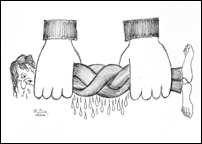 KARACHI, May 20: How would one explain and interpret more than 100 per cent increase in tax collection by the Central Board of Revenue in the last six years (1999-2000 to 2005-06) when compared with tax recovery made in 10 years of 1990s.
In the last six years, the people of Pakistan paid almost Rs3.5 trillion to the exchequer as taxes. During the whole decade of 1990s, the total tax collection was only Rs1.95 trillion. During the first 10 months of the current fiscal year, the total tax recovery is more than Rs606 billion and it is likely to touch Rs720 billion by the end of June this year. And if the present Musharraf-Shaukat setup withstands successfully the vagaries of coming general elections and continues to run the affairs of Pakistan, the people will be made to pay at least Rs4 trillion more in the next four years.
Tax recovery showed a rough annual average increase of 11 per cent in the last five years, but it remains a dismal nine per cent of GDP. What does this mean? It means that many segments of the economy are either under taxed or are completely spared. They are the vulgarly rich landed gentry now well entrenched in the federal and provincial governments and legislatures. They are also the stockbrokers and real estate dealers, transporters, wholesale and retail operators. The services sector is now 52 per cent of the economy but pays hardly 17 per cent of taxes.
The Karachi Stock Exchange at 12,000 points means a market capitalisation of Rs3 trillion, which is outside the tax net and a handful of stockbrokers remains beyond reach of tax hounds. But an employee in an office or in a factory or in a shop, who is getting Rs9,000 to Rs10,000 a month, has to pay tax on his income.
“Those who demand a tax on income of agriculturists should offer stock market transactions and real estate business for taxation,” argues Engineer M.A. Jabbar, who is a former vice-president of the Federation of Pakistan Chambers of Commerce and Industry. He is of the view that Pakistan’s taxation has failed to document the economy.
But Tariq Sayeed, a well-known business leader, is an admirer of the government and is convinced that the taxation policy has effectively checked smuggling, regularised imports of a number of items like spices, and has provided an enabling environment to small businessmen.
Qazi Sajid Ali, chief executive of German multinational giant BASF, is extremely unhappy on income tax which he believes discourages the high-salaried executives to work in Pakistan. Tax rates are too high and harsh to bear for a middle-class income earner. About GST, he said its rate should be brought down preferably at 10 per cent and its scope should be expanded to more and more people.
Notwithstanding this debate, it is a fact that a substantial amount of the indicated Rs11.5 trillion tax recovery during the current “shining and glittering decade” of President Musharraf will come from the most poor people of Pakistan. The poor, according to official estimates, are now 25 per cent of the population and number 37.5 million, but unofficially they are 40 per cent and number 60 million, and pay almost all taxes, including the so-called direct income tax which in practice is indirect, coercive and retrogressive. The poor bear the brunt of customs duty, suffer direct and indirect impact of development surcharge on petroleum and endure the draconian all pervading 15 per cent sales tax.
The advocates of the government policy — ministers, advisers and holders of key position like the SBP governor and the CBR chairman — are working overtime to emphasise on the citizens every other day how important and sacred it is to pay taxes so that a hefty budget of more than one trillion rupees can be financed. This includes one-liner budget for defence of Rs230 billion which cannot be discussed, debated or argued what to talk of questioning its cost effectiveness. The debt servicing has to be done and, therefore, remains beyond debate. The National Assembly has never debated on the bulging stock of domestic and foreign debts. Why these loans were acquired? Do we see assets around us to justify these debts? Most of the budget allocations remain till day deceptive and camouflaged, and it is a document of concealment rather than of information.
Looking at the structure of taxation and impact of each and every tax on various segments of the population, the question arises whether Pakistan’s taxation system is a tool of social justice or it is an instrument of exploitation and pauperisation of the fast vanishing middle class. Is Pakistan’s taxation bridging class disharmony or promoting income disparities? Has the taxation led to documentation of economy or it has generated black economy? Does Pakistan’s taxation provide an enabling environment for the small and big business? Is Pakistan’s tax assessment and payment system easy and simple or it is cumbersome, complex and give all opportunities to the enterprising officials and staff of the taxation departments to exploit taxpayers?.
Since the beginning of 1990s, sales tax has emerged as the most active and ever enlarging tax. It started with a 12.5 per cent rate and touched the peak of 18 per cent but has been stabilised at 15 per cent. It is a crippling and back breaking tax. In the last three years, the people of Pakistan paid more than Rs800 billion as sales tax.
Economy documentation still remains a dream. Even officials concede that a parallel economy is as much as the officially estimated economy which is $123 billion (about Rs7.4 trillion). How sales tax is collected and refunded is understood by the frequent media reports on one scam after the other. One such scam involves a whooping sum of Rs20 billion.
In its annual report of 2004-05, the CBR has noted with concern the negative growth in sales tax in cement, seven per cent fall in fertiliser, sugar and iron and steel industry.
The CBR report has asked for an “in-depth analysis based on investigative and collaborative research” of the cement industry, as it found a negative sales tax from the cement industry is not compatible with collection of excise.
Rising international oil prices has led to an immense rise in custom duty on petroleum products and also on the collection of other levies. Paper and paperboard, edible oils, chemical products, petroleum products, tea, coffee, machinery, iron and steel are the revenue spinners for the CBR.
Income tax depends to the extent of 55 per cent on withholding tax. There are 25 such withholding taxes but government collects mainly from six withholding taxes. Taxes on contracts contribute 30 per cent, followed by 22 per cent from import, 12 per cent from salary, seven per cent from export, 4.3 per cent from electricity and 4.6 per cent from telephones and mobiles. The impact of all these taxes is indirect.
A government-sponsored study conducted by the Lahore University of Management Sciences (LUMS) found that out of every taxable Rs100, income tax was netting only Rs36, while the losing Rs64 was shared by the tax officials and tax practitioners while the taxpayer is the biggest beneficiary. The Customs was found recovering only Rs52 from every dutiable Rs100 while sharing Rs48 between the three. Sales tax was found collecting Rs55 and sharing Rs45 between the three.
In other study to measure the level of corruption on a scale of 1 to 5, where 1 represented the least corrupt and 5 the most corrupt, income tax and customs duty were three plus and sales tax was 2.75.





























