0
0

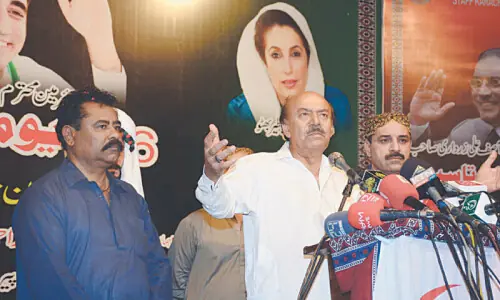
KARACHI, May 11: Speakers at a seminar on Thursday expressed grave concern over the law and order situation in the country and urged the government to take concrete steps for creating national harmony.
The seminar titled `Internal Law & Order Situation and National Harmony: Foundation Stones of National Security’ was organized by Hamdard Thinkers' Forum (Hamdard Shura) in a hotel here. Former diplomat Qutubuddin Aziz presided.
Speaking at the seminar, Justice Haziqul Khairi said as the number of legislators from Punjab was greater than even the total number of lawmakers belonging to the other three provinces, such a scenario could never create national integrity.
He said the 1973 Constitution was inherited from the Government of India Act of 1935 and it was not capable of resolving national issues.
He called for sustainable policies and 'disciplined' politics for improving the internal law and order situation and regional harmony.
“The best solution to problems we are facing is imposition of Islamic system keeping in view present and future challenges,” Justice Khairi added.
Burhanuddin Siddiqi, former PTV director, highlighted causes of violence in the country, and said it was sectarian differences that were pushing us towards a terrible situation.
He said Al Qaeda might have backed the Nishtar Park tragedy, adding that it was the foremost duty of government to provide protection to the masses.
He stressed the need for understanding the Quran to resolve issues like rampant lawlessness and lack of national harmony.
Mazhar Ali Arif said it was universal rule that progress of any country was linked to regional and national harmony and urged the government to show sincerity in strengthening unity among provinces and adopt multi-pronged strategy to form a crime-free and safe society.
Afaq Siddiqi said the main causes of lawlessness and terrorism were economic disparity, which had made rich richer and poor poorer, and subversive activities of Pakistan's enemies who used to hire local people for terrorism. “Taking stringent measures against saboteurs can check terrorist activities,” he added.
Mustafa Barelvi urged government to adopt a policy of direct interaction with the people instead of Sardars and feudals and launch development schemes for the betterment of a common man belonging to Balochistan and other provinces.
Haq Nawaz Akhtar, former chairman of Steel Mills, was of the view that we were running short of trust among the provinces. He said all powers were concentrated in the centre and provinces had to seek permission from the federal government even to start an uplift project.
He called for providing basic rights, social justice and equal opportunities to people and end to all kinds of discrimination.
M. A. Sabzwari, an economist, said crimes could not be curbed in a society where there was no collaboration between the government and the administration.
He called upon the federal as well as provincial governments to take stock of law and order situation and chalk out a joint policy to combat increasing incidence of terrorism and crime.
Islamuddin Aga emphasized the need for the rule of law and supremacy of the constitution for economic and political stability.
Saeed Siddiqi said the rule of law, respect of law and equality was necessary to maintain law and order in the country. He urged the people to elect honest and patriotic candidates to bring about positive changes in the country.
Abdul Jalil Jaffery proposed that such courses be introduced in schools that spread love among children and helped eliminate hatred.
Qutubuddin Aziz emphasised on seeking help of retired bureaucrats in solving national problems.
He also criticised declaring Pakistan a failed state and said the US itself was a failed state as it had failed in controlling the situation in Iraq and Afghanistan. -—PPI