0
0

WASHINGTON, April 29: As a UN member, Pakistan would have to honour any sanctions imposed on Iran but such restrictions could do more harm than good, Foreign Secretary Riaz Mohammed Khan told journalists in Washington.
Briefing the Pakistani media on the first round of the US-Pakistan strategic dialogue, Mr Khan said if the Security Council did impose sanctions, “they are binding on all members of the UN, so we’ll have to respect” them. But he also felt that it’s too early to take this kind of action against Iran because such sanctions could “do more harm than good.”
At the same time, he said Pakistan believes Iran must abide by international nuclear obligations, but the world also must “exhaust all (diplomatic) possibilities” before imposing sanctions that could provoke “undesirable consequences”.
“It is a grave issue, a source of concern for us as well,” he added. Mr Khan acknowledged that there were “international obligations” that Iran must meet but he also noted that “Tehran says its programme is not directed towards weaponisation.”
The foreign secretary, who was in Washington for the first round of US-Pakistan strategic dialogue, said the Bush administration again turned down Islamabad’s request for a nuclear energy deal like the one it signed with India but Pakistan would continue cooperating with China in this field.
“We have discussions … and cooperation with China in this area. We already have two projects and will continue to have this type of cooperation with China.”
Mr Khan recalled that in 1998, before Pakistan responded to India’s nuclear tests, New Delhi had adopted a very aggressive posture towards Islamabad, claiming that by testing its devices “India had called Pakistan’s bluff”.
“We do not wish to go back to that situation and that’s why we believe in maintaining the current nuclear deterrence,” he said. “It is a reality that now both India and Pakistan are nuclear weapon states.” Mr Khan said that the nuclear status also brought some responsibilities with it and that’s why it was necessary for both India and Pakistan to have an agreement to “avoid accidents”.
The foreign secretary said that during his meetings in Washington he urged the US to encourage India to resolve the Kashmir conflict because “it’s in the interest of both India and Pakistan to do so.”
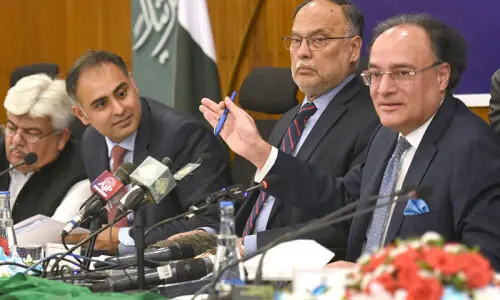
Describing US, Pakistan cooperation in bilateral and international fields as “good, sound and robust,” the foreign secretary hoped that the strategic dialogue – which he described as “structured talks” aimed at providing a forum for regular consultations – would further strengthen bilateral ties.
Mr Khan said that both sides have identified four fields – economy, energy, education and science and technology – for bilateral cooperation.
Pakistan, he said, has already appointed four coordinators who will work with the US for identifying areas and means of cooperation in these fields. These included minister for science and technology, adviser for energy, secretary education and secretary finance.
“We agreed that these groups are going to meet in the next two months,” he said. “We have already given them papers- some preliminary ideas, what our side would like to discuss within the framework of these groups for bilateral cooperation.”
The groups will hold four meetings, two each in Washington and Islamabad while Undersecretary of State Nicholas Burns, who headed the US delegation in the strategic talks, will also visit Islamabad soon.