0
0

 ISLAMABAD, April 25: The fourth round of Pakistan-India expert level talks on nuclear confidence-building measures that began here on Tuesday focused mainly on a proposed agreement to reduce risk of nuclear accidents with the draft going back and forth.
A draft agreement on reducing risk of nuclear accidents or unauthorised use of nuclear weapons was presented by India during the last round of talks in New Delhi in August 2005.
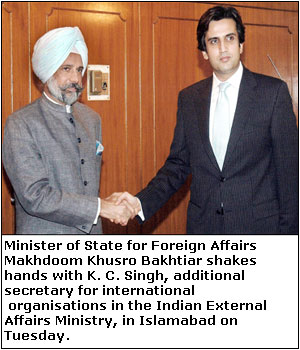
The eight-member Indian delegation was led by K.C. Singh, Additional Secretary, International Organisations at the External Affairs Ministry. Indian High Commissioner Shiv Shankar Menon also attended the meeting held at the Foreign Office.
Tariq Osman Hyder, Additional Secretary, United Nations and European Commission at the Foreign Affairs Ministry, led the Pakistan team, which included South Asia Division Director-General Syed Ibne Abbas, Arms Control and Disarmament Affairs director at the Strategic Plans Division, Khalid Banuri, and officials of the ministry.
A joint statement will be issued at the conclusion of the talks on Wednesday.
The two-day talks will be followed by a meeting on conventional CBMs on Thursday when Pakistan will hand over a draft agreement on prevention of incidents at sea. The agreement is meant to ensure safety of navigation by naval vessels and aircraft belonging to the two sides.
The Indian delegation also called on Minister of State for Foreign Affairs Makhdum Khusro Bakhtyar, who stressed the need for both countries to avoid an arms race and redirect resources for socio-economic development.
Mr Bakhtyar reiterated Pakistan’s commitment to establishing good neighbourly relations with India and an environment of lasting peace in South Asia.
However, he underlined that for lasting peace and security in the region, resolution of all outstanding disputes, including Jammu and Kashmir, was imperative.
He said conventional stability was an essential element of the overall security calculus in South Asia.
The minister said CBMs provided the necessary foundation to sustain the composite dialogue.