0
0

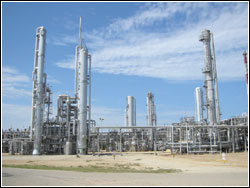 In the oil, gas and power sector in Pakistan the need for investment capital is very large and the profits exceedingly good. Pakistanis would like to play a major role in this sector or willingly to commit small funds though such companies are available relatively cheap and on rather easy terms.
The cost of a mega oil refinery to be set up in Hub is $2 billion Dollars, for example heedless of the cost of dealing with the violence in the region. The refinery is to be commissioned by 2010. Investors are needed for this major project.
The government has directed the OGDC to drill a 1000 gas and oil wells during this financial year, but only a third of the wells have been drilled during the three-fourth of the financial year.
The government has been influencing the incentives for oil and gas companies but they have been asking for more than what the government is ready to give.
So it has come up with liberal tax incentives for major gas and power projects. It has offered to provide tax and duty holiday for LNG plants, which it prefers, with a 10 year tax and duty holiday. The tax relief covers import and distribution of LNG plants.
The government has also come up with a new tariff for hydro units. The average power tariff for gas-based projects has been increased 8—10 cents, and diesel projects to 13 cents. Work on six dams is to start in two years. But Pakistani investors in this area are too small to cope with the task of producing hydro power. And too few of them are very adventurous in this area.
They prefer risk free and maximum profit enterprises, which the energy sector is as the KESC-100 index shows.
Farooq Hasan, who wanted Pakistan’s entrepreneurs to take over KESC following its Privatization, went from one rich Pakistani entrepreneur to another asking them to take over KESC jointly instead of letting that fall in to foreign hands, following its privatization. But all of them complained of the rowdy labour of KESC and opted out .
The same is the experience of the others, more or less who wanted the oil and gas companies led by the PSO, Sui Southern and Sui Northern gas following their privatization. And their eventual ownership remains to be seen.
With the purpose of achieving larger production of hydel power, work on six major dams including Basha dam, Kalabagh and munda dams is to begin in a period of two years says the minister for water and power Liaqat Jatoi.
The first to begin in Chilas would be the Basha dam with a storage capacity of 7.3 million-acre feet of water, the biggest dam of the six. Its feasibility study is complete and its design and tender documents are under preparation.
These dams including Akori dam and Nai Gaj are scheduled to be completed over a period of 10 years. As they come up, the power production units are expected to be setup to produce power even before their formal inauguration.
The World Bank and other international lenders may be ready to lend large sums for the dam. In fact, the World Bank had been urging the government to take early decisions on the dams, so that their construction can begin early.
While the World Bank loans will be available for the construction of the dams, the government expects the private sector to come up with a required investment for power production.
The higher Hydro rates may attract the foreign investors to play a role in producing more of the cheapest source of power in Pakistan. If necessary the government may raise the rates for hydel power higher. The higher rates have been announced at a time when the world oil price has shot up to $75 a barrel and even the Americans are outraged to pay $3 for a gallon of gasoline.
Unlike in the past more foreign countries are interested in the energy sector in Pakistan, the Russians with their waste experience in the oil and gas sector are keenly interested in the oil and gas projects.
A Russian consortium comprising five companies had recently visited Pakistan to take part in the cross border gas pipeline projects and to invest in import of natural gas, PNG and other major projects.
A five member delegation from Russia recently met the Pakistan petroleum minister Amanullah Khan Jadoon and discussed the investment prospects which appeared bright.
China which has a 300-MW nuclear power reactor working at Chashma and another construction in the same sight is ready to offer three more nuclear reactors with a capacity of 900 MW. China is interested in participating in other areas of energy production including renewable energy.
Pakistan has signed an agreement with the US during President Bush‘s visit to set up a working group with the US to assist it in the expansion and diversification of its energy sources, except nuclear power.
Pakistan wants the US to treat it at par with India, but the US is not willing. But India is able to get nuclear fuel from the Soviet Union as well.
The US wants Pakistan to opt out of the Iran-Pakistan-India gas pipeline and if it does so, the US will help in financing the Turkmenistan-Afghanistan- Pakistan gas pipeline.
Apart from the Iran-Pakistan-India gas pipeline which is under negotiation, Pakistan has signed a memorandum of understanding for a gas pipeline from Turkmenistan passing through Afghanistan, before reaching Pakistan.
The pipeline may eventually end up in India. The Saudi Arabian investors are also interested in financing the pipeline and to participate in various other energy enterprises in the region after they have taken over KESC and Pakistan steel.
The issue is the Pakistani participation in the energy enterprises, which is very small. It is to be seen what part the Pakistani entrepreneurs will play following the privatization of PSO, Sui Southern and Sui Northern gas companies.
They will have to join hands to be able to play a substantial part in such companies. Otherwise too much of the large profits will be going out and straining the balance of payments critically over the years.