0
0

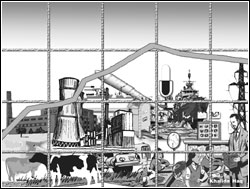 Findings of the various World Bank studies conducted during last two years to assess the progress made by developing countries to achieve millennium development goals (MDGs) continue to place Pakistan at bottom of the ladder in the light of current policies, institutional framework and availability of external resources.
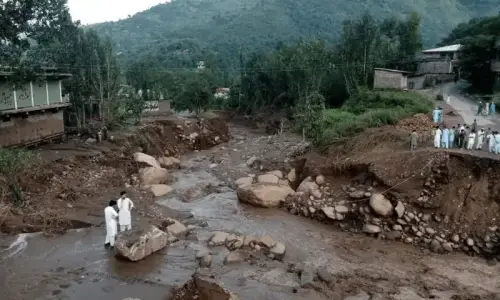
The recent earthquake causing havoc to country’s resources has further aggravated the situation for which changes are required in policies and institutional framework.
While good governance is the responsibility of the government of Pakistan, developed countries have to extend promised funding on time to help rebuild infrastructure for reviving both— economic and social sectors’ development— in the affected areas and to regain momentum of progress, particularly towards poverty reduction, education and health related goals/targets. It is also an imperative that loans are converted into grants to prevent the country from falling into another debt trap.
Despite a phenomenal economic growth and substantial rise in per capita income lately, poverty reduction strategies funded by both external and indigenous sources remained ineffective as a result of rising inflation specially food inflation index and stagnant high unemployment despite creation of new jobs through infrastructure development works.
The privatization and restructuring of the public sector entities coupled with loss of business in earthquake affected areas resulted in loss of livelihood of millions, thus offsetting number of new jobs created. Hence percentage of unemployed continues to be the same.
In view of the situation arising from earthquake set back, government has been forced for downward revision of GDP growth rate target for coming years. To achieve GDP growth rate of seven per cent would definitely reduce poverty in course of time, but achieving sustained growth trend depends on host of factors like effective control on growing inflation, good governance, substantial investment on development of human resources/human capital, (so as to enhance percentage of skilled population), presence of strong institutional and legal framework and degree of integration with world economies specially relating to level of its export trade and foreign investment coming in.
For this, excessive regulatory and institutional constraints need to be removed to motivate private sector and foreign investors to invest. This includes simplifying regulations for starting a business; ensuring secured property rights and legal support for adhering to terms of business contracts.
Unfortunately, due to lack of good governance/weak institutional framework, substantial allocation of Rs272 billion for public sector development programme (PSDP), particularly on education and development of infrastructure remains unutilized to the extent of 70 per cent.
A majority of the projects to be undertaken during the current fiscal year are yet to be implemented. Hence most needed infrastructure particularly dams, power projects and highways would again be not available on time.
Similarly, hardly 30 per cent utilization of funds allocated for social sector development projects by creates doubt on full implementation of development programme in this area.
All current public sector projects have been designed without consulting stake holders, hence they lack participatory approach. Anyhow leaving these loopholes, infrastructure-related projects need to be completed in time to sustain the projected economic growth rate.
The poverty reduction strategy programme (PRSP) reports released by Finance Division in 2005 is reflective of some efforts undertaken to achieve the target in the education sector. It has emphasised on the education sector reform programme, particularly making the primary and middle level schools functional and teachers regular presence and uninterrupted teaching during the academic year. The number of these schools has recorded an increase of three per cent and 16 per cent, respectively during the period from 2001/2002 to 2004 - 2005.
However, this number is far short of incremental rate, which is needed for providing education to all by 2015 and ultimately achieving human development MDG. Similarly, efforts to put in place basic health facilities, despite substantial aid inflow from donor agencies give least hope of achieving human development MDG. Since the aid is mostly in the form of technical assistance, any head way in this regard will be possible only through funding from indigenous sources.
This can be achieved through improved domestic resource management and effective and timely implementation of health-related development projects. Delivery of health-related services need to be looked into. Public sector initiatives can be fruitful if sufficient incentives are given to health care providers and quality of private service providers are strictly controlled.
The progress regarding ‘gender equality and women empowerment goals’ is also not very promising. Despite governments very positive initiatives towards enhancing women representation in local government, provincial and National assemblies and Senate and opening all professions / occupations for women, gender disparity continue to exist. Economic and social sector development policies need to be made gender-sensitive and discriminatory laws falling outside the purview of religion need to be eliminated on immediate basis to ensure women socio-economic empowerment.
Environmental sustainability goal’ requires three dimensional approaches. Firstly by preventing further degradation of environmental resources, secondly by making safe drinking water accessible to 50 per cent of the population and thirdly, by improving life of slum dwellers.
Pakistan has made some headway regarding improvement in quality of life of slum dwellers in some parts of the provinces by regularizing houses in ‘katchi abadis’ and providing utility services.
As reported in PRSP report for 2005, signs of good governance are visible in the country’s judicial system. There has occurred a fast increase in the number of cases disposed of by High courts as well as by all lower courts in all the provinces.
In order to eradicate poverty and improve the quality of life of impoverished population, special efforts are needed to provide them with quality education and health services to develop highly skilled and energetic work force capable of undertaking skilled jobs and offer efficient professional services.
To sustain reversing trend in growing poverty as claimed by the government, it is essential that inflation be checked, especially food inflation or more specifically the sensitive price index(SPI), which has lately risen to 12 per cent. This, if not checked, will continue to off set all affirmative results of poverty reduction strategies.
All speculative buying and selling and hoarding of essential consumer items need to be checked through a law. Similarly to combat speculative activities in property and stock exchange all deals of this nature must be brought under tax net.
Speculative buying and selling of stock exchange securities and properties has lately exposed number of poor to devastating losses, who in view of depleting returns on their savings placed in government securities or with banks were lured to invest in stock exchange and property. Contrary to it, people belonging to the affluent class, involved in this scam have become richer.
Emphasis should be on integrating all poverty reduction strategies under PRSPs and also those funded through Baitul-Mal with public sector development programmes, particularly infrastructure, education and health sector development programmes and translating these into annual development budget, simultaneously incorporating expectations regarding funding from external sources.
To ensure low income developing countries are able to achieve poverty reduction target by year 2015, it is incumbent upon international community of industrially advanced countries to give boost to economies of developing countries by providing them access to their markets for their exportable goods including agriculture and agro-based industrial products and eliminating subsidies provided to their farmers.