0
0

 In its second quarterly report on the economy released late last week, the State Bank of Pakistan warned that sustained growth in the long term would be dependent on improvements in infrastructure, implementation of further reform to strengthen governance and institutions and greater liberalization.
The central bank also cautioned that in the short run, “emerging macroeconomic imbalances that are still small and not threatening” need to be addressed. These include a widening savings-investment gap, rising trade and current account deficit, a weakening fiscal deficit, and persistently high levels of inflation.
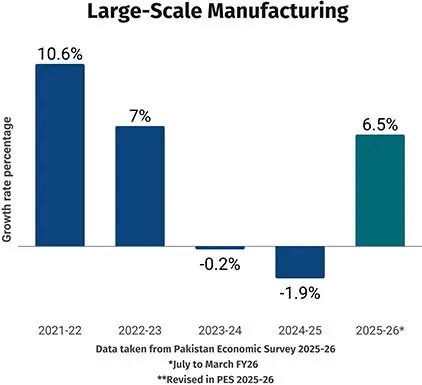
The SBP’s prescription for long-run success is valid. The report says GDP growth will fall below the seven per cent target but will be in the range of 6.3 to 6.8 per cent. Disappointing harvests of cotton and sugarcane as well as lower-than-expected growth in large-scale manufacturing will be the major reasons for this. Typically, higher-than-expected GDP growth takes place when a bumper crop comes as a surprise. Last year, for example, a record cotton crop added 1.3 percentage points to the high GDP growth of 8.4 per cent. The SBP’s forecast of lower growth underscores the need to reduce continued dependence on agriculture and undertake serious investments in the sector which will increase productivity and yield in a sustainable way in the long term.
In the short term, there is far greater urgency than the SBP would have us believe to address the economic imbalances which are far from just “emerging” and indeed have firmly taken root in the economy.
Savings-investment gap: One worry is the widening gap between the rates of savings and investment in the economy. The rate of savings has been on the decline leading to a widening gap between savings and investment. The savings rate stands around 14 per cent whole the rate of investment hovers near 16 per cent. Clearly, rising levels of consumption far exceed the nation’s ability to save. The SBP warns that in coming years Pakistan will be increasingly constrained in its ability to meet the growing consumption and investment needs without generating inflationary pressures and rising levels of debt. But the SBP clubs this problem with other “emerging” imbalances which need to be addressed in the long term. To the contrary, the declining rate of savings and the rising gap with investment have been problems that have been emerging for some years now and should have been analysed and addressed by now. Economists say the rate of investment needs to rise to 23 per cent to keep growth in the economy strong. And the rate of savings needs to climb above its long-term historical trend rate in order to prevent the need for greater borrowing. However, the government has not yet proposed a plan on how to tackle this and the seven to eight per cent gap between savings and investment will need to be financed by foreign capital.
Current account deficit: Another increasingly worrying concern is the ballooning trade and current account deficits. The SBP predicts the current account deficit will close the year at 4.7 per cent of GDP as the trade balance continues to widen. Export growth is not insubstantial but is far from able to keep up with the 50 per cent plus growth in imports. The exchange rate has been maintained with a pro-import stance that penalizes exporters and with general elections scheduled for next year, it is unlikely the rupee will be allowed to depreciate this year. The SBP says it would favour a policy of reducing the rate of inflation and transport costs to reduce the trade deficit rather than resorting to large, sudden exchange rate adjustments. This makes little sense when the bulk of imports are consumer goods that do not add productive resources to the economy. Economists say the rupee needs to weaken by three to five per cent to help reduce imports and raise exports.
However, the real question is why the SBP chose to ignore in its report the serious and growing problem of massive consumer imports? In a research note put out this week, Sakib Sherani, chief economist at Abn Amro Bank points out that in the period from July to October 2006, consumer goods excluding food and oil food amounted to 36 per cent of total imports and for almost 40 per cent of the increase in imports over the same period last year. These numbers are alarming. Sherani predicts that the current account deficit will rise from $1.6 billion in 2005 to $8.9 billion in 2007. The SBP admits that in the longer run, larger current account deficits would initiate a vicious circle of debt creation, exchange rate depreciation and inflation. But it is severely disappointing that the central bank failed to take a hard line on this matter.
Fiscal worries: Part of the problem, of course, is that these economic imbalances have become dangerously intertwined. If imports are drastically curtailed in a bid to cut down the trade and current account deficits, revenue collection which has become heavily dependent on import duties will be hurt and the fiscal deficit will worsen. Already, the fiscal deficit is expected to widen to 4.5 per cent of GDP. The SBP points out that the revenue balance is in deficit in both years and even the primary balance has deteriorated significantly this year. This is as a result of lax discipline on both the expenditure side—where unproductive current expenditure is rapidly increasing—and on the revenue side where import taxes excluded, collection is unable to match growth in the economy.
The issues on the fiscal front too, need to be addressed immediately rather than in the long term as the SBP says. Despite heavily publicized reform, the tax base has not been widened in any meaningful way. Sectors that have traditionally escaped the tax net continue to do so and the limited sectors that have always paid taxes continue to bear the burden. The Central Board of Revenue does not appear to have evolved a strategy to address this concern and impressive tax collection figures are largely a result of higher collection from import taxes as imports of consumer goods continue to rise.
Similarly, fiscal indiscipline has crept in and the government’s current expenditure continues to rise and add pressure to the fiscal deficit.
Persistent inflation: To finance its deficits, the government has resorted to heavy borrowings which are adding to already substantial inflationary pressures in the economy. The State Bank says that while the rate if inflation has moderated in recent months, the “downtrend is still unsettled” and “inflation remains at relatively high levels.”
The SBP expects consumer price inflation to fall between 7.7 per cent and 8.3 per cent by the time the fiscal year draws to a close. However, several inflationary pressures remain in the pipeline. Primary among external factors is international oil prices which have not stabilized. Abn Amro’s Sherani says that every five dollar increase in oil prices that is passed on to domestic consumers increases the CPI by 3.5 percentage points. That is a major concern. Moreover, as the SBP points out, hoarding and collusive price setting by industry needs to be tackled by the government through tough monitoring in order to prevent internal inflationary pressures from rising in the economy. However, there is little hope on this front since no real plan has been put in place to revamp the powerless Monopoly Control Authority and manipulative industrialists resort to hoarding and profiteering with the greatest of ease, as has been the case in the sugar business. Political considerations are clearly paramount to the government and take precedence over consumer problems which is why President Pervez Musharraf and Prime Minister Shaukat Aziz wasted no time in calling off a NAB investigation on the sugar crisis.
The SBP says it will keep monetary policy tight and may even tighten further. The bank appears confused about whether price stability or maintaining growth is its real objective.
The way ahead: There are also greater worries ahead. While the economy will grow at a solid six to 6.5 per cent this year, the period beyond 2006 is far more uncertain. Elections in 2007 means there will be a reluctance to pursue tough reform. That, in turn means present import-friendly policies will continue, leading a ballooning current account deficit. It also means the government will be reluctant to crack down hard on tax evaders and so the fiscal deficit worries will persist. Additionally, the reluctance to tackle manipulation by industrial cartels will persist and intensify, leading to greater inflationary pressures in the economy.
Meantime, the dependence on external inflows will continue to grow. Privatization-related flows and promised funding for earthquake related spending all remains uncertain. This is perhaps a major factor that has forced the government to declare that sovereign bonds will be issued every year as a matter of policy. While Islamabad argues that this is a deliberate plan developed keep Pakistan on the radar screens of international investors, it is by now amply clear that the strategy is also borne out of necessity to finance the uncontrolled deficits in the economy.
—