0
0

ISLAMABAD, April 18: The government on Tuesday offered little relief from high prices of essential commodities at the end of a three-day National Assembly debate on inflation, which it saw partly as a negative effect of economic growth.
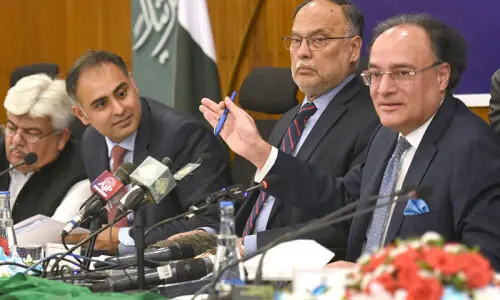
Minister of State for Finance Omar Ayub Khan, winding up the marathon debate marked by severe criticism of the government’s economic policies, said model vegetable markets would be set up in Islamabad and provincial capitals to improve supplies and stabilise vegetable prices.
He assured the house of an improvement in sugar supplies at government-fixed rates as a result of a recent promise by sugar mills to earmark 10 per cent of their produce for the state-run Utility Stores.
A total of 33 members, most of them from opposition, spoke to a poorly attended house on the third day of the debate about high prices of commodities such as sugar, cooking oil, petroleum products and cement.
Mr Khan made a comparison of the present government’s performance with previous governments’ but did not have much to remedy the situation after the ruling coalition appeared lacking a will to put up a defence against the opposition onslaught.
He began his speech with an assurance that the government would respect opposition suggestions but later indulged in rhetoric directed at opposition members such as “do they know what fiscal deficit is?” and “they talk of their favourite country India” (for comparison of the prices), provoking protests from the other side.
The state minister said increase in circulation of money due to economic growth had led to inflation.
About future plans for ‘inflation control’, he said the State Bank would keep a tight ‘control on monetary expansion and mark-up rates.’
Referring to opposition criticism of sugar mill owners in the ruling party and the cabinet, he hinted the blame could be shared by both sides of the house, saying: “Yes there may be mills of ministers but sugar mills are also owned by members of the People’s Party and the PML-N and something black will also be seen there.”
Earlier, Minister of State for Environment Malik Amin Aslam blamed the prevailing price spiral mainly on ‘negative effect’ of high economic growth and high oil prices and claimed a ‘reverse trend’ had started as a result of measures taken by the government.
Naveed Qamar of the PPP accused the government of playing havoc with the economy by letting liquidity created by debt rescheduling to be used for consumer finance non-productive activity than on creating assets in a long-term planning.
He attacked the government for privatisation programme, particularly the recent sale of the Pakistan Steel Mills, and for high sugar and cement prices and predicted a rise in fertiliser prices soon.
He said the government seemed bent on benefiting ‘10 to 15 families on which it depends’ and warned ‘a minor incident could create an uncontrollable storm.’
“If you think the situation is now beyond your control, go home and make way for a competent government,” he told the ruling coalition.
Maulana Abdul Ghafoor Haideri and others of
the Muttahida Majlis Amal called for enforcement of an interest-free Islamic economic system.
Maulana Mohammad Khan Sherani suggested adoption of presidential system of government on US pattern in which a ‘directly elected civilian president will also be commander-in-chief of armed forces.’
Prime Minister Shaukat Aziz made a brief appearance in the house during the debate.