0
0

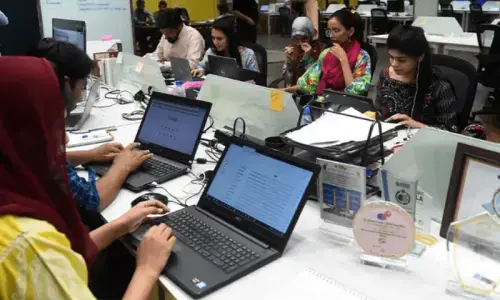
PESHAWAR, March 3: Speakers at a workshop said that poverty, illiteracy and social taboos were the main reasons for the rise in domestic violence against women.
They called for educating people, raising awareness and proper legislation against the menace.
“Extreme poverty and lack of education are plunging poor women into vicious cycle of domestic violence. There is an urgent need for spreading the level of awareness about women’s rights,” said Salma Masood at the concluding day of a two-day workshop entitled ‘Violence Against Women’ here on Friday.
The event was organized by the federal Ministry of Women Development in collaboration with an NGO, Sanjh.
She said that most of the women avoided reporting domestic violence because of fear. “Those who report about husband or in-laws ill-treatment are not accepted back in the family. So, they keep silence,” she added.
Ms Masood said that the misuse of the Hudood Ordinance should be checked and police should be very careful on investigating women cases.
Sanjh coordinator Shumaila Tabbasum, citing the Human Rights Commission of Pakistan (HRCP) report of 2004, said that domestic violence was the second largest killer after road accidents in Pakistan.
According to the HRCP, in 80 per cent of the domestic violence cases husbands and in-laws were involved, which resulted in the death of 90 per cent of the victims.
Ignorance about family planning on the part of poverty-stricken people also caused the number of children due to which men were unable to fulfil children’s needs and resorted to violence against their wives. “Poor men are often blamed for beating their children and wives which heighten the tension,” she added.
She also referred to bad customs, such as Swara, forced marriages, selling of women by people to pay off loans, human trafficking and unbecoming attitude of the police as the reasons multiplying the problems of women.
Superintendent of Police Ihsan Sadiq said that domestic violence was prevalent equally among the poor and rich families, but the later were able to resolve the issue within their household, while the former made the issues talk of the town.
He said that once women get awareness about the fact that police could protect them then they would go to police stations for registering cases.
District Nazim Ghulam Ali expressed concern over the rise in domestic violence and underlined the need to equip the police department with scientific and modern facilities so that they could check such crimes.
Provincial minister for population and women welfare Kashif Azam Chishti said that the MMA government was taking steps to provide prompt justice to women.
The provincial government, he said, had established women university and medical college to enable them to continue their education unhindered.
The government, he said had been providing free books to girl students for the last two years, which had encouraged their enrolment in schools.