IPI — firmly in place?
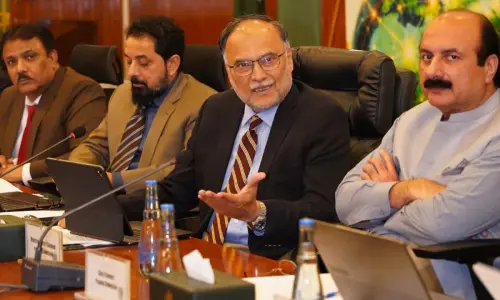
TO THE relief of all concerned, the meeting of the oil ministers of India and Pakistan in New Delhi has confirmed that the IPI gas project is very much on. Considering the many factors that could have thrown this tripartite venture into jeopardy, it is reassuring that two of the key parties involved have considered it necessary to reaffirm their continued participation in IPI. This specially holds true for India which voted twice against Iran in the last five months in the IAEA’s board of governors’ meeting fearing the loss of American support for transfer of nuclear technology. As for Iran, it is in its own interest that the project should move forward at any cost because it is at the moment at the centre of an international crisis and would not want to be isolated. Iran has been at loggerheads with the United States. The contentious issue is Iran’s nuclear programme under which it now plans to enrich uranium. Even though Iran would not be violating the NPT and until recently it had been observing the safeguards imposed on it by the Additional Protocol, Washington has chosen to confront the Iranian government. In this context the India-Pakistan statement on IPI is significant because it amounts to taking a stand against the wishes of the US which is now working to have sanctions imposed on Tehran.
Washington is known to be exerting pressure on India and Pakistan not to have any truck with Iran. The two South Asian partners’ decision to proceed with the pipeline in spite of US opposition has two important implications. First, it indicates that they are not prepared to knuckle under American pressure and are determined to take policy decisions themselves on matters that concern them. Secondly, this move confirms the growing trend towards regionalism in South and Central Asia. This will have profound implications for world politics. On its own, Islamabad has not been able to resist American pressures. Given the current war on terror and Pakistan’s supportive role in it, Islamabad has found it difficult to get the United States to show respect for the sovereignty of smaller nations. But it can assert itself in this respect by joining hands with India which is the world’s second largest power in terms of population and is a force to reckon with given its level of development and the market it provides. With India-Pakistan relations on the mend and greater cooperation between the two countries, one can expect them to demonstrate greater independence in relation to a major power seeking to establish its hegemony over the Third World. It remains to be seen if Washington seeks to block the funding of the IPI project. The pipeline is estimated to cost seven billion dollars and without funding from one of the financial agencies, the parties might find it difficult to finance it.
The IPI is also important for the boost it will give to regional cooperation. India has also joined another project in which Pakistan is involved, namely TAP (Turkmenistan-Afghanistan-Pakistan project). This crisscrossing of gas pipelines in the area will make it inevitable that the participating countries are bonded together. They will ultimately become interdependent not just in energy projects but economic forces will also be generated to bring them together. This in the end will also create political compulsions for them to normalize and stabilize their relations.
In the aftermath of riots
THE Punjab government’s decision to compensate motorcycle owners whose vehicles were burnt by rioters last Tuesday and Wednesday in Lahore is welcome. But an estimated 150 automobiles were also torched, including several private cars. The number of vehicles damaged and vandalized, with their windscreens smashed and gadgets stolen, is anyone’s guess. Retail stores, showrooms, eateries, travel agencies, offices and roadside vendors in the city’s business district fared no better; utter lawlessness prevailing in the street reduced many from riches to rags overnight. Traders insist that if the government had prepared to deal with the possibility of violence breaking out and taken appropriate security measures, the huge losses incurred by them could have been minimized, if not avoided altogether. This is a fair assessment, and calls for a compensation plan to help the affected business community pick up the threads and make a fresh start in business. The Frontier government, too, should compensate victims for the loss of life and property during similar riots in Peshawar the next day.
Punjab has also announced compensation of Rs 200,000 for the family of the university employee who succumbed to bullet wounds on Wednesday as students and police exchanged fire. Six other ordinary citizens — three each in Lahore and Peshawar — lost their lives in the rioting. It is only fair that their families, too, are given adequate compensation. One says this because it is the government’s duty to protect the lives and property of citizens, especially on occasions when violence can be anticipated but is not prevented. After all, it was the government that had allowed hitherto unknown group of small religious parties to hold the rallies which turned violent in Lahore and subsequently in Peshawar. Also, it is the government’s responsibility to bring the arsonists, looters and other culprits to book. Some of them were captured on film by TV cameras as they went on a destruction spree. The failure of the intelligence agencies in warning the civil administrations in Lahore and Peshawar of the possibility of violence breaking out is another question mark that calls for thorough investigation.
Danger of bird flu
GLOBAL health authorities are once again sounding the alarm bell as Africa records its first cases of avian flu. Some days ago, Nigeria, followed by Egypt, became a victim of the H5N1 virus strain. First detected among birds in Asia, the virus spread to Europe, where several countries are reporting an outbreak of the disease among wildfowl. On Saturday, India too confirmed cases of bird flu. While human casualties, resulting from contact between infected birds and people, have been relatively few, it is feared that virus mutations could greatly increase the chances of human-to-human transmissions in the near future. This would result in a pandemic that, in the absence of preventive vaccines or medication, could kill millions across the world. Pakistan, where a milder variant of avian flu some years ago caused several deaths among domestic birds, has to be especially careful.
There are two reasons for this. Firstly, the country lies on the path of migratory water fowl, certain varieties of which are known to be natural repositories of avian flu viruses. Secondly, national health authorities are simply not prepared yet to tackle the possibility of an outbreak. Some steps have been taken to lessen the threat, including the ban on poultry products from countries where cases of bird virus have been detected. However, it is just as important to have a comprehensive plan so that in case the deadly strain is detected in poultry or wildfowl at home, immediate steps can be taken to protect those who are in close contact with poultry and prevent the disease from spreading. It is also essential to provide the people with general information about the disease. Unless the authorities begin to take preventive measures — including keeping a watchful eye on poultry farms — there won’t be much that could be done to control the spread of the H5N1 virus if it struck Pakistan.
Time for a moratorium
THE sense of outrage over the cartoons (which none had seen) was over-powering and all-pervasive as I entered the National Assembly Hall on February 13. There was a shared sentiment that parliamentarians must also march in protest. When I addressed the house, I proposed that our march must be different. It must be absolutely silent. No slogans. No speeches. Nothing that would incite, provoke or cause hurt.
If we were indeed to march, we must show to the entire Muslim world that the “sound of silence” is itself quite deafening, and there is a dignity, indeed a majesty in non-violence. Silence and non-violence do not indicate weakness. On the contrary, they establish the strength of the cause.
I pleaded that were we to march with dignity and in silence, other marchers would hopefully emulate us. The image of Pakistan’s parliamentarians walking would surely be transmitted and relayed across the globe and would be an example for others to follow. Despite some initial MMA reservations, all agreed.
The parliamentarians marched on the 14th, in absolute silence and with a sombre dignity. Initially, as we came out of parliamentary premises, some members of the MMA began to raise emotional Islamic slogans, but they too stopped immediately on my personal intervention. Thereafter not a sound was heard. The rally culminated as agreed, with a prayer led by an MMA leader, for world peace and inter-religious harmony. Minority members also raised their hands in prayer. It should have been an image that Pakistan and the world ought not to have missed.
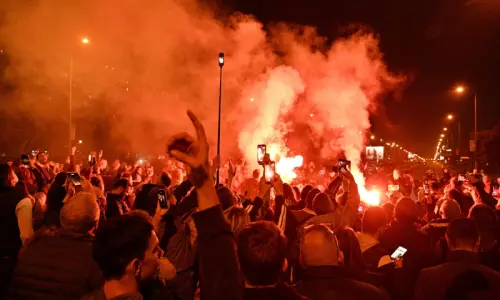
But that very day, Lahore descended into chaos and madness. Cameramen and reporters therefore focused only on the black smoke emanating from burning buildings, cars and motorbikes. They captured the images of young men running up to aim stones at buildings, including that of the Punjab Assembly. They relayed pictures of youth breaking traffic lights and shop windows. They showed footage of burning workshops and offices. The cameras caught looters emerging with armfuls of merchandise. The networks beamed shots of carnage and frenzied madness. One day it was Lahore. The next day it was Peshawar. In that city, where the MMA rules, even a hospital was attacked. Shutters in many other cities were sent crashing down.
The parliamentarians’ example of a peaceful and silent way of protesting was naturally lost on the world.
Much else was also lost in the turmoil and anarchy. The credibility of those expressing outrage was demeaned. The image of the Islamic world, and particularly of the Pakistani social order, was undermined. The authority of the state was subverted. Innocent citizens lost precious properties: buildings, merchandise, vehicles. None of the victims had done anything to attract the ire of the rowdy elements. And the element of violence and destruction in these protests tended to tarnish the immutable virtue and the everlasting dignity of the very benefactor of mankind that the protesters claimed to protect and uphold. Nothing could have been more self-defeating.
It was thus with a heavy heart that I stood up to speak in the House again on the 15th. The leader of the house, Mr Shaukat Aziz, had just made his statement. That statement has been widely reported. The government had taken strong and effective measures against the offending publications and the concerned governments, he said. It would move the OIC and the United Nations for the drawing up of a common international code of inter-religious harmony.
He then also echoed the sentiments expressed by the Punjab chief minister a day earlier. The government would strongly condemn and oppose any attempt to ridicule the name of the Holy Prophet. There was intense outrage and anger among the Muslims of the world on the Danish cartoons. Emotions could not be controlled. Demonstrations were natural and could not be stopped. [This almost amounted to a justification of the carnage]. However, the government would henceforth come down with an iron fist on all the miscreants and vandals who take to damaging property or putting lives at risk.
When I spoke, I could not endorse all that the prime minister or the chief minister had said. My perspective was somewhat different. This elicited wide support across the partisan divide.
First of all, I felt that anyone who had profaned the sanctity of protests related to the name of none other than the Holy Prophet was himself guilty of the same offence and outrage he was seemingly protesting against. For what else could be more blasphemous of the Prophet of Islam than to pretend to be his follower and then to loot or burn properties of innocent compatriots? Each one of the vandals, whether they belonged to any religious party or not, should be dealt with accordingly.
I also pleaded, and do so now, that the parties that have given calls for further marches declare a moratorium on protests. Several calls have been given for Fridays and other days. Although a big procession in Karachi has passed peacefully, but it was buttressed on both sides by civil armed forces. Hence, too, the peace. Yet, who is to count the cost of the total shutdown of Pakistan’s commercial capital?
Now, one definite call for a countrywide protest has been given by none other than Ch. Shujaat Hussain himself. He was joined by some prominent leaders of the opposition belonging to the MMA and other religious parties. Together, they have called for a total strike on March 3. Together the PML-Q and the MMA account for all the five governments — federal and provincial.
That brings in the direct involvement of all the governments. With the ruling parties themselves in the forefront, even after the tragic events of Lahore and Peshawar, who is to be stopped from taking to the streets? Already the ruling PMl-Q’s handling of the Lahore demonstration, particularly the remarkable absence of the police, has cast suspicion on it. Why else would a force that is always mobilized in the thousands to prevent a PPP demonstration, or even a women’s march, be held back when such a large demonstration was on its way?
Chaudhry Shujaat’s call also implies that the protests must continue unabated at least till March 3. That is many a day too many. I thus implored Ch. Shujaat, and the leaders of the religious parties who had joined him to review their strategy of protests and call off that strike. The Lahore and Peshawar violence indicates that their professedly non-violent protest had taken a turn that must not be acceptable to them.
There is no loss of face in calling off such protests for the time being. Leaders of mass movements have done so in the past. Maybe a new strategy has to be devised — a strategy in which there are foolproof safeguards against violence and rampage, a strategy that allows business and commerce to go on peacefully even as the protesters protest.Those who lead any such movement are themselves most concerned with its purity, honour and integrity. They cannot countenance the descent to violence and anarchy.
And how does it hurt Denmark if we burn our own shops and bazaars? What if the avowed opponents of Islam took it upon themselves to bring out such nonsense every three months or so? Would the entire Muslim community, from Morocco to Indonesia always pre-occupy itself in burning its own properties to spite the offenders?
Let us be rational. Let us reflect and ponder over our own situation as Muslims for a moment. Is there a single scientific advance or invention over the past millennium that can be attributed to a Muslim? Electricity, railway engines, motor cars and cycles, wrist watches, thermometers, computers, satellites, cameras, television, telephones, x-ray machines — the list can go on endlessly. What are we preoccupied with? For the last few days, schools and colleges, the institutions for learning and research, are again preoccupied with protests.
Then there is that element in the violence that is impelled more by the economic disparities and sense of deprivation than any pious zeal. That, alone, should be an eye-opener for all our economic tsars talking of “Shining Pakistan”. The clubs that the youth ploughed into windshields and shop windows represented their anger at the vast difference between their wretched lives and the consumerist ostentation of the powerful civil and military elite of Pakistan. The actions also protested against the denial of democratic rights.
Those who lead these processions for the glory of Islam must ponder on another aspect as well. The element of violence has had one other negative effect. The Europe that seemed to be gradually breaking loose from US domination, is back in its embrace. It can now empathize with the Islamophobia of the American neo-cons. Did the protesters intend to thus strengthen neo-con hands?
We must finally consider that these are protests about the attempted desecration of the piety and virtue of one, of whom, as a child my generation used to recite the “Salaam” written by Maulana Hali and we were always moved by the lines:
Salaam us par keh jis nein gaalian sun kar dowaiyn deen
Salaam us par key jis nein khoon key piason ki balaiyn leen.
Is random violence a step in consonance with that image?
The writer is an MNA and a former federal minister in the PPP government.