Torture in Iraq
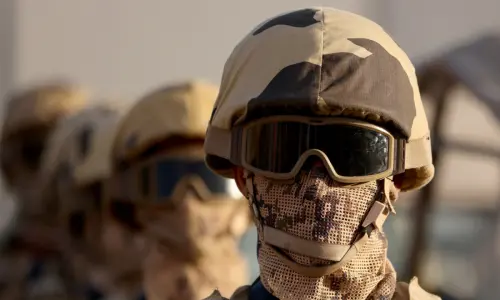
MILLIONS of people the world over have seen the video showing British soldiers beating and kicking young Iraqi boys, while a corporal watched and encouraged them. Against this background, one must accept with a pinch of salt Tony Blair’s claim that his troops were doing “a great job” for their country and the world. Torture is no more an American monopoly in Iraq, and Mr Blair’s Britain, which joined the US in attacking Iraq while bypassing the UN, is now a co-accomplice in what the press has been calling “savage abuse” of Iraqi prisoners. The question that comes to mind is: are Abu Ghraib and the young street demonstrators’ abuse somewhere in south Iraq in 2004 the only instances of torture? The video of the torture was shown to troops, but then someone’s conscience pricked and he gave it to a newspaper. There must be countless other cases where no film was made or nobody blew the whistle. All that the British prime minister promised to do was to ask the ministry of defence to investigate the “mistreatment”.
There is no relationship between the Danish cartoons and the protests now taking place in the Muslim world on the one hand and the abuse of young demonstrators by the British troops on the other. But there is no doubt that the torture to which the British troops resorted will add to the current fury in the Muslim world over the blasphemous cartoons. The prospects of a healthy and mutually fruitful relationship between the West and the Islamic world now seem increasingly bleak, because the relationship between the two seems to have become accident-prone. The 9/11 hijackers and the soldiers at Abu Ghraib or Guantanamo or those seen in the recent video may not have the approval of the civilizations they represent, but there is no doubt that their misdeeds have a global dimension.
Can the US and Britain assure the world that Iraqi prisoners — young or old, hardened guerrilla fighters or stone-throwing youngsters — will not be tortured in the future? The answer is a categorical ‘no’, because colonial occupation has its own weird logic. Whether it is Nazi-occupied Europe or the West Bank under Israeli occupation, whether it is Iraq or the Kashmir valley, military occupiers act the way they are intended to do. Which is to crush all resistance. But as recent history shows, all military means to crush resistance have failed. Ultimately, it is by political means that peace is restored and one-time terrorists — Palestinian guerrillas or Algerian freedom-fighters — become negotiating partners of the occupying power. There is no other way it can happen in Iraq. The resistance there shows no signs of abating. Precisely on the day on which the ruling United Iraqi Alliance nominated Ibrahim Jaafari as a candidate for what will be the country’s first elected prime minister, a series of blasts, one of them caused by a suicide bomber, rocked Baghdad. The only guarantee against prisoner abuse is a withdrawal of the US-led troops, and there is no sign of this happening any time soon. In fact, President George Bush re-emphasized his determination to stay on in Iraq in his recent state of the union speech. This means Iraq will continue to be what it is today — a killing field where peaceful and defenceless civilians continue to be killed and where torture by the occupying forces is accepted as routine.
When protests turn violent
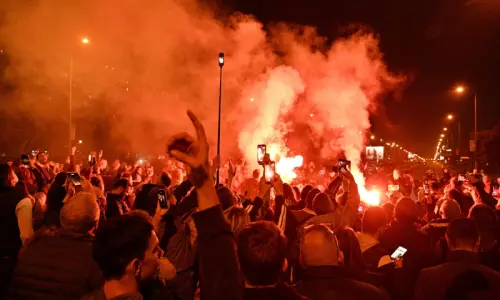
WHEN it comes to protests and demonstrations in Pakistan, it seems that they are often undertaken to create general mayhem rather than make a point. This was painfully evident this past weekend during the nationwide protests over the cartoon controversy. Most of the protests turned violent with burning of tyres and effigies. What cannot be understood, however, is why protesters in Okara damaged four cinema houses, besides pillaging two petrol pumps on Sunday. While one can understand the outrage over the printing of the blasphemous cartoons, that doesn’t justify religious leaders whipping up frenzy among the protesters and encouraging them to damage private or public property. No amount of anger can justify a mob vandalizing a cell-phone company’s office in Rahimyar Khan as was also done on Sunday. Merely arresting some ‘miscreants’ who did all this will not be enough. It is important that strict action is taken against those who encourage this sort of behaviour. In the past, the government has arrested rabble-rousing leaders for inciting violence but it inevitably drops the charges once the furore has died down — as happened in the Gujranwala mixed marathon case last year. This lax attitude only strengthens violent protesters’ resolve and their confidence that they can get away with their excesses. It is important to take exemplary action against the leaders now as more demonstrations are in the offing, notably a nation-wide protest scheduled for March 3.
One fails to understand the purpose behind holding a nationwide rally on March 3? Why that late? Do the religious parties, which originally called for the strike, need that much time to organize the protest? It would make more sense to register the sense of outrage now, as is being done all over the world, than to keep the issue alive for a further two weeks, by which time the anger would have subsided elsewhere. The ruling party has also decided to participate in the strike in the hope perhaps that its participation will ensure a modicum of discipline and order. One will keep one’s fingers crossed.
Tree cutting in Nara
IF the Sindh wildlife authorities don’t look out, pretty soon the province will be losing another chunk of its natural surroundings. The Nara desert wildlife sanctuary is home to several species of plants and animals, besides being rich in mineral resources. However, the logging mafia, backed by influential local figures, has reportedly taken over parts of the area and is engaged in the indiscriminate cutting down of trees that, besides having medicinal properties, have for years provided shade, shelter and fodder to desert wildlife including some rare species. The land cleared is intended for cultivation and apparently the Nara canal is feeding several water channels, including illegal ones. The extensive tree cutting may also be at the root of the reduced rainfall that the area has been receiving during the monsoons in recent years.
What is surprising is that the trees being cut down form part of a protected area whose flora and fauna the government is expected to preserve under the law. However, the authorities have chosen to disregard the illegal logging and the wholesale elimination of delicate ecosystems. The Nara sanctuary is not the only area to have suffered on this count. Despite the existence of forest laws, trees are being lopped off all over the country with disastrous consequences as Pakistan’s forest cover shrinks year after year. Besides strict implementation of the law, there is also the need to educate local communities about the importance of trees and the consequences of their destruction. The reality is that human pressure on natural resources will continue to grow. Unless faithfully enforced, no number of rules is going to stop environmental degradation. And while protests of the sort witnessed recently in Islamabad against the imminent destruction of a banyan tree might be welcome, much more needs to be done to create environmental awareness among ordinary citizens.
In a state of self-imposed siege
PRESIDENT General Pervez Musharraf has argued once again that if the US Predator had violated Pakistan’s sovereignty on January 13, the Al-Qaeda elements and their supporters operating in Pakistan were as much guilty of the same crime. The president’s seeming attempt to equate the two markedly different but highly serious concerns sounded as if he was trying to justify the violation of our sovereignty by the US but in the process he seems to have ended up creating the impression that Pakistan was an open game for any bully.
If, however, he had simply wanted the people of Pakistan to protest with as much vehemence against Al Qaeda’s Pakistan operations as they were doing against the US Predator attack, perhaps he should have mobilized his party to the effect inside and outside parliament rather than making the point through media interviews which at best can have only fleeting impact.
It is not only the US and Al Qaeda which seem to have taken Islamabad for granted some other actors too seem to have joined in the game of embarrassing Islamabad. On December 27 last year New Delhi had the gumption to violate the universally accepted principle of non-interference in the internal affairs of other states when it asked Islamabad to exercise restraint and take recourse to peaceful discussions to address the grievances of the people of Balochistan.
Earlier, on December 13, the so-called Baloch ‘insurgents’ severely tested Islamabad’s writ by firing rockets in Kohlu during President Musharraf’s visit to the town. On December 4, the chief minister of Sindh, Arbab Ghulam Rahim, a member of the ruling PML, warned Islamabad against building the Kalabagh dam. Subsequently, almost all the Sindhi members of both the provincial and federal cabinets publicly defied Islamabad on the issue.
On January 8, the MQM, which holds the balance of power both at the centre and in the Sindh province, asked Islamabad to back off on this controversial dam, threatening to walk out of the ruling coalition if it did not do so. While one would like to believe the Saudi ambassador when he says that King Abdullah was misquoted by Indian media on the issue of New Delhi’s OIC ambitions, what the Saudi monarch had actually said (“Yes, as Russia did which have been given an observer status in the OIC. But it is better if a move in this regard is made in agreement with Pakistan”) on an Indian TV channel on January 22, shorn of diplomatic lingo, amounts to asking Islamabad to sponsor India’s association as an observer.
And what have been the responses of Islamabad to all these setbacks in a matter of a month or so? Let us consider them one by one. First, the prime minister went to Washington on January 24 and took care of the January 13 incident in his own way by joining the US president in stating that “Pakistan-US are one in the war on terror.”
Second, India’s gratuitous advice on Balochistan was taken care of by sending foreign secretary to New Delhi on January 17 to join his Indian counterpart in preparing the agenda for the third round of the composite dialogue. Meanwhile, the Amritsar-Lahore and Amritsar-Nankana Sahib bus services were started and the Khokrapar-Monabao railway link was finalized to give a further boost to the on-going CBMs.
Third, Immediately following the Kohlu incident, Islamabad launched an armed action against ‘miscreants’ in Balochistan. Now the Balochs are demanding ‘demilitarization’ of their province and ‘self-governance’ as preconditions for disarming and a negotiated settlement of their conflict with Islamabad.
The Kashmir conflict and the current Baloch imbroglio are two qualitatively different issues, still if, as the president believes, ‘demilitarization’ and ‘self-government’ could open the doors for resolving the Kashmir conflict without first meeting the Indian condition for complete stoppage of the so-called cross-LoC terrorism, why can’t the some principle be applied in the case of Balochistan and work out a solution without the militants in the province first requiring to disarm?
Fourth, on January 16, seemingly succumbing to the MQM pressure, Islamabad backed off from Kalabagh. Fifth, on the issue of granting observer status to India in the OIC, Islamabad seems to have chosen to hide behind the fig leaf of Saudi ambassador’s clarification.
But what else could have Islamabad done under the circumstances? Pick up a fight with Washington, New Delhi and Riyadh all at the same time? Out of the question. Without the US and Saudi support, the bluster that Islamabad exudes currently within and outside the country would simply vanish in the thin air. Pakistan simply cannot afford to walk away from the on-going peace process with India, no matter what the provocation, short perhaps of an Indian aggression, because its closest friends and many more global influentials, who see the region as a nuclear flash point, would not let Islamabad do that come what may.
Also, in Islamabad’s own enlightened self-interest all options other than peace with India seem to have already lost their relevance. And what about the Sindhi members of the ruling party and the MQM? If they walk out of the government, Islamabad would be left with no option but to fall back on either Nawaz Sharif or Benazir Bhutto or both — a prospect totally unacceptable to the present rulers in Islamabad under any circumstances. So, it abandoned Kalabagh to save the governments at the centre and in Sindh.
And with all the fire power at its command and accountable to no one in the country, the government can hardly afford to be seen to be succumbing to the armed challenge by a few rag-tag Baloch groups and negotiating a political solution with them. So, the uprising in Balochistan must go on. A similar situation is also going on in the Fata along the border with Afghanistan and action is being taken to flush out the so-called foreign militants with alleged links to Al Qaeda. In any case, being a victim of terrorism, it is in the interest of Pakistan to do everything in its capacity to eradicate the menace from its soil.
What has brought Pakistan to this sorry pass? Or is it really all that bad? Could it be that since all this has happened within a month or so, the sum total has given an exaggerated picture of each one of these chastening developments? Perhaps a mountain is being made out of a molehill. However, much as one would like to believe this, one simply cannot ignore the realities on the ground. Islamabad is getting increasingly besieged by the day.
It seems to be a self-imposed siege because our ruling elite which includes the civil-military bureaucracy, the big business, the Chaudhries, the Khans, the waders, the sardars and the media tycoons, has not yet unlearnt the lessons of governance that it had learnt from our colonial rulers. It still regards the four federating units, the AJK, the Northern Areas and Fata as its satraps. This has been the root cause of all our problems.
Take, for example, the feigned surprise of our present rulers at the hostile local opposition to the Rs. 140 billion worth of development projects in Balochistan. What those sitting in Islamabad don’t understand is that unless the local beneficiaries are made stakeholders in these projects in the real sense, they would continue to suffer from the suspicion that all these efforts were nothing but a ruse to further tighten the stranglehold on them.
Another set of eyes
THE BUSH administration will like the debate over its warrantless wiretapping programme to divide neatly along partisan, and potentially electorally useful, lines. But some Republican legislators aren’t with the programme. Their responsible pressure has nudged the administration from its customary highhandedness. The resulting congressional briefings are a good first step, but a framework for real oversight of the surveillance programme remains necessary.
When Attorney General Alberto R. Gonzales appeared before the Senate Judiciary Committee, Republican senators — Chairman Arlen Specter and Mike DeWine, Sam Brownback and Lindsey O. Graham — expressed discomfort with the administration’s end run around the Foreign Intelligence Surveillance Act (FISA).
Then Rep. Heather A. Wilson, who chairs a House intelligence subcommittee that oversees the National Security Agency, called for a full congressional investigation into the eavesdropping. She’d been trying in vain to get information from the administration about the programme since it was revealed in December. After her public statement, the administration wisely, if belatedly, agreed to brief House and Senate intelligence panels not just with a rehash of its unconvincing legal arguments but with actual details about the surveillance.
This is a promising reversal but not enough. Lawmakers beyond the “Gang of Eight” congressional leaders and intelligence committee chairs need to know what the surveillance programme entails. But it is even more important to try to put in place a mechanism — beyond the executive branch monitoring itself — to make certain the surveillance stays within constitutional boundaries.
—The Washington Post