Making a mess of it
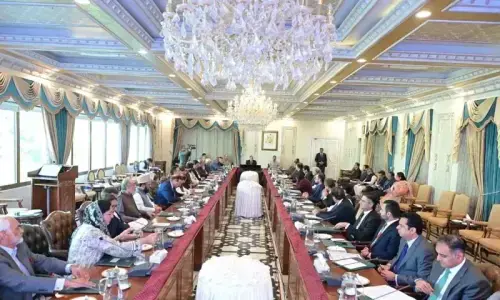
THE government has made a right royal mess of its handling of the sugar muddle. Prices have refused to come down, and now there have been allegations in parliament of ministers and ex-ministers owning sugar mills in an echo of a similar problem with sugar in Ayub Khan’s days. First the government seemed to underplay the issue of rising prices, or failed to fully realize its gravity. Then it allowed imports from India and also promised greater availability of the commodity at utility stores, which sell sugar at almost half the price in the open market. It was pointed out then that the number of utility stores was grossly limited, and the shortage could not be tackled by such cosmetic measures alone (more stores, it is said, are to be opened). Imports from India could also be easily cornered by moneyed millowners or the traditional hoarders. Then a meeting was held under the chairmanship of the president, and people wondered why the government had to drag in the general into a problem that it should have tackled on its own. On Friday, the Economic Coordination Committee of the cabinet said the responsibility for handling the issue rested with the provinces.
The point is not to look at the issue of high prices of essential commodities — of which sugar is certainly one — in purely technical terms, which the government would dearly like us to do. It is the attitude towards the basic needs of the people that is galling. This attitude is one of indifference. Inflation has greatly eroded incomes. Many people have given up or curtailed eating meat, wheat prices remain high and now citizens are expected to give up sugar also. Rising prices are in addition to all the other unattended miseries that people face in their daily lives, such as the lack of urban transport and housing. Ministers are pictured in the media sitting with elegant handkerchiefs in their waistcoat pockets and wearing smartly cut suits. There appears to be a general public perception of indifference on the part of the government that could prove damaging because it cuts off the masses from the rulers. The government has failed to establish that it is conscious of the basic needs of the people, the sugar crisis bringing this to the fore again.
It is also clear that while moving towards free trade, which is a compulsion of the times, we have paid scant attention to appropriately strengthening our regulatory framework, which is weak and outdated. Greater sophistication is required than piecemeal solutions such as permitting imports. The Monopoly Control Authority as it exists was set up for a regulated market and has become ineffective in today’s conditions. A comprehensive policy cries out to be framed that meets the basic requirements of the people and charts out a multi-dimensional approach that checks market abuses. Regularizing trade with Afghanistan and India and bringing items now in the informal sector into the formal sector should also be urgently considered — to prevent price and market manipulation. We don’t want more committees and commissions: these have been set up every time a food crisis has hit the country, and nothing has changed. We just want a little more care and consideration from the government for those millions left out of the charmed circle created by free market economics.
A welcome decision
THE lifting of the ban on kite-flying by the Supreme Court for a period of 14 days will be counted as a blessing by many, especially those whose livelihood depends on the economic activity generated by the Basant festival in Punjab. The need now is to scrupulously observe the rules of the game, as set by the apex court. The order passed by the full bench says that kite-flying may be permitted, provided sharp, glass-coated threads and metal string are not used. It directs the inspectors-general to monitor the kite-flying activity and submit a daily report; if the use of hazardous material is not curbed and casualties are reported, the court shall review its decision on the lifting of the ban. Last year, Basant festivities claimed 17 lives in Punjab; most deaths occurred as a result of sharp thread cutting throats and kite enthusiasts falling from rooftops. In Lahore, where the highest number of casualties took place, the frenzy gripping the merrymakers during the festivities also involved aerial firing on a large scale. It is such excessive acts of indulgence that negate the norms of responsible conduct and should be curbed. The Lahore Electric Supply Company also suffered heavy losses owing to the use of metal strings which knocked out power as frequently as over 500 times a day. Since the imposition of the ban on the sport this year, which only a daring few continue to flout, Lesco has recorded less than 100 power outages a day in the city, significantly reducing the damage suffered by the utility on account of kite-flying.
Like they say, a sport should remain a sport and not become a public safety hazard or a social nuisance. It is now the responsibility of all stake-holders — the kite and thread manufacturers, the enthusiasts and the law enforcement agencies — to ensure that kite-flying is done in a decent and safe manner during the stipulated 14 days. The people need, and they enjoy, popular festivals like Basant, but there can be no justification for the deadly sting that came to be attached to the celebrations in recent years.
Unrest in Sukkur jail
SUKKUR Central Jail was once again the scene of prisoner violence last Tuesday when five jail officials were taken hostage by 2,000 inmates for several hours. The hostages were threatened with death unless the authorities met their demands that included the sacking of a jail official and the removal of restrictions on visits by relatives. The prisoners also complained of extortion and torture by jail staff. This was the fourth incident of prisoner unrest at Sukkur jail in six months, and one can expect more of this unless effective steps are taken to remove the grievances of the inmates. Unfortunately, the state of affairs in Sukkur reflects the Dickensian conditions prevailing in prisons across the country where episodes of jail breaks and prison riots appear to be on the rise. Overcrowding, extortion, disease, torture and the long wait for justice are some of the reasons why Pakistani prisons are generally regarded more as punitive units than reformatories.
In recent days, the appalling conditions that exist in jails led the Senate committee on human rights to term prisons as “human zoos”. Meanwhile, the Pakistan Law and Justice Commission has recommended several jail reforms ranging from initiating disciplinary action against errant jail officials and ensuring prison inspection to better living conditions for the inmates. While these recommendations may be heartening, it should be noted that nothing concrete seems to have come of similar proposals of previous commissions looking into prison reform. The fault really lies in the lack of will to implement much-needed reforms and the public perception of criminals as persons unworthy of compassion or humane treatment. No reform is likely to work unless such misconceptions are removed and an effort made to see prisoners more as victims of an unjust social system than as hardened criminals.
Mending our India policy
IT is not an exaggeration to say that Pakistan’s relations with India since its inception have been the central or rather the determining factor of its foreign policy. One would, therefore, presume that our India policy would be marked by steadiness of purpose, clarity of vision, the virtue of moderation, soundness of analysis and depth of strategy.
As against this, our India policy has suffered from lack of a sense of direction, confusion of thought, a tendency to take extreme positions, pious hopes and the absence of a carefully worked out long-term strategy, particularly in the recent past. This has predictably led to disappointments and frustration on our part, and to flip-flops of our India policy.
Since the birth of Pakistan, its relations with India have been generally tense and uneasy and occasionally hostile as reflected by the several wars and military confrontations between the two countries, the last one being the full mobilization of troops by both sides following the terrorist attack on the Indian parliament in December 2001.
There have been two primary reasons for the discord between India and Pakistan: the Kashmir dispute and India’s quest for hegemony in South Asia which was met by Pakistan’s opposition. Another underlying factor for the tension-ridden relationship has been the grudging reluctance with which India accepted the creation of Pakistan and its continued hope, sometimes nurtured secretly and sometimes expressed publicly, that sooner or later the partition would be nullified and Pakistan would become a part of the Indian federation.
The latest example of this not-so-secret hope was the reported statement by the Indian president on February 2, 2006, that a federation between India and Pakistan was a possibility in the next 50 years or so. It explains the pains that the Indians take to stress that Pakistan and India are culturally the same, thus negating the very rationale for the creation of Pakistan. This is also the subtle message that is being conveyed to the masses in Pakistan through the cultural onslaught by the Indian electronic media.
The fact of the matter is that Pakistan belongs to the Islamic civilization whereas the vast majority of the Indians represent the Hindu civilization. As stressed by the Quaid-i-Azam at Lahore in March 1940 and later in his famous correspondence with Gandhi in 1944, the Muslims and the Hindus belong to different civilizations and cultures, have distinctive outlook on life and of life, and, therefore, they constitute two different nations.
In the face of the challenges that a hostile India posed and the tensions generated by the Kashmir dispute, our leaders and policy-makers have been guilty of three fundamental flaws in managing our relations with India: they have pursued policies which our resources cannot sustain leading to the classic mistake of a strategic overstretch, defined the concept of security almost exclusively in military terms with politics and economics taking a back seat, and ignored the lesson of history that in modern times nations that have prospered in the world have accorded higher priority to building economic strength than to military strength at the initial stages of their development.
Since 1990s, we have added to these policy flaws the blunder of policy formulation in a vacuum, ignoring the dictates of the global and the regional strategic environment and a tendency to swing like a pendulum from one extreme to the other.
The combination of strategic overstretch and over-reliance on the military at the expense of the political, diplomatic and economic dimensions of policy in managing our relations with India drained our resources and weakened us gradually vis-a-vis India. The preponderant weight of the military in our body politic and frequent military take-overs stunted the growth of political and representative institutions in the country, destabilized our polity and undermined the process of economic development through large-scale diversion of resources from development to military purposes.
It is not surprising, therefore, that, according to the UN Human Development Report for 2005, Pakistan’s annual GDP per capita growth rate during the period 1975-2003 was 2.5 per cent as against 3.3 per cent recorded by India. Our performance during the period 1990-2003 worsened further with the comparative figures being 1.1 per cent for Pakistan and 4.0 per cent for India. The net result is a much weaker Pakistan politically, economically and militarily relative to India now compared to the situation in early 1960s.
The disintegration of the Soviet Union drove home the primacy of economic strength in any long-term contest between nations. The Soviet Union was defeated in the Cold War not because of a lack of advanced weaponry. In fact, its fundamental mistake was to build a heavy military superstructure on weak economic foundations resulting in its inevitable collapse. The lesson of history is that sustainable military power can be built only on the foundation of political stability and economic strength. Unfortunately, we have put the cart before the horse by building up military power at the expense of political stability and economic development. Our defence expenditure has consistently exceeded the development expenditure during the 1990s and subsequently. Little wonder that India has moved far ahead of us in almost every aspect of economic activity.
As for the global strategic environment, two developments relevant to Pakistan-India relations stand out. One is the rejection by the international community of terrorism and resort to violence by non-state actors which has had an adverse effect on freedom movements in Kashmir and Palestine. The second is the gradual emergence of India as a major player on the international political stage. Both these developments have important implications for Pakistan’s India policy which are too obvious to need any elaboration.
Finally, a word about the flip-flops of our India policy as exemplified by the travel from the Lahore Declaration through to Kargil, the Agra Summit and the Pakistan-India Joint Statement of January 6, 2004, and more recently by the talk about economic union with India. Such pendulum-like swings in our India policy betray the absence of steadiness of purpose and a carefully worked out long- term strategy based on national consensus, and instead a preoccupation with quick results flowing from short-term and arbitrary approaches.
It is axiomatic that only a politically, economically and militarily strong Pakistan can safeguard its national interests and security by standing up to the Indian hegemonistic designs in the region. Only such a strong Pakistan in this power-based international system can have some hope of generating pressure on India and attracting international support for securing a just and honourable settlement of the Kashmir dispute.
Judged from this standpoint, our India policy of the past half a century which weakened Pakistan vis-a-vis India and resulted in the dismemberment of the country without any significant success to its credit can only be considered a failure. The need, therefore, is a fundamental review of our current India policy which continues to suffer from the shortcomings mentioned above.
What are Pakistan’s options in an admittedly difficult strategic environment? Perhaps the most important requirement right now is to adopt a long-term strategy for handling our relations with India based on a careful calculation of all the relevant factors and on national consensus to be evolved after debate and discussion among all the stakeholders.
Such a long-term strategy must recognize that peace is a strategic imperative for both India and Pakistan now that they both possess nuclear weapons. This strategy should aim at avoiding a confrontational approach towards India, which we can ill afford, and loose talk of economic union with that country, which would strike at the very roots of Pakistan. Instead, our long-term objective should be to build up our internal strength and take well-calculated steps externally through adroit diplomacy to turn the strategic situation in our favour. The process of composite dialogue with India, meanwhile, should continue to defuse tensions in our relations with India, avoid the risk of the outbreak of an armed conflict and resolve the outstanding disputes politically.
However, it must be understood that a satisfactory settlement of the Kashmir dispute is not feasible in the immediate future because of its emotional overtones and historical background. Indian Prime Minister Manmohan Singh has ruled out any redrawing of borders between India and Pakistan in response to repeated appeals by our leaders. He reiterated this point on February 1, by stressing that he had no mandate to negotiate the transfer of “Indian territory”.
Perhaps more importantly, an immediate settlement may not even be in our interest as the current strategic realities, which would determine its substance, favour India. We should, therefore, bide our time and wait for the right moment. As for the immediate future, while maintaining our principled position on the issue based on UN resolutions, we should persuade India, as interim measures, to improve the human rights situation in the held Kashmir and allow the Kashmiris maximum autonomy in running their affairs.
Pakistan’s policy-makers need to devise a long-term strategy which would secure an honourable peace with India and achieve a just and satisfactory settlement of the Kashmir dispute while ensuring our national security and economic well-being. This indeed is a daunting but not an impossible task. However, the prerequisite for any chance of success in this endeavour is a democratic, politically stable and economically strong Pakistan.
The writer is a former ambassador.