0
0

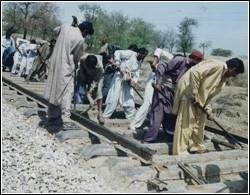 ZERO-POINT (KHOKHRAPAR): The renovation of the Khokhrapar railway station has been abandoned half way after the government’s decision to build a new railway station at Zero Point, bordering India.
The government has attached prime importance to the station at Zero Point, and work on it is in full swing. The decision on this was taken at the eleventh hour owing to security reasons. Construction work began on Jan 19 in the desert area.
Thar Express is scheduled to start its first journey at 11pm on Feb 17 from Karachi and will cross the border around noon on Feb 18. Most of the tickets for the train, having a capacity of about 900 passengers, have been sold, railway officials say. The train will have two stopovers, at Hyderabad and Mirpurkhas, en route to Zero Point. It will not stop at the Khokhrapar railway station.
Tenders were floated for renovation of the Khokhrapar station, but after the change of policy the exercise was abandoned. Stalls for food, public call facilities and other amenities have yet to come up at the new station.
The assistant executive engineer, bridges, of Pakistan Railways and project director of the railway station, Mustansar Ahmed Khan, told Dawn at the site of the under-construction station this week that the station would have a 1,000 ft-long platform, 11 12x12 ft rooms and 12 toilets, besides other facilities.
“We have to complete construction by mid-February to be in time for the inauguration on Feb 18,” he said.
“It is a challenge for us to build a railway station in such a short time and we are working on it.” It might be a makeshift arrangement initially, and the railways were considering construction of a proper edifice to be built in two years.
Syed Tauqueer Mumtaz, inspector, works, said the main problem was logistics as there was no road from Jhalu Jo Chunro, some 33 kilometres from Zero Point. He said “kekra” trucks, which could travel in the desert, were the only means of transportation of construction material. Track laying work had been completed, with a 42-ft. portion left to be connected with the Indian side. He said electricity had been provided to the station while 20 telephone lines would soon be available.
Officials say that 30 railway police will be deployed on the train for security. The Rangers will carry out a physical examination of the train and passengers each time.
The Indian government has built roads on either side of the railway up to Monabao, some two kilometres inside the Indian border. Officials said that the Monabao railway station was a modern station where a duty free shop had also been established.
On the Pakistan side, there is so far the under construction station and a Rangers check post. Except for the two structures, there is sand everywhere. The Rangers do not allow labourers and officers to stay overnight at the new station due to safety considerations. They have to go back to Khokhrapar, some eight kilometres from Zero Point, everyday. A citizen who wants to travel up to Khokhrapar or Zero Point has to seek permission from law-enforcement officials from the Chhor Cantonment, 52 kilometres or so from Khokhrapar. A road network exists from Chhor to Jhalu Jo Chunro and from there travel up to Khokhrapar or Zero Point is cumbersome.
The station master of the Khokhrapar railway station, Akhtar Ahmed Qureshi, recalled that Khokhrapar was connected through rail link to Mumbai in 1908 during the British era. Train service between the two countries was first suspended soon after partition in 1947. The link was restored in the mid-1950s but it was again suspended on Sept 5, 1965.
He said that before the suspension of the link in 1965, the train used to travel between Hyderabad (Pakistan) to Jodhpur (India) and it made a stopover at Khokhrapar.
Mr Qureshi said that one station master, one assistant station master, three booking clerks, three pointsmen, two sanitary workers, and two porters had been posted at the new railway station. The local train service from Mirpurkhas was suspended on May 7 last year as the tracks were being converted from meter-gauge to broad-gauge.
The residents of Khokhrapar, a small village with scattered houses made of mud with wooden roofs, are angry about the suspension of the train service from Khokhrapar to Mirpurkhas, which was the only cheap, comfortable, and reliable means of travelling for low-income people. They demanded early resumption of the service. They have expressed their resentment over the sitting up of the new railway station and termed this as unjustified and tantamount to depriving them of the opportunity of jobs. However, they are mostly happy at the decision to re-open the rail link between the two countries.
But they said that although their village was hardly eight kilometres from the border, they could not travel to India unless they first got a visa from Islamabad.
A 22-year-old youth Khuda Bux said: “My grandparents live in a village in Rajasthan but I have never met them. I wish I would go to India to see them but I cannot afford to travel to Islamabad. If the rail link is established and we can get visas from Karachi, I will definitely go to India.”
He said that the government should open the Khokhrapar station so that local residents who had travel documents could catch the train from their village. Residents of Chhor and Umerkot were also of the view that the visa facility should be provided in Karachi.
Another resident, in his late 20s, introduced himself as Qadir Bux and said: “We were expecting that the opening of the rail link between the two countries would create job opportunities for locals but we gave up all hope when we came to know that the train would never stop at Khokhrapar.”
Other residents pointed out that since the railway stopped running from Mirpurkhas, they had to go to Umerkot to buy groceries and had to hire trucks. The trucks leave Khokhrapar and its adjoining areas at 6am for Umerkot and reach there by noon. They start their return journey to Khokhrapar at 12:30pm when many people are still busy shopping. Then they have to spend the night in the town and get a truck to return to their village the next day.
One resident Habibur Rehman said that school buildings were constructed in the desert during the tenure of Benazir Bhutto but the teachers appointed for the schools did not turn up as there was no road network and nobody was willing to work in the desert. The buildings were now lying abandoned.