0
0

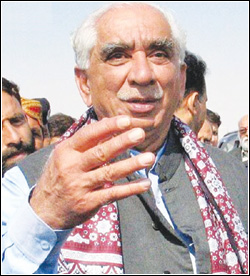 KARACHI, Feb 3: India’s former external affairs minister and currently leader of the opposition in the Rajya Sabha Jaswant Singh has emphasized the need for a constant endeavour by India and Pakistan to “expand the constituency of peace”.
He hoped that his visit to Pakistan would have a positive impact on people-to-people contact and possibly on improving bilateral trade relations.
He was talking to Dawn on Friday during a wide-ranging interaction that included bilateral, regional, nuclear and energy related issues.
When asked whether his visit through Munabao-Khokhrapar border route was with the sole purpose of undertaking a pilgrimage to the Hinglaj shrine or it had other dimensions, the BJP leader said: “It was intended to be and originated only as a pilgrimage. I am myself astonished at the reaction that we have generated and the great response of love and affection that all the pilgrims have received all along the route in Sindh as well as in Balochistan.
“But there is another dimension to this visit and that has begun to surface and it could have some beneficial consequence for the people-to-people relationship between the two countries.”
Asked about prospects of bilateral trade, he was of the view that prospects for bilateral trade were great, particularly in the context of Sindh and Rajasthan. “I would extend that context to Gujarat because Kathiawar and Kutch are very much part of the hinterland and the prospects are enormous. What we make of them is a challenge for us,” he said.
Asked about his own and the BJP’s views on the status of the current dialogue between the two countries, Mr Singh said the BJP “has been committed and is the initiator of the process, because we are convinced that our two countries have to learn to live together in amity. To peace, there is no alternative. And if there is no alternative, then wisdom and good sense require that both of us work together.”
Q. There have been proposals for self-rule in Kashmir and demilitarization of the territory but reservations have also been expressed. What is your position on that?
A: My position is that we should not start running before we walk. It would be a great error. There is a process now set in motion, we are moving, slowly. We could move faster provided we learn first to walk slowly. The two countries of ours have suffered enormously. Let haste not bring more suffering on our people.
Q: There have been many proposals to resolve the outstanding issues but the two countries seem to be bogged down in a vicious circle. Is there any other proposal that has not been discussed to resolve the Kashmir issue?
A: Firstly on the proposals. The sentiment that they seem to be bogged down is because of the distance that separates the two governments in their respective positions and they require reconciling their irreconcilable positions. It naturally takes time. However, that should not generate impatience. It is not a circle in which we are going. It is a line, there is a direction. Yes, we should have a sense of urgency about it, but don’t mistake urgency or a sense of urgency with haste.
Q: In a roundtable on civilization in New York in 2000, you had said that what marked the transition from the 20th to the 21st century was the end of the age of imperialism. Do you think it has really ended after what has happened in Iraq, Afghanistan and elsewhere?
A: I had referred to the end of the age of imperialism because of the collapse then of the Soviet empire and the pulling down of the Berlin Wall. At that time, the End of History was authored. Time has proven the author wrong and time has proven that I was premature in my judgement that the age of imperialism was over. Because what we witness today is a different manifestation of the assertion of national power. I don’t think that we will see the end of it very easily because it is in the nature of a nation’s power to perpetuate its power. Today, the most powerful state on earth is, undoubtedly, the United States. To the extent that it is the most powerful, of course, India must continue to have cooperative, constructive and good relations with the US. But as among two equals, as two sovereign countries.
Mr Jaswant Singh was asked about Iran and the quest for the control of energy resources? He said: “When you enquire about the relevance of hydrocarbons in today’s world, you witness a curious anomaly. There is a continuing relevance of hydrocarbons because the world has become more energy dependent and large energy consumers like the US are very conscious of this. The great game of the 19th century has not yet ended. And what we are going through today is a different manifestation of that Great Game.”
Specifically on Iran’s nuclear programme, the BJP leader said the minute one used the term “Iran’s nuclear programme”, it gave the question a certain direction. “After all, Iran is a signatory to the NPT which in itself is a flawed document because it has created an ‘artificial five’ and has shut the door on rest of the world. This was the principal point I had endeavoured to explain to the US and the entire international community after May 1998, because we have to understand the entire nuclear order. The global nuclear order and non-proliferation are in a state of flux. The CTBT is a dead letter now after the US senate rejected it. Though not ratified by the senate, the US keeps stressing no tests. What has happened is that the NPT and the CTBT were attempts to block any other country in the world from breaking into this what I have often called ‘nuclear apartheid’. Now, an alternative route is being projected which is through the control of production of fissile material. The NPT, CTBT, after decades, were efforts for controlling proliferation and for putting a clamp on testing. Now you are going to the situation before testing, that you cannot have fissile material at all because it would lead to XYZ. If the Iranians were to assert that their hydrocarbon resources were theirs and they will preserve them for the future generation, this is their right. But they (the US and the West) say no you cannot do that. But there is no fissile material control treaty. It has been under discussion in the conference on disarmament, in Geneva. Seemingly there is no movement on it.
Q: In Strobe Talbot’s book Engaging India, perhaps you are quoted as saying that Pakistan was a failed state and was going into the lap of Islamic militants. Did you really say so?
A: Since I am writing my own account, therefore I did not read Strobe’s book because I did not want my book to become a rejoinder to his book. I don’t know what he has said and I don’t know to what he is referring. But you have experienced a phase in Pakistan of great uncertainty when the people themselves were uncomfortable about what was happening. But what Gen Musharraf has brought about, and I see it with my own eyes, I witness development. Your economy has moved and people are relatively at much greater ease. I have always said publicly in parliament and then in mutual discourse that a Pakistan that is economically prosperous, socially at ease, politically having adopted a system that it is comfortable with, is good for Pakistan, is good for India-Pakistan relations, is good for the region.