0
0

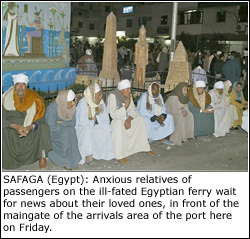 CAIRO, Feb 3: About 300 passengers were rescued after a ferry carrying nearly 1,400 people from Saudi Arabia to Egypt sank in the Red Sea on Thursday night. Rescue teams also pulled 185 bodies from the water.
Plane and boat rescue operations continued as darkness fell, but hopes diminished of finding more people alive.
Twelve of the survivors were brought ashore at the Egyptian port of Safaga, where the 35-year-old ferry was scheduled to arrive at 2am (midnight GMT) on Friday.
“So far, 185 bodies were picked up from the sea and we have around 300 survivors,” said a senior police official. One person close to the operations added: “There aren’t expected to be many survivors, because it’s been so long since the ship went down,” he said.
Most of the passengers were either Egyptians working in Saudi Arabia or Hajis returning to Egypt.
Giving a break-down of the passengers’ nationalities, Egypt’s MENA news agency said on board were 1,158 Egyptians, 99 Saudis, six Syrians, four Palestinians, a Canadian, a Yemeni, an Omani, a Sudanese and one person from the United Arab Emirates. The ship had a crew of close to 100.
The ship was also carrying more than 40 vehicles.
The Panamanian-flagged ship is 118 metres long and 24 metres wide.
The 11,800 gross ton ferry, Al Salam 98, last had contact with shore at 10pm (2000 GMT) on Thursday on its way to Safaga from Duba, northwestern Saudi Arabia.
An official at Al Salam Maritime Transport Company, owner of the Panamanian-registered ferry, said it might take hours to find out what had happened to the ship, which was built in Italy in 1970 and moved to the Egyptian company in 1998.
None of the officials said there was any indication that the sinking was the result of an attack on the ferry.
A search and rescue centre in Scotland picked up a distress signal from the ship at 2358 GMT, a spokeswoman from the British defence ministry said.
SEAWORTHINESS: The Al Salam 98 had received a safety management certificate from an Italian organisation in October, covering safety drills and other on-board procedures.
But almost 24 hours after the tragedy, controversy started to emerge over the 36-year-old vessel’s compliance with safety regulations and Egyptian President Hosni Mubarak demanded an immediate probe into the accident.
“President (Hosni) Mubarak wants an immediate probe into the causes of the accident of the ferry and guarantees that other similar ships comply with safety regulations,” his spokesman Suleiman Awad told public television.
“The speed at which the ship sank and the fact there were not enough life rafts on board confirm that there was a (safety) problem, but we cannot anticipate on the results of the investigation,” he said.
A spokesman for the Italian classification firm RINA, which is in charge of the ship, said his company was ready to cooperate with the investigators, a team of whom was heading to Safaga.
Andrea Odone, from the operations department of the Al Salam Maritime Transport company’s Cairo headquarters, said the ship complied with all safety rules.
“The ship is registered in Panama. It met all the safety requirements, and it fully complies with international safety rules... The number of passengers on board was less than the maximum number,” he said.
According to French-based shipping expert Yvan Perchoc, the Al Salam 98 is one of several old Italian ferries to which extra levels were added in order to boost passenger capacity, sometimes threefold.
“Despite the addition of extra bulges on the sides of these ships, one can wonder about their stability,” he said, adding that the draft of such ships was generally very low.
A ship owned by the same Al Salam company collided with a cargo ship near the entrance of the Suez canal in October, causing a stampede that left two dead and up to 100 wounded.
The London-based Lloyds Casualty Service, citing the Egyptian defence ministry, said the ship was believed to have sunk about half way across the Red Sea, which is some 200kms wide at that point.—Reuters/AFP