0
0

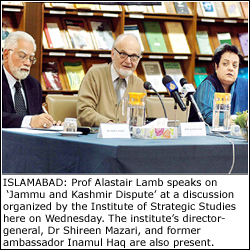 ISLAMABAD, Feb 1: British scholar Alastair Lamb, known for his studies on the Kashmir dispute, endorsed here on Wednesday “the regional approach” that President Gen Pervez Musharraf proposed in October 2004 for resolving the dispute.
“In a way this is the new ball game. This initiative should not be dismissed or ignored,” he said in a “public talk” on Jammu and Kashmir dispute organized by the Institute of Strategic Studies Islamabad (ISSI).
Prof Lamb, who has produced several well-researched books on the Kashmir dispute, said that Jammu and Kashmir had never been a “single entity” and partition of the territory as a solution had been discussed from the very beginning of the dispute.
What impressed the professor about President Musharraf was that for the first time a Pakistani government leader gave “a direction” to resolving the issue. His ideas reflected “detached analysis” of the complexities of the dispute and his approach to the possible solution represented Sir Owen Dixon’s line that proposed plebiscite on regional basis.
A study that Lord Mountbatten had got done on the future of Kashmir just before he affected the partition of British India had suggested partition of the princely state, the professor said.
But when he went to India Office Library where it was kept he found it had disappeared.
From the very start of the conflict in Kashmir, India and Pakistan were agreed that the dispute be resolved through a plebiscite. Two powerful officials, V.P. Menon of India and Chaudhry Mohammad Ali of Pakistan, met on November 8, 1947 and discussed details of holding a plebiscite, he said.
Both sides also agreed to take the issue to the United Nations Security Council jointly but to placate Pandit Nehru Pakistan allowed the privilege to India. But India, betraying joint action, went there as a complainant.
Prof Lamb said the Nehru Papers, published in India, reveal that in a letter to Nehru on November 18, 1948, Pakistani Prime Minister Liaquat Ali Khan proposed plebiscite in the Valley.
Five years later, another Pakistani premier, Mohammad Ali Bogra, repeated the proposal to Nehru when tensions again flared up in Kashmir with dismissal and imprisonment of pro-India Sheikh Abdullah. But Nehru’s response was that it was not the moment to do that.
Asked how India could be brought to “reconciliation”, the British scholar said “the problem is to reconcile the acceptability of a theoretical basis” of a solution.
“There are no obstacles on the part of the UN Security Council (to reach a solution) but only obstacles on the part of both parties,” he said.
“Objections are put about the implementation (of plebiscite) because neither party wanted a solution,” he added.