Inching towards peace
THE foreign secretaries of India and Pakistan who met in New Delhi earlier this week have confirmed that the composite dialogue between the two countries will remain on track. They have also reached agreement on a number of issues that has been recorded in a joint statement. Most of the points agreed upon are not matters of substance in the context of the core dispute over Kashmir but they do have a far-reaching significance for the process of confidence-building that began in January 2004 when the dialogue was initiated. Given the mixed results achieved in New Delhi, the third round is being launched in a mood of circumspection and not euphoria. That the two sides have agreed to continue the dialogue is a positive factor, especially after strains had developed in the relations between the two in the wake of Indian statements on the Balochistan crisis which amounted to downright interference in Pakistan’s internal affairs.
The extremely slow pace of progress on issues that are being discussed has given rise to some disappointment, especially because public expectations have been raised and people are looking forward to closer ties between India and Pakistan. The focus of the talks was on peace and security and two expert groups have been mandated to continue consultations on security concepts and nuclear doctrines with the idea of avoiding conflict, preventing incidents at sea and developing modalities for conducting monthly flag meetings between local commanders. Agreement was also reached on promoting people-to-people contacts by agreeing to launch a bus service between Rawalakot and Poonch and a truck service between Muzaffarabad and Srinagar. All these decisions will be widely welcomed since they will help bring the people of the two countries closer to each other. But there is a strong feeling in the two countries that the two governments have not done enough to facilitate an exchange of visits and interaction between people and professionals. The biggest constraint has been the difficulty in obtaining visas in Islamabad and New Delhi for intending visitors. The consulates which were to be opened in Karachi and Mumbai are still not yet in place and the inauguration of the Munabao-Khokhrapar train service has been delayed. All this detracts from the credibility and good intentions of the two governments to develop close ties between their people.
Another area where progress has been extremely slow is Kashmir. It is encouraging that Kashmir continues to be on the agenda of the dialogue and officials disclosed that they had for the first time discussed the possible redeployment of troops in the disputed territory. But no solution appears to be in sight. Although President Musharraf has suggested demilitarization of the state and self-governance — a significant move away from Pakistan’s earlier stance — the impression one gets is that India has not reciprocated in the same vein. It is important that progress is sustained in order not to slow down or halt the peace process. This way the pressure will continue to be felt to keep the talks going. Any slowing down of the pace could take things back to square one. Moreover, until a firm understanding is reached between India and Pakistan, the possibility of any unfavourable incident derailing the peace talks is very real. One therefore hopes that the two will step up the pace of their dialogue.
Insecurity in Waziristan
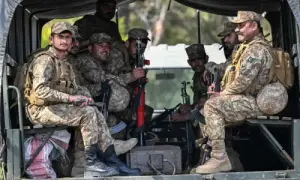
REPORTS from our correspondents that insecurity is forcing people in Waziristan to migrate are highly disturbing. The worst affected areas are Mirali and Miramshah where non-combatants are often caught in exchanges of fire between security forces and foreign militants. The situation in both North and South Waziristan has been grim since the American attack on Afghanistan in Oct 2001, but the current wave of social instability follows an attack by militants on a security checkpost at Eisakhel on the night of Jan 7, killing eight soldiers. The retaliation by the security forces and the ensuing exchange of fire caused civilian casualties, besides damage to property. People are now selling their cattle and moving to nearby areas which are safe, especially Bannu and Karak. Normally, rural people cherish their livestock and do not sell them except in emergencies. But the level of violence there now is so high that people seem desperate to get out even if this means parting with their homes and cattle. The ones to blame for this situation are both the foreign militants — who have no business to be in Pakistan — and our own security forces, which sometimes fail to realize that their operations against foreign terrorists could also hit innocent Pakistani civilians.
On a larger scale, Fata, of which Waziristan is a part, is trapped in America’s war on terror. Being on the border, it often receives hits from the Afghan army or from US or Nato-led forces, as happened in Bajaur agency on Jan 13. This, however, does not absolve the local authorities of their responsibility. Foreigners must be weeded out or taken prisoner, but most certainly, innocent men, women and children should not be made to pay with their lives. Pakistani security agencies must see to it that the operations against terrorist do not upset normal life in Fata, especially Waziristan, and it is only the foreign militants and their local hosts who are disarmed and dealt with. A more pertinent question is as to how long will Fata remain outside the national orbit. It has suffered enormously because of the failure of successive governments to integrate it into the national mainstream.
Far too many holidays
A LOCAL holiday for all government offices and educational institutions has been announced for the coming Monday by the Karachi nazim for the annual urs of a local saint. If all the local, national, religious and seasonal holidays are added up, they will show a staggering amount of time lost. This should be particularly worrying where educational institutions are concerned. Students need a break, but not the prolonged one we seem ready to give. While such an occasion is something to revere and commemorate, it is difficult to understand why give the entire day off for that purpose. Educational institutions in Sindh already had a lengthy winter vacation, which was originally scheduled to run from Dec. 24, 2005, to Jan 1, 2006, but was extended by a week for no sound reason. They reopened on Jan. 9 only to close again for three days.
Then we are far too generous in announcing school holidays every time there is a cricket match. Recently when England played a one-day match in Karachi, the city government announced a holiday for schools and colleges. As if this wasn’t enough, the next day too was declared a holiday since Pakistan had won the match. One cannot understand why the hosting of a cricket match or indeed a win by the home team should call for schools being given a day off. Now that India are playing here, will we again see a rash of holidays in different cities — that i, if we win?
Holidays for schools and colleges in such cases have regrettably become the norm all over the country and serve little purpose except to send students the message that studies should take a back seat over merrymaking. When government offices are also closed, that entails a loss of another kind. The whole question of holidays needs to be seriously reconsidered.
Global challenges, local solutions
WHAT is the future for an economic system that is not an efficient producer of goods and services in the globalized economy? The latest round of WTO negotiations in Hong Kong did not see the materialization of the hopes of developing countries in securing access to the markets of developed countries and the removal of agricultural subsidies, meaning their economies would continue to be adversely affected by global challenges.
The fig leaf of the promise to do away with export subsidies on agriculture by the US and the EU by 2013 does not raise much hope in the developing countries of gaining in terms of the Doha development package.
Pulling down the barriers to entry in the markets of developed countries — especially for agricultural products — is very important for a fair trade system to prevail and to reduce poverty in the developing countries. The issues of market access and removal of agricultural subsidies remain to be pursued through multilateral and bilateral trade negotiations for whatever good results these bring. However, a big part of the solutions to global challenges being faced by countries like Pakistan effectively remains within national boundaries.
Market access is one thing; market share is quite another. While one can gain the former on various economic or non-economic considerations, the latter cannot be given away by any government. Even if all barriers to entry in the markets of richer countries have been pulled down, the winning market share will be determined by the competitiveness of the products that various developing countries including Pakistan can field.
Improving the competitiveness of their products is the responsibility that lies squarely upon the shoulders of the governments and businesses of developing countries and not an any outside forces or institution. It is difficult to win the battle of the market forces and expand the customer base in developed markets even when market access is achieved without having efficient and competitive national production systems in place.
History tells us that those who can produce or/achieve more out of less, can neither be displaced nor stopped from achieving their objectives. Countries and companies have won and lost the battle for prosperity and power depending upon how well they have adjusted to the demands of the commanding technologies of their times. Some have risen to take their position at the high table; others have fallen from grace. There are many who have remained incapable of harnessing competitive forces for so long that they have come to look upon their lowly position as be their destiny and given up their search for excellence.
The Global Competitive Index published every year by the World Economic Forum (WEF) is one measure of who is rising or falling in the globalized economy. Those who do not make to the top 50 in the order of competitiveness of their business and public institutions do not occupy the high table in the world economic and political systems.
Pakistan’s production efficiencies even among developing countries are rated way down at the bottom along with lowly Myanmar and Zimbabwe in the index of competitive producers of goods and services; and much lower for instance than rising Asian economies like Malaysia, China and India. The latest evidence (2005) from reports on competitiveness by WEF continues to place Pakistan among the least competitive countries and finds fault with several underpinnings of its economic system such as: technology absorption, research & development, availability of high quality human resources, FDI and technology transfers, open and competitive nature of the economic system and others.
In the globalized economy whose rules of game are set largely by the developed world, the only way to move out of the losers’ corner is by enhancing the productivity of enterprises through efficient production technologies, labour productivity, professional management and a legal and regulatory environment that protects economic rights, promotes efficiency, penalizes waste and keeps the adjudication of disputes free from political interference. Improvements in these areas of the national economic system are local responsibilities and they that the WTO nor anyone else from outside can do this job for us.
We continue to forget the fact that market access does not necessarily translate into higher market share. No one had closer access to the American market than Mexico and with Nafta protection; it even had bilateral legal preferences agreed among US, Canada and Mexico. And yet, “low-cost but high-quality” goods from faraway China have been able to take big chunk of the market share away from Mexican companies. In fact, several American and other companies that had earlier set up their manufacturing facilities just across the US border in Mexico relocated their factories in China and are still able to beat many local producers.
If China has used globalization to such advantage for itself, and Pakistan and others have not, the answer lies in the comparative efficiency of their national system of production. Once a country’s production system has achieved this competitive edge, the best allies are customers in the developed countries. It is this force of customer preference that lies behind the flooding of the American and other markets by goods manufactured in China that keeps displacing inefficient producers — whether distant or nearby.
For all the pressures exerted by WTO, the best way to fight back for Pakistan lies in improving the productivity of its enterprises. The risks are so high for inefficient systems of production in the globalized economy, that a country might as well forget about producing for its domestic market if its products cannot compete in the global or at least the regional markets, since others can easily invade the domestic market even if a country is not able to export anything. The difference between the foreign and domestic markets is, therefore, eroding with every passing year. Without an efficient system of production in place, the more we produce, the more we lose since national resources will end up being wasted by uncompetitive enterprises.
And yet, the urgency for improved productivity is still individualistic and scattered. One does not see any evidence of the many significant steps from government, banking or industry organizations to induce a culture of efficiency and productivity in the economic system. On the contrary, our economic system encourages inefficiencies and waste and there are no incentives to be productive and competitive.
Our corporate and securities laws are silent on the takeover of inefficient private enterprises. No market for corporate control exists through active and balanced laws on mergers and acquisition of private enterprises, whether profitable or not. The minority shareholders have neither corporate protection nor legal redress against inefficient management. It is easier for inefficient enterprises to get their loans written off than do the hard work at improving production efficiencies. And again, if profits can be made by persuading governments to tinker with fiscal and monetary policies or the tariffs, where is the incentive to improve the competitiveness of products in domestic or foreign markets?
Thus, our governmental as well as corporate systems continue to reward inefficiency and waste. The challenges of globalization cannot be successfully met by any country where higher rewards can be reaped through rentseeking than by improving the efficiency of its production system. The solution to global challenges lies in fundamentally changing the underpinnings of our national production systems.
Creating an efficient economic system is more than a financial or technological issue. This is a cultural challenge for Pakistan as it affects more than the economy. It affects the way we live our lives and how we plan to advance our interests and well-being of society — whether in the public or private sector. As a starter, the country would need to put in place a national productivity council that pulls together various elements of government, industry, banking, research organizations, legal and regulatory environment and creates an incentive-driven system of production in agriculture, industry and the services sectors.
Pakistan’s share in expanding the volume of international trade and its hopes of reducing poverty through this would depend upon its success in finally adopting the culture of productivity in its economic system.
Email: smshah@alum.mit.edu