Only a political solution will work
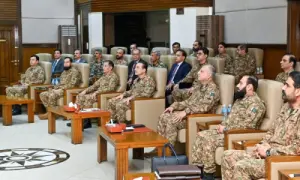
THE president’s briefing on Balochistan to the 94th corps commanders’ conference is of great significance, though it is disturbing too. He has said that the government’s writ will be protected when challenged. This indicates that the situation in Balochistan is serious necessitating the use of force to restore peace and order in an area that has been in turmoil for the better part of 2005. From the president’s statement it would appear that the political option that Islamabad was exploring earlier has now been put on hold. If that is really the case, it comes as a cause for serious concern, as political disputes can be resolved by political means alone. The experience of Bangladesh in 1971 shows how difficult it is to restore the government’s writ when the local population supports leaders who give a call for armed resistance to the federal government. Indeed, the crisis in Baochistan calls for mature handling through a political dialogue. This is important because failure to address the political issues has given rise to turbulence in the province every few years.
In 2004 when Balochistan’s troubles began, the government set up a parliamentary committee under Chaudhry Shujaat Hussain. This constituted two sub-committees and a dialogue was opened with the Baloch. It was hoped that the cause of discontent and frustration in the province would be rooted out once and for all this time. It is a pity that this has not happened because the political approach has not been carried to its logical end. The sub-committee headed by Senator Nisar Memon tackled the issue of provincial autonomy — a demand of other smaller provinces as well. It prepared a list of subjects which were to be removed from the concurrent list in the Constitution so that they would fall in the provincial jurisdiction. But the necessary constitutional amendment has so far not been placed before parliament for reasons unknown.
The other sub-committee which met a number of Baloch leaders presented a report before parliament in November 2005 seeking to address Baloch discontents. The sub-committee’s recommendations are wide-ranging and quite positive but have failed to pacify the province. The economic recommendations that can have a direct impact on the causes of discontent behind the present trouble have not been taken up yet for implementation. If the backwardness of the province for which the federal government as well as the sardars are responsible is not alleviated on an urgent basis, the Baloch leaders will continue to incite the people and exploit the unrest to their own advantage. To pre-empt them, the government must immediately implement the report’s recommendations on Balochistan’s job quota in the federal government and Baloch representation in Gwadar port. Similarly, other recommendations regarding building of highways, providing increased funds to the province and the enhancement of royalty for gas that will benefit the people should be attended to immediately.
In addition to this, the military dimension of the issue needs attention as well. The army operation, the establishment of new cantonments and the visible presence of the military in the province have disturbed the Baloch. The Mushahid Hussain sub-committee took note of these concerns and suggested the withdrawal of some checkposts but had nothing to say about the cantonments or cessation of the military operations. It is these contentious issues that must be taken up on a priority basis if peace is to be restored soon.
Disease in quake areas
THE death of 35 children from pneumonia in the past week in Azad Kashmir is a grim reminder of the worsening weather conditions in the quake-hit zone, especially in high-altitude villages where sub-zero temperatures and heavy snowfall have rendered aerial and ground relief operations difficult. Even before the Oct. 8 quake, the health infrastructure in these remote villages was virtually non-existent. Now, poor temporary shelters and the absence of winterized tents have increased exposure to the elements while access to lower altitudes, where temperatures are more bearable and medical help available, has been blocked by snow and landslides. The one obvious, though partial, solution — lighting fires in tents to keep warm — presents its own hazards as became evident earlier on when a number of people died after their tents caught fire. This scenario had been predicted by relief agencies soon after the quake struck, and could well worsen as more and more people fall prey to a host of cold-related health conditions. The situation is especially precarious for children many of whom have not even received basic vaccinations that could have mitigated the effects of serious diseases, or prevented these altogether.
The challenge before the government and aid agencies is to work round the clock to ensure that the number of deaths resulting from disease and harsh weather conditions is minimized and that prompt medical help reaches those who are most at risk of contracting infections. This means the clearing up of paths leading to mountain villages, so that sick villagers can be brought down to camp hospitals and the air-lifting of relief goods and medicines to the stricken areas can be resumed. While more funds are needed at this point to expedite relief efforts, it is distressing to note that the existing resources are not being put to maximum use. According to a report, there is no one attending to a huge pile of medicines and medical equipment at a hospital in Bagh, while villagers nearby are suffering from the effects of the worst winter of their lives. The authorities should take immediate note of this.
More thefts, please
IT’s good that Ms Nilofer Bakhtiar, adviser to the PM, has been robbed of her cellphone. The theft galvanized almost the entire constabulary of Islamabad: the city’s ASP said the police had examined the scene of crime —- a tailor’s shop —- and started a hunt for the culprit. Such alacrity is singularly missing when ordinary citizens are victims of phone snatchers, and if more ministers and advisers were to be robbed, there could be hope that the full dimension of this particular crime may become clearer to the police. Cellphone thefts have assumed almost epidemic proportions in Karachi; most take place in busy downtown areas. No police officer visits the scene of the crime or questions possible witnesses. There are gangs operating — some, it is said, with the connivance of the police
and dealers. But have any convictions taken place or traces found of those involved?
That’s why if more government functionaries are robbed of their cellphones or their houses rifled or their cars lifted, it may put some life into our police force. For that to happen, ministers will have to live like ordinary people and undertake ordinary tasks without police protection. Their houses should get the same kind of water and electricity that the hoi polloi get, and they should occasionally travel by public transport. The next time they run a fever, they should go to a public hospital and wait for their turn for the doctor to peer down at their tonsils. Then perhaps some of them may realize the daily travails of the people who elect them to power. And just may be we might then be able to get a fairer deal.
Khaddam’s shocking somersault
ABDEL HALEEM KHADDAM, veteran Ba’athist and the late Syrian strongman Hafez Al Assad’s most trusted lieutenant for well over three decades, has apparently rocked the boat for the younger Assad, now ruling Syria, in a no-holds-barred television interview that has shocked and electrified both East and West.
In a 2005 interview from his sanctuary in Paris with the Saudi-owned Al Arabiya television, Khaddam directly faulted President Bashar Al Assad for having threatened former Lebanese prime minister Rafiq Al Hariri. His direct assault on the successor to his late mentor and friend couldn’t have come at a more embarrassing and inopportune moment for the younger Assad. With his own role in the Hariri murder of last February still saddled with a huge question mark in the eyes of the world, Bashar could have done without Khaddam literally pulling the rug from under his feet.
By the same token, Khaddam couldn’t be of greater help to those in the West — the US, in particular — that is gunning for Bashar Al Assad and Syria in order to pronounce them guilty of Hariri’s cold- blooded murder. Khaddam’s verbatim reproduction of the words Bashar allegedly used to warn Hariri of dire consequences if there was any attempt in Lebanon to bring in a new president hostile to Syria must have been music to the ears of the neocons in Washington.
An immediate fallout of Khaddam’s interview was a request by the UN special investigator into the Hariri murder, German attorney Mehlis, for an interview both Bashar and Foreign Minister Farooq Al Shara as part of the ongoing investigation. It will be interesting to see how the Syrians tackle this awkward demand. Up until now Syria has resisted all efforts to allow the involvement of Assad into the inquiry. However, the rules of the game may change — and not in Syria’s favour — now that one of its own prominent stalwarts has virtually implicated Assad in Hariri’s murder.
But a more riveting question is why did Khaddam say what he had to when he and everyone else related to Syria knew so well that his country and its leadership were under intense scrutiny in Washington and New York?
The answer to this prickly question lies in the most endemic and bedevilling factor of Arab political culture: the arcane law of succession, or lack of it, in autocratic regimes. Perhaps no other factor has so consistently dogged and damned the Arab world as the passing of the baton from one strongman to another. Recent Arab history is replete with instances of autocratic rulers using their minions and lieutenants like slave masters for the extension of their rule but conveniently ignoring them otherwise.
Saddam Hussein in Iraq used his cabal of hangers-on and minions ruthlessly but was grooming both his sons, Uday and Qusay, to inherit his mantle. Some of his faithful supporters are still behind him, while others have either quietly faded out or have been a factor in the preparation of the dossier of charges against him. The late King Hussain of Jordan dumped his younger brother and heir-apparent, Prince Hasan, in his dying moments to put his own son on the throne because that was what his western mentors had ordained.
Hosni Mubarak of Egypt is brazenly grooming his 40-year old son, Jamal, to take over from him whenever the aggrandizing autocrat is ready to hang up his boots. Colonel Qadhafi of Libya is, likewise, preparing his eldest son to step into his shoes, whenever they become vacant.
Hafez Al Assad did exactly the same. He had been grooming his elder son, Basel, for years to take over from him but quickly brought Bashar back to Syria from Britain when Basel met with a fatal road accident. For him, the political leadership of Syria was a right belonging to the Assad family. He wasn’t the only one who thought along these lines. All other Arab monarchs and autocrats — there being a conspicuous absence of democrats in the Arab world stretching from the Maghreb to the shores of Oman — have looked upon power as family inheritance, irrespective of how they may have come to power themselves.
But this wasn’t what the founding father and chief ideologue of the Ba’athists, Michael Aflak, had preached when he inspired a whole generation of Arabs — intellectuals and soldiers-of-fortune alike — to broaden the base of Gamal Nasser’s pan-Arabism by weaving into its matrix the strands of socialist international. Aflak was a Syrian, like Khaddam and Assad, and believed that Arab political emancipation and enlightenment needed the empowerment of the Arab masses with a socialist creed at its grass roots.
Aflak was banished to Iraq by Assad once he had dug his feet into Syria on the slogan of Arab people’s power, or Baathism. But a committed Ba’athist like Khaddam subscribed to the enlargement of the popular political base for the sake of its resilience. He served Assad faithfully and was seen, in the Arab world and abroad, as Assad’s heir apparent, until Assad opted for power to reside in his own family.
It isn’t unthinkable that Khaddam may have carried a chip on his shoulder against Bashar since being passed
over to succeed Hafez Al Assad. But he obviously lay low
for years, until this moment, when he found a most opportune hour to strike at Bashar’s weakest moment.
There is no doubt that the noose around the Syrian leader’s neck has been tightening ever since Hariri was murdered. The spark lit at that moment has seen the Syrian troops, till then comfortably entrenched in Lebanon, pull out in an ignominious retreat. Bashar’s position was further compromised when the Mehlis inquiry found his regime not cooperating fully. Bashar took another serious hit when his chief of security in Lebanon took his own life, in dubious circumstances, following the publication of the Mehlis report.
Nothing, however, could have prepared Bashar for what most loyal Syrian Ba’athists see as a calculated stab in the back by Khaddam. In sheer pique, the puppet Syrian National Assembly has promptly passed a resolution charging Khaddam with “high treason” and calling for his trial. An emotional outburst of this kind is not anything strange in the Arab context.
But Khaddam’s affront to Bashar is also a tribute to the success of the relentless psychological pressure mounted against Syria by the US and its votaries in Israel and Europe. Khaddam has no doubt chosen his moment of comeuppance with meticulous care; he is sending a clear message to those in the West looking for an alternative to Bashar. The message from Khaddam’s Paris sanctuary is that he is available to take over should Bashar be toppled or forced out of Syria.
The Americans have been eminently successful in finding and patronizing the likes of Alawis and Chalabis in Iraq, despite decades of Saddam. They can covet similar success in Syria in spite of the long — and to many dark and dismal — decades of the Assad brand of autocratic rule. Khaddam could just be a reformed Baathist, in the mould of Iyad Alawi, to do the American bidding in Syria.
There is no gainsaying that the neocon Bush regime, facing a popular backlash because of appalling reverses in Iraq, is desperately seeking to stage something spectacular to shore up its dwindling fortunes. Syria and Iran have long been cited as targets in of the Bush administration.
Of the two potential targets, Iran has undoubtedly a higher priority and yield than Syria. But a high-priority target necessitates greater preparedness and planning. Syria, a notch lower in the pecking order, has always been a target of quicker pickings. And it wouldn’t be such a bad bargain, especially to the Zionist fringe of neo-cons whose top priority is to consolidate Israeli interests in the vicinity.
A quick and relatively cost-effective regime-change in Damascus would a feather in the Bush cap to boost the Republican Party’s sinking fortunes, in time for the mid-term elections now only months away.
Khaddam, a perceived adversary in layman imagination but an asset to the wizards planning the next move on the Middle East chessboard, may have unwittingly (or mischievously) presented Bush with a trophy that no known friend of US could. Bashar Al Assad in the dock should be as welcome a gift to the White House as Saddam Hussain on trial in Baghdad.
The writer is a former ambassador.