0
0

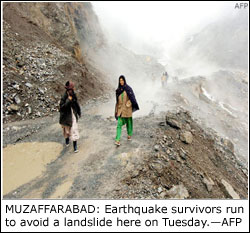 ISLAMABAD, Jan 3: Severe cold weather is likely to intensify in earthquake-hit areas in Azad Kashmir in the next 24 hours as landslides and deep snow cover hindered relief operations in many high-altitude areas for the third consecutive day on Tuesday.
“A intense cold wave is likely to envelop the AJK in the next 24 hours. This wave has already consolidated its grip over the western parts of the country, including the NWFP and Balochistan,” said a spokesperson of the Pakistan Meteorological Department here on Tuesday.
This cold wave is likely to last another week, he said.
Rains and snowfall continued intermittently for the past three days in areas affected by the earthquake.
The temperature at night is already below freezing point in the earthquake-hit zone and is likely to drop further in the next 24 hours. Freezing weather is posing a greater challenge for the earthquake survivors, who are still living in non-winterised tents in high-altitude areas.
The Met office has forecast temperatures between minus three and minus 13 degree Celsius on Tuesday night in areas located above 5,000 feet.
Diseases, particularly pneumonia, have broken out in hilly areas and in cities of Bagh, Muzaffarabad, Mansehra and Balakot.
An official of a UN agency told Dawn that landslides and snow cover on high altitudes near Bagh and Muzaffarabad is hindering people from bringing down their patients to hospitals. He feared that pneumonia would cause more fatalities in children this week as majority of children remained vulnerable in tents, adding their parents were unable to bring them down to the city camp hospitals for treatment.
He said most of the residents in high-altitude areas had recently received corrugated metal sheets and were in the process of building temporary winterised shelters when the snowfall hit. He said the fatalities among children and women could rise because majority of these well-populated villages on mountains were without medicines, doctors and basic health unites.
APP adds: Quetta is still in grip of severe cold as the minimum temperature dropped to 13 degrees below freezing point, causing water pipelines to burst in most parts of the city. The maximum temperature was recorded at three degree Celsius.
Local Met office said the chilly weather is likely to persist during the next 24 hours with a little improvement in minimum temperatures. The maximum temperature is likely to remain between 3 to 5 degree Celsius and the minimum between minus 12 and minus 10 degrees Celsius.