Judicious use of funds
THE international donors’ conference in Islamabad last week was a huge success. It certainly produced far more funds than last month’s conference convened in Geneva by the UN when the full dimension of the tragedy was not well known and the widespread pain it had caused had not sunk into the conscience of the world’s rich nations. There was also the problem of donor fatigue with nations contributing $10 billion for the victims of the Asian tsunami and additional funds for Hurricane Katrina in the US and for other tragedies.
On the basis of World Bank and Asian Development Bank estimates, losses for both immediate relief and rehabilitation and reconstruction were calculated at $5.2 billion. What was pledged last Saturday was $5.827 billion. Canada, Australia , Ireland, and some other countries have yet to make their pledges. The total, says Prime Minister Shaukat Aziz, will exceed six billion dollars. Prior to the conference only $210 million had been received out of over $2.5 billion pledged — $10 million from bilateral donors and $200 million in soft loans from the World Bank.
Out of $5.827 billion pledged, $1.9 billion is in grants and $3.927 billion in soft loans with interest below one per cent. The loans are spread over 40 years with a 10-year grace period. Seventy-five countries and international organizations attended the conference in the presence of the UN Secretary-General Kofi Annan who had been making fervent appeals for generous donations after his visit to the quake-devastated areas. A great deal of legwork had been done by President Musharraf before the conference to persuade foreign governments to attend it and make large donations.
He rang up President George Bush, King Abdullah of Saudi Arabia and President Chirac of France among the world leaders. All that made Shaukat Aziz say the results were beyond expectations. In addition to the funds pledged, the IMF has offered $375 million in emergency funds without conditions. The government has not yet decided to accept it.
The feasibility study of the reconstruction project is to be prepared before it is put into operation, says the president. He is keen that the infrastructure of the region should be completely rebuilt including the Karakoram Highway which was built by the Chinese and Pakistanis. The Chinese have offered to rebuild it as a part of their contribution.
An issue now is how much of a success will the sponsorship or adoption scheme proposed by the government be. Overseas Pakistanis, foreign citizens, institutions and governments can adopt a village or two, a school, a college or a university, a hospital, or a clinic. How many of them will come forward to run such institutions? The president wants rich businessmen and the chamber of commerce to do likewise. He has also invited major cities like Karachi and Lahore to adopt whatever they think fit.
President Musharraf says that 400,000 houses would be needed to accommodate three million survivors but the final figures of the cost will be known only when the report of the feasibility study is available and is properly scrutinized.
Will the entire sum of $5.827 billion be delivered to Pakistan? Usually in such cases there can be large gaps between what is pledged and what is actually delivered. However, the World Bank has pledged one billion dollars in soft loans and the Asian Development Bank another one billion dollars. The Islamic Development Bank has pledged $500 million. These institutions are sure to deliver on their pledges as are countries like Saudi Arabia ($573 million), China ($326 million) and the United States ($510 million).
In fact, what is pledged may increase. Two leading members of the US Congress are moving a resolution in the Congress to raise the US donation from $510 million to one billion dollars. Since they represent both the Republican and the Democratic parties the resolution is likely to be passed, more so when President Bush is for offering maximum aid to Pakistan.
The final fatality figure has been established at 73,000 with the injured numbering far more. Those rendered homeless are more than three million. There are thousands of children without parents or other supporters, and thousands of old people with no one to take care of them. The children in particular have to be protected from professional kidnappers on the rampage.
India has provided $25 million in relief goods including a large number of tents and medicines but the real donation which President Musharraf expects from India is an agreement on the Kashmir issue. Prime Minister Shaukat Aziz wants the five crossing points on the Line of Control in Kashmir to operate not once a week but daily. He also wants trade between the two Kashmirs and manufacturers on both sides to pass through the five crossing points.
Mr Kofi Annan who made strenuous efforts for the success of the conference came up with his own set of priorities. The first was rehabilitation of the victims; second, the construction of temporary houses; and finally, the overall reconstruction of the region. These priorities are not different from that of the Pakistan government or other parties. Achieving these depends on the final cost of relief and reconstruction after proper feasibility studies have been made and the actual aid money has become available.
The question which often arises is will the high economic growth rate be affected? The World Bank and ADB as well as the IMF agree the impact of the quake on economic growth will be small. The growth may be 6.4 per cent to 6.6 per cent. But inflation which is nearly nine per cent may be higher.
But the employment avenues will expand as the reconstruction programme gets underway. The cement industry is expanding, anticipating larger consumption of cement for reconstruction purposes. Other industries which make varied inputs to the building industry and infrastructure will also employ far more workers and far more construction workers will be employed by the rebuilding industry.
President Musharraf has declared that there will be total transparency in the use of funds for reconstruction. As requested by the donors the auditor general of Pakistan is to audit the accounts along with Ford Rhodes. If the donors want any other audit organization to probe the accounts that is to be welcomed.
In the past it was suggested that to prevent misuse or embezzlement of public funds there should be a pre-audit so that the funds go where they should go instead of fishing for lost funds after the money has gone. This may be a fit case for pre-audit. We are told in view of the requisite funds pledged that there will be no new taxes, no increase in budget deficit and no reallocation of development funds from defence to any other high priority area. However, the purchase of F-16 aircraft from the US has been put off for the moment. And there is nothing conclusive on the SAAB radar system from Sweden.
The prime minister has repeated his appeal to the opposition to join in the work of overseeing relief and reconstruction. The opposition is reluctant and has come up with various conditions including that political leaders outside the country should be allowed to return home first.
If the government had been slow to act earlier and had committed mistakes in its approach to the relief work, that does not mean the opposition should let the government commit more mistakes during the next few years of reconstruction work, particularly when it will have a fund of $5.827 billion. It is better for the opposition leaders to assert themselves to make the government do the right thing and in good time in this very complex area.
The reconstruction process may take three to five years. The earlier estimate of five to 10 years was rejected by the government as it did not want to wait that long. In the meanwhile, the government should take care that there are no scandals relating to the misuse of funds as this could impair the flow of foreign funds.
As the reconstruction can last up to five years for completion some governments may delay delivering the pledged aid. If in the meanwhile reports of misuse or waste of aid funds appear they may wriggle out of their financial commitment. Anyway, after half a century of receiving foreign aid we should have learnt to make more productive use of the funds instead of getting more indebted.
Meanwhile, the prime minister announced on Monday the formation of a parliamentary committee of 17 members, with nine from the ruling coalition and eight from the opposition with himself as the chairman. He convened the first meeting of the committee on Thursday.
The government has also raised the compensation for survivors of the quake from a total of Rs 20 billion to Rs 80 billion and increased the compensation for each devastated household to Rs 175,000 following Saturday’s conference.
Lessons from disasters
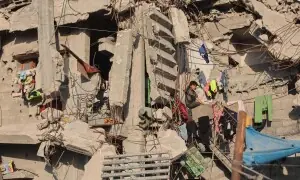
THE kind of destruction and devastation the Oct 8 earthquake has brought is unprecedented. In their time, the 1992 floods and the destruction that they wrought, were also unprecedented. Then village after village was washed away, some 14,000 people died and estimates of people affected and left homeless ranged from six to eight million.
At that time too there was a massive response from the general public just as there has been for the earthquake victims now, and international agencies also came in with money and experience. The government of the time announced reconstruction and rehabilitation programmes, but despite all this it was the local communities who successfully rebuilt their villages and livelihoods.
Heading towards Balakot, the destruction is of the same nature as it was downstream Mangla dam. Is there anything that we can learn from that devastating time in 1992?
After the immediate emergency response, I visited a number of flood-affected communities, still surviving along the west and east banks of the river Jhelum. Many promises made by the government had not been fulfilled, but people were still determined to restart their lives even with meagre resources. As the media turned its attention away from the floods, and governments were no longer held to their promises, we felt that this was the time for civil society to build on the strength of local people, and support them in reconstruction. Unfortunately, the same scenario is likely to be played out now.
There were two villages which I still remember with feeling. Bhart, in tehsil Shahpur, district Sargodha was completely destroyed. Only 20 families were living in makeshift camps on the remains, the rest had left, and perhaps gone to friends and relatives to survive. I had initial discussions with these remaining 20 families, to see if they would resettle in a nearby location, as the river had eaten up their village. None of them wanted to leave their village and relocate, they wanted to rebuild, but had no resources.
It became very important for us to see if other village members would also return if the village were reconstructed, so we asked for a village meeting including as many displaced people as we could find. The meeting was held, and everyone at the meeting said that they wanted to come back.
After establishing that this was the desire of these people, to come back together as a community, the next important phase was to involve them in designing the housing units. It was important not to make the mistakes of former Prime Minister Muhammad Khan Junejo’s housing scheme for widows, which remained empty even eight years after it was built.
Both women and men were involved in the housing design, and then they formed purchase and quality control committees.
A combination of village and expert labour completed the rebuilding of 94 housing units in 10 months, without any hiccups. Twelve years later, the village has more than 200 families, with schools, roads, a community centre, and electricity. The biggest achievement of the project was not just the rebuilding of the community but making a contribution to more equitable gender relations, as every home was made the joint property of husband and wife, with legal rights for both.
Megha was a village consisting of 250 households, situated on the river Jhelum, and was also washed away. Unlike Bhart, nobody had left the area. In the first village meeting, attended by men and women, people told us that they did not want houses. Their demand was that we build an embankment around the village.
Nawaz Sharif, the then prime minister, had visited the village soon after the floods, and promised to fulfil this request. Six months later, nothing had been done. As the community were so clear about what they wanted, we agreed to carry out the work. The irrigation department had prepared a design for the embankment and its estimate was 5.5 million rupees. We improvised on their design, the community was mobilized with each household agreeing to provide one person to work as a labourer. Water pumps and hoses were provided and children during summer vacations were involved in spraying the earth with water for compaction. A project implementation committee, consisting of male and female community activists was formed to keep a record of all the earthworks. The earthwork was completed in eight weeks, and the original design was improved by local people with a retaining wall and stone pitching over a further six weeks. The total cost of the project was Rs 600,000, a fraction of the original cost.
Since then, the Jhelum river has seen two major floods and both villages, despite being only a few hundred metres from the river bank, have survived, with good design and quality of work protecting homes and keeping the embankment strong. It is notable that the government school built a few years later was destroyed by the next flood, while the other houses are still standing.
We are now face a similar situation.
The houses built by Pattan and financed by Concern International (an Irish NGO) in these villages, were of a flood resistant design, and in the current situation to make houses earthquake resistance has become important. The lessons are that the community and the experts should sit together, and no “external” design solution should be “imposed”. Vitally, the community should be fully involved in the reconstruction of their homes and villages, from design to implementation, and it is their involvement which will ensure the “community rehabilitation” which Musharraf has referred to in his address to the nation. Finally, community involvement will ensure low cost and high quality of reconstruction at a time when resources are low. If the reconstruction is carried out in the same way as the Junejo scheme, the homes will remain empty, and the money will be wasted. We have been down this road before.
Intelligence for dummies
 THE battle for the hearts and minds of the intelligent people who live in Washington continues. The president is accused of using faulty intelligence to get us into a war.
He, on the other hand, insists his detractors had the same bad intelligence he had, and now they are using it to do damage to the Americans fighting over there. This much we know: There is good intelligence and bad intelligence, and if you act on either, you wind up using military force to solve the problem. Let us discuss how we might get into this state. A rug dealer in Yemen reveals to a cafe owner, who is really a CIA agent, that he saw a camel caravan carrying biological weapons towards Syria.
The agent reports this raw information to the CIA station chief in Cairo. It is then sent to other stations throughout the Middle East, asking them to report any unusual camel traffic in their area. An eyes-only message in code is sent to Langley, Va., where it lands on the desk of an analyst on the second floor. His/her job is to decide whether the information is true or false. To do this, he/she orders up satellite pictures of all camel tracks in the area. The analyst’s report is then sent to the third floor to see if it agrees with what experts on the fourth floor already know. But there are 16 different intelligence agencies in Defence, State, NSA, FBI, etc., who have their own people sifting through the dispatches sent from Yemen. So the information goes to the CIA liaison officers on the sixth floor. There in a soundproof room, the ACTCOM, 12 men and one woman meet to decide what to do and to whom the information should be shown. This discussion can go on for days. One group is for showing it to Bush, but not to the secretary of state. Another insists Condoleezza Rice should know, but Secretary Rumsfeld should be kept in the dark. A third group wants to have more information on the Arab rug dealer before recommending that the US invade Yemen. Now here is where intelligence gets complicated.
The neocons (hawks) have been looking for an excuse to teach Yemen a lesson, so they decide to leak the camel story to the Washington Post. Congress, which has not been clued in, is furious and asks the Justice Department to find out who leaked the story and threatens to send the Post reporter to jail if he won’t reveal his source. To this day the camel caravan is moving across the desert, and as far as the vice president is concerned, it is still carrying biological weapons. — Dawn-Tribune Media Services
Europe’s problem of integration
THE recent riots that gripped France for three weeks have highlighted the problems of the European model of integration with regard to immigrant populations. As against the multicultural model of integration followed by the US and Canada, much of Europe has largely followed a national culture model. Although there are many welfare and other benefits for the weak and disadvantaged, the social and economic separation and the exclusion of large segments of the citizens have brought this model of integration under severe strain.
Recognizing that the rioting was fuelled by high unemployment — four times the national rate of France — in these immigrant communities and social prejudices, French Prime Minster M. de Villepin has acknowledged that the rioting was “questioning the effectiveness of our integration model”.
The unrest spread by young French citizens of Arab and African origin has also underlined the weaknesses in the leadership of the immigrant communities. Instead of highlighting their problems by organizing peaceful protests, like those organized by Martin Luther King during the civil rights movement in the US, they have resorted to senseless arson and violence weakening their own cause and alienating many of their sympathizers. The leadership weaknesses of these immigrant communities stem from their countries of origin where organizing people for peaceful marches, for however a legitimate cause, is considered a serious offence. Thus France witnessed mobs which although they had many genuine grievances had no real leadership to channel their energies into a peaceful mode of protest and thus send out a far more powerful message of their discrimination and denial of civil rights.
The fathers and grandfathers of many of those who indulged in arson and rioting were encouraged to immigrate and do hard work for the industrial and economic recovery of post-war Europe during the ‘50s and the ‘60s. But their offspring have not been integrated into French society and have remained “eternal immigrants” in their new country even after two or three generations. Ironically, French Interior Minister Nicolas Sarkozy, whose intemperate language has only added fuel to the burning fires, is himself a second-generation immigrant which also goes to show what a world of difference successful policies of integration can achieve.
The immigration of Asians, Africans and Latin Americans to Europe and North America is a relatively new phenomenon which started after the Second World War. During the 18th, 19th and up to the first half of the 20th century, apart from the indentured Chinese and Indian labour taken by European companies to other parts of the world, cross-continental migrations largely comprised Europeans who also went on to populate the US, Canada, Australia and parts of South America. With the end of colonialism and the requirements of running the industry and the economy in many developed economies, large inflows of immigrant workers were encouraged. The migrations have also been triggered by political, racial and religious persecutions as also by wars and conflicts in the developing countries.
Between 1990 and 2000, the annual flow of all migrants from the less developed to the more developed regions of the world has averaged around 2.5 million people — both legal and illegal. These immigrants are making huge contributions to the economies of the poorer countries of their origin as over $150 billion are sent back every year by them to their countries of origin — much more than by the host countries as official development assistance.
But even more important are those immigrants who are returning to their countries of origin not only with their funds but also with the education, skills and other resources they have acquired abroad to set up businesses and create more wealth and value at home. Pakistan now receives a little over $4 billion a year out of this flow of immigrant funds which helps improve its balance of payment position, but this is still way below the potential.
One important thing that has emerged in the case of France is that despite some attempts by extremist fringes, the rioting has been widely seen and acknowledged for what it is: a result of a string of miseries stemming from faulty social and economic policies.
After the civil rights movement of the 1960s, the American — and Canadian — model of ‘multiculturalism’ has been more successful in integrating immigrants into the mainstream. Requiring the immigrants to pass a language, history and governance structure test a system has been put in place for positive integration of visible minorities. In the US, apart from affirmative action programmes in education and employment, special arrangements exist that set aside certain federal government-funded businesses and contracts for visible minorities and small businesses.
Many state and local governments have their own provisions some of which require as much as 35 per cent of publicly funded businesses and contracts to be awarded to qualified minority businesses to help them improve their economic well-being and integrate into the commercial mainstream of the country.
Consequently, the US has emerged as the country that has most successfully harnessed immigrants as an integral force of its powerful and competitive economic machine all the way from the so-called ‘4-D’ jobs — domestic, difficult, dull or dangerous — to the highly skilled and professional jobs and top management positions in business and industry.
In France, too, already some reform measures have been set in motion and many more are bound to follow to create a new and more inclusive model of integration. France’s long cherished traditions of liberty, equality and fraternity as also of Europe’s deep-seated respect for human and civil rights for all would no doubt work to produce socially and economically more inclusive models of integration.
Continuing tensions between economic and social models have driven many countries to disasters reaping nothing better than a continuing harvest of social unrest, poverty and declining respect in the international community. The fact is that in a competitive and globalized world where interdependence is the order of the day, a self-contained economy and a mono-cultural state have both been turned into an anachronism and do not have much of a future. Models of exclusivity have become obsolete.
Therefore, multiculturalism and inclusiveness is not just a successful model for integration in western countries. Respect for human rights and fairness in the social and economic integration of people are equally valid for peace and prosperity in developing countries like ours.
In Pakistan, the way the poor handling by the Sindh government of the issue of teaching both Urdu and Sindhi languages from class X to X11 and the manner in which the matter was hijacked by some fringe elements of chauvinism show even a greater need for inclusiveness.
Sindh is home to many communities whose energies and skills have enriched the province in varied ways. Its multicultural diversity is best harmonized through its bilingual character which was enshrined over 30 years ago in law, and the best way forward is to keep faithfully implementing this inclusive model in education.
Many among those who did not belong to the coalition partners wanted the provincial government to succeed in integrating the people of the unfortunate province and build synergies between them to tackle its immense problems of poverty, unemployment and its declining share in the country’s industrial and agricultural output. The lessons learnt from abroad are no less valid for our moving forward in an inclusive and mutually beneficial way.
Email: smshah@alum.mit.edu
Risking peace
ARIEL Sharon is a gambler. Whether leading troops in battle against Arab nations more than 30 years ago as an Israeli army commander or overseeing the withdrawal of Israeli settlers from the Gaza Strip this summer as prime minister of Israel, he has always been a daring tactician. The danger of his latest manoeuvre, his dramatic decision on Monday to bolt the Likud Party, is that it will immobilize the Mideast peace process just when it was showing some small signs of progress.
Sharon’s decision, which capped two weeks of upheaval in Israeli politics, will force new elections, probably in March. Palestinian parliamentary elections scheduled for January already threaten the peace process, as politicians worry more about getting elected than agreeing with their foes.
Sharon is betting that his formation of a new party, more centrist than the conservative Likud he co-founded three decades ago, will keep him in power with a public that largely supported the Gaza pullout. Sharon is 77. Two weeks ago, 82-year-old Shimon Peres was ousted as leader of the Labour Party in favour of a politician who wanted Labour to secede from Sharon’s coalition government.
Between Peres’ defeat and Sharon’s decision came last week’s hands-on diplomacy by Secretary of State Condoleezza Rice to achieve concrete progress in the Israeli-Palestinian relationship. Rice extended her stay in Israel to work through the night on an agreement that gives the Palestinians control of the border between Gaza and Egypt.
— The Los Angeles Times
| © DAWN Group of Newspapers, 2005 |