



 0
0

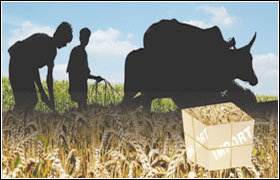 A calamity of unprecedented destructive proportions hit vast areas of Azad Kashmir and North Western Frontier Province on the morning of October 8. One can only bow one’s head in acceptance; Nature is all powerful and the man helpless against it. But man made disasters?
They can certainly be contained. Not in Pakistan though. They are often unleashed callously, mercilessly in our country. The increase in the price of wheat is an example. Its impact on Pakistan’s agriculture promises to be terrible, indeed disastrous.
The earthquake visited Pakistan on the morning of October 8; sometime during the day on October 13, the Economic Coordination Committee (ECC) decided to increase the support price for wheat by the princely amount of Rs15 per bag of 40kg. The decision, it was officially announced, was taken on the recommendation of the federal Ministry of Food, Agriculture and Livestock (Minfal).
I am not certain if the ministry was at fault. A summary sent by it earlier was sent back by the ECC for revision; it may have proposed a better deal for farmers and for Pakistan’s agriculture. What the first summary contained is not known; the outcome of the second proposal is a four per cent increase in the price of wheat in a period of time when inflation is over eight per cent and prices of fuel have been on fire.
It was also announced that the increase in the price would ‘encourage farmers’ to enhance the output of the crop that should soon reach the cultivation stage in Punjab and the NWFP; sowing has already commenced in Sindh which is about one month ahead of the other two wheat growing provinces in its agricultural cycle.
Farmers were expecting an upward revision of the support price and must have tilled fields for the wheat crop in the hope that their sweat and toil would be rewarded. One wonders how many farmers of Sindh would have considered shifting to some alternate crop if they had known what the new support price was to be.
The impact of the state’s generosity on the agriculturists of Punjab and the NWFP should be on view in the next few days. They are expected to cultivate wheat as they had done in previous years but they cannot be pleased by the new price that is a bitter raw deal.
A target of 22 million tons has been fixed for the wheat crop. In addition to the generous support price enhancement, acreage under the crop is planned to be extended for producing this quantity. The price was increased by Rs50 last year.
The government has been regularly revising the amount per bag of 40kg upwards since it took over the administration in 1999 and has continuously emphasized the importance of making Pakistan’s agriculture more productive. Farmers consequently expected a decent revision. But state sector experts obviously knew better and felt that the wheat cultivating community would go delirious with joy with an additional Rs15.
Another measure to be undertaken for ensuring target fulfilment is a Rs50 million ‘grow more food’ publicity plan to be launched by Minfal; urea is also to be imported to facilitate farmers for producing the amount of wheat needed for feeding the nation. Nothing has been said about import of wheat that has become a regular feature of Pakistan’s agriculture sector that is rightly regarded as the backbone of the national economy.
Wheat would, in all likelihood will be imported to meet domestic consumption requirements. The government cannot leave its citizens with empty stomachs. Moreover, there is no restriction on imports any more. So many items are already being imported regardless of whether there is shortage of the concerned commodity or not. One presumes the government cannot escape the pressure of influence wielding segments in its decision making. Shortage of wheat would strengthen their case for imports in the name of welfare of the masses.
A question arises here whether the decision to increase support price by less than four per cent was taken in naivety or with full realization of the production cost of the farmers. One does not know whether agriculture minister and the ECC members were briefed on this aspect of the crop or not but officials of the ministry did work out exactly how much one kg costs a farmer. This is done as a matter of routine and current year has been no different in this regard as 40kg costs the farmer Rs450, according to experts of Minfal.
The government thus consciously decided to allow farmers to earn Rs415 from an investment of Rs450. This is a most remarkable deal. Comprehending its purpose defies common sense. The only explanation that comes to mind is that perhaps the authorities dislike the idea of Pakistan producing enough wheat for meeting its requirements.
A major, indeed the pivotal role is to be played by the Punjab province to make the main contribution towards the targeted quantity. It is not that other provinces do not count but Punjab is mentioned specifically because of the target it is assigned. The share of province has been placed at 17.6 million tons in the Rabi season. This is not unachievable. But can it be achieved?
A committee on agriculture in Punjab comprising officials, private sector representatives and farmers had carried out an exercise on costing wheat production. It put the cost at a little above Rs400 in a meeting held over three months back. A member reminded that the price of diesel had been raised thrice since then which would automatically up the cost and put it around Rs450 per 40kg, if not more. Thus both federal and Punjab administrations of the sector are aware that the new support price is not fair, let alone profitable to the grower. The government has nevertheless fixed a grossly unrealistic rate.
At a time when the local farmer would receive the official price of Rs415, imports would be costing between Rs550 to Rs600. The government’s generosity towards farmers of far and away lands can only be lauded. One does not know what the price of wheat would be in the international market if and when imports, which are now allowed to all and sundry, are undertaken. They could well be higher if the previous pattern is kept in view. They tend to rise when Pakistan’s crop is low and decline when the crop is high.
The policy is bewildering and leaves one wondering what the government wishes to achieve. The only conclusion to be drawn from available facts is that people at the highest level in the country are neither concerned about how the farmers, small farmers, that is, survive or perish and neither is it worried about the crop meeting domestic needs. This is a strange situation, undeniably detrimental to the agriculture sector and a prescription for a low crop.





























