Emerging political map
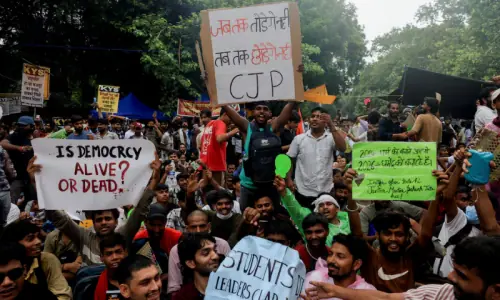
THE local polls have been completed, with only the naib nazims left to be elected. The outcome was hardly ever in doubt and the pattern had been set with the very first stage. The PML and its allies have swept district, tehsil and town naib nazim seats in all the provinces. There was little room for ballot tampering in this the last phase, but there were many allegations of pressure on councillors prior to polling. In Punjab, a whole group of councillors was kept in Murree, apparently to prevent them from being influenced by opposition or independent candidates. There were also charges of councillors being ‘abducted’ in other parts of the country, with a letter published in our correspondence columns yesterday pointing out one instance in Karachi. It is a measure of our lack of political maturity, or an indication of the feudal attitudes that now permeate every level of society, that we cannot tolerate anything short of a ‘convincing’ victory. Each win should be by a big margin. This leads to reliance on unfair means and the use of state machinery that mar the credibility of each electoral process.
The local body process was no exception to the rule, right from the engineering of new districts to blatant expressions of support for the official candidates by the federal and provincial governments. The political map of the country has been firmly outlined, with the Musharraf government now in control nationally and down to the most local of local levels. What this portends for the scheduled general elections in 2007 is for the opposition political parties particularly to consider. It is tempting to read in the local election results a decline in popular support for the MMA, but in the Frontier this had more to do with the split between the JUI-F and the Jamaat-i-Islami than a return of voters to the ANP and other parties. Moreover, since the government is in no mood to concede any significant ground to the PPP and the PML-N, the MMA might yet be kept by it as a reserve in times of need. In urban Sindh, individuals and groups in power in district and city governments were in office largely by default since the MQM had abstained from taking part in the last elections. The situation is different this time, and the MQM will be on test to prove that it can do better than the previous set-ups. This will be especially so in the case of Karachi, whose civic woes are unending and which needs fundamental improvements in its basic infrastructure than just beautification and mega projects. For any significant headway, the MQM will have to work in close cooperation with all sections of the people irrespective of party affiliations. In the local body context, it is important for provincial governments to ensure that the new nazims do not unduly reward areas where support for them was strong nor punish localities that backed other groups.
It gives no one any pleasure to be seen as picking faults with everything, but the tendency to float ‘sarkari’ parties, convert natural majorities into minorities and consider dissent and opposition as a cardinal sin has distorted the entire political structure of the country and led to unrepresentative governance. It is nothing short of tragic that we should have gone through a massive electoral undertaking at the ground level and yet be unable to feel the enthusiasm that it should have evoked in a normally functioning democratic polity.
Terrorism strikes again
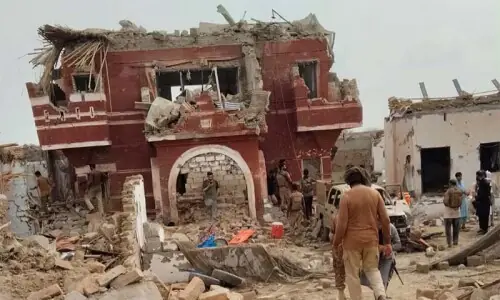
ONCE again a place of worship has been attacked in Pakistan, it being of no consequence what religion or sect the dead and wounded belonged to. The dastardly act occurred at Mong near Mandi Bahauddin yesterday at a mosque where firing by unknown gunmen left eight people dead and 14 injured. A diabolical feature of terrorism in Pakistan is that it focuses on places of worship. None of the major terrorist attacks in the world — 9/11, Bali, Madrid, Istanbul, 7/7 and Sharm al Shaikh — chose places of worship as their targets. It is only in Pakistan — besides isolated cases in Iraq — where terrorists have chosen to slaughter innocent worshippers. No one has claimed responsibility for the attack, but it is obvious that one of the many banned organizations must be behind the dastardly act. This brings us face to face with the reality that the mere outlawing of militant organizations has not served to check terrorism. The parties that have been outlawed include Sipah-i-Sahaba, Lashkar-i-Jhangvi, Lashkar-i-Taiba, Jaish-i-Muhammad, Tehrik-i-Jafria, Sipah-i-Muhammad and some others, but for all practical purposes they are very much alive and kicking, often with new names. The banning has driven them underground, but they continue to operate, as is evident from the events in Karachi last May and in May 2004. They have well-trained and motivated cadres at their disposal, and their sources of funding and arms supply evidently remain intact.
Over the years, the intelligence agencies have netted some big fish in the terrorism underworld. The recent arrests include Abdul Latif Hakimi, the Taliban spokesman, and Asif Chhotu, who belongs to the Lashkar-i-Jhangvi and has a head money on him. However, crimes of the kind that took place in Mong yesterday point out the deficiencies in the working of the intelligence agencies. We have quite a few of them on the military and civilian sides, but the continued acts of terrorism emphasize the need for the security agencies to be more efficient and alert. These banned organizations cannot operate unless they are sustained by clandestine sources. The intelligence agencies’ failure to unearth the brains behind the militant outfits is a major cause of terrorism in Pakistan.
Protecting the real culprits
AMERICA’S sliding reputation as the upholder of democracy and human rights across the world took another nosedive the other day when a television channel broadcast remarks by an ex-soldier implicating army high-ups in prisoner abuse at the notorious Abu Ghraib jail in Iraq. Lynndie England, commonly described as the public face of the Abu Ghraib scandal after pictures showing her humiliating prisoners were released in 2004, was convicted and sentenced last week to three years in prison on six counts of prisoner abuse. Her charge, corroborated by others, is not expected to draw the attention of the US military high command that had earlier cleared its top brass of any wrongdoing. But the Bush administration’s insistence that the scandal was the result of the actions of a “few bad apples” has a false ring to it. Is it at all possible that the high command of a tightly-knit military structure was not in the know of the grave human rights violations taking place under its very nose in Iraq?
Judging by similar atrocities taking place at the Guantanamo prison camp in Cuba — where prisoners are currently on an extended hunger strike — it is far more likely that the Abu Ghraib barbarities had the sanction of the top hierarchy of generals. Quite conceivably — and America’s abjuration of the Geneva Conventions underscores this point — it was part of deliberate state policy, one that has resulted in America’s defeat in the battle for the “hearts and minds” of the Iraqis. The doors of accountability should not be shut after England’s conviction. In fact, independent investigations should be conducted to tighten the noose around high-ups in the civilian and defence establishments, forcing them to face accountability for their conduct.
Madressahs: need for a broader curriculum
THE opposition of Islamic orthodoxy to the teaching of sciences, mathematics, economics, history, philosophy, other secular subjects and foreign languages, especially English, is inexplicable, for Islam places great emphasis on knowledge and learning. The Quranic version of genesis of man (2:30-33) makes this point abundantly clear because it was by teaching the names of all things (“nature”, according to A. Yusuf Ali) imparting knowledge to Adam that Allah had conferred superiority on him over the Angels and asked them to prostrate before him.
The purpose of the story is to show that Allah chose knowledge over all other attributes that He could have easily endowed Adam with attributes such as physical strength and beauty, speed to travel faster than the Angels, ability to become visible or invisible as he liked or a thousand other attributes that Allah could have bestowed on him. But He chose knowledge and thereby made Adam superior to all other creatures even though he was made of clay, a material far inferior to light of which the Angels and fire of which the Dijins are made of. Iblees’s (Satan’s) refusal to bow before Adam was based on his arrogance that Allah had made him of fire which was a superior material and, therefore, he could not bow before a being that was inferior to him.
But he did not realize that Allah had made Adam superior by giving him knowledge and on that basis made him His vicegerent on earth. Secondly, it was not only that Allah had made man from “rotting and smelling clay”, but also made him a creature of sin (maaseeat ka putla), who was destined to be a source of “fitna,” (serious trouble) and bloodshed whereas Iblees was so pious and devoted in his prayers to Allah that he had gained a ranking above the Angels. Yet Adam was made superior, “ashraf ul makhlooqat”, simply on the basis of knowledge.
That is one example of the fact that Allah gives the highest importance to learning and knowledge. The second is that He revealed the Holy Quran to Prophet Muhammad (PBUH) with the command “Iqra” (read), “Iqra bismay Rabbikal-lazee khalaqa. Khalaq al Insana min alaq. Iqra wa Rabbukal Akramul lazee allam bil qalmay. Allamal Insana malam yalam. Kalla innal Insana layabtagha” (Read, read in the name of thy Lord Who created all. Created man from a clot of blood. Read, and your Lord is most generous, Who has taught by pen. He has taught man that which he knew not. Nay, verily man does transgress, 96:1-6).
Thirdly, the Quran tells us to pray, “Rabbay zidnee ilman” (my Lord give me knowledge), that is, knowledge of all things and not merely shariah. And the Holy Prophet (PBUH) leaves no doubt about the kind of knowledge meant by telling Muslims to acquire knowledge even if that meant going to China. The Prophet attached so much importance to learning that he allowed those prisoners of war who could not buy their freedom with money to do so by teaching a Muslim to read and write. It hardly needs to be pointed out that he was not sending the Muslims to China to learn Islamic Shariah or wanted the POWs, who were all non-believers, to teach them the Quran.
Although one can go on and on, I would like to mention two more points to show the importance of knowledge in the eyes of Allah. One, unlike all other prophets who were given only the power of miracles and could invoke God’s wrath on the incorrigibles, the Prophet of Islam (PBUH) was given the power of knowledge and made “Rahmatal-lil-Alameen”, (benefactor of the universe). So he was neither aided by miracles nor by an ability to inflict divine punishment on non-believers to make them believe.
Two, while the Torah (Old Testament) and the Bible are merely books of miracles, morals and commandments, the Quran is mainly a book of reason, contemplation and science because it asks mankind to observe, study and think about natural phenomena as they are manifestations (Ayays) of His creative power and omnipotence (Qudrat) over the entire universe.
This point — to recognize and believe in Allah — through reason and contemplation is made abundantly clear throughout the Quran but very emphatically in one of the most powerful Suras, Al-Rahman, which refers to man’s creation, the fine speech taught to him (by Allah), the movement of the sun and the moon and many other signs of His existence and power mentioned in the various verses of this Sura, after each of which, He asks the question “and which of the blessings of your Lord will you deny?”
It is obvious from these and many other verses that: 1) the basis of man’s superiority over all other creations of God is knowledge; 2) this knowledge is all inclusive, of matters secular and non-secular; 3) the Quranic prayer “My Lord give me knowledge” implies that man has to continue to seek knowledge throughout his existence; 4) Allah says in the Quran: “Alyauma akmalto lakum deenukum”, (this day, I have perfected your religion for you: Al-Maida 6:3) and not ilmokum, or knowledge; 5) when Allah teaches to ordinary man to seek knowledge, He is not telling him to seek it the way the Prophets were given knowledge, through revelations, but by endeavoring for it; 6) Allah attaches the highest importance to knowledge because it is by transmitting that to man that He made a sinful and inferior being superior to Angels.
In spite of such clear emphasis laid in the Quran and by the Prophet of Islam (PBUH) on acquisition of knowledge of everything created by Allah, the ulema shun the teaching of sciences, philosophy, even history, which constitutes a major part of the Quran, and other secular subjects. That was not the attitude of the first generation Muslims who did not hesitate to learn Greek, Pahlavi, Sanskarit and other foreign languages and studied sciences, philosophy, mathematics, astronomy, history, etc., and eagerly mastered all the knowledge of their times without fearing that it would undermine Islam and their faith in it.
Why should madressahs, therefore, feel so scared of teaching these subjects today? When ulema are asked to explain the reason, most of them say it is against Islam; it will make us wayward, liberal, promiscuous, westernized and undermine Islamic values, culture, morals, etc. In short, it will weaken the hold of Islam over Muslims as it has weakened the hold of Christianity over Christians.
But these fears are ill-founded. The fact is that six million or so Muslims living in the West for over 40 years and their children born, brought up and educated in the West are as good a Muslim as those living in Muslim countries are. Rather than abandoning Islam they have built hundreds of mosques, opened numerous Quranic schools and observe as meticulously all the essential duties, rites and rituals of their religion and culture as their relatives back home do. More Muslim women are wearing Hijab today than before and are demanding their right to wear it in educational institutions.
Similarly, modern education is not undermining the Islamic faith of hundreds of millions of students who are studying in regular schools rather than in madressahs in Muslim countries. But more significantly, these regular schools did not undermine the Islamic faith of even those who studied in them when no religious education was being imparted before Ziaul Haq’s 11-year-long dictatorship.
The irony is that ulema are even opposed to the reading of the Quran in native languages. In the madressahs in Pakistan students are taught to read the Quran in Arabic and memorize it without understanding its meaning and message. That is not in keeping with the basics of Islam for Allah tells the Holy Prophet that He had revealed the Quran in Arabic language (rather than in Aramaic, Hebrew or any other) so that he and the Arabs could understand it.
Ulema should understand that if they truly want an Islamic renaissance, they will have to produce scholars well versed not only with the Quran but also with the books of other religions as well as secular subjects. Only a reading of the Quran and shariah will not suffice. On the contrary, it is only after gaining knowledge of other religions and modern sciences that they will come to realize how much rational, scientific, tolerant and compassionate Islam is.
Finally, the issue of jihad. Even if one agrees with the extremists that “Yahood and Nasara” (Jews and Christians) cannot be our friends and Muslims must wage a struggle against them to regain economic and political freedom, respect and power, does it have to be an armed struggle? Yes, when they are under occupation as are the Palestinians or the Afghans were or Iraq is now.
But can 9/11 or 7/7 achieve the purpose of making us politically, economically and militarily strong and reviving the lost glory of Islam? And how can large-scale killings of Muslims in Iraq by extremist Muslims contribute to that cause? In fact, all these actions including bomb blasts in Bali and killing of Muslims in Afghanistan, Pakistan, Saudi Arabia and elsewhere have proved to be counterproductive and given a bad name to Islam and Muslims.
The ulema and managements of madressahs need to understand that they are living in an age of knowledge, education and science, and the only way that Muslims can regain their power, prestige and prosperity is through mental jihad, modern education, creativity, productivity, mastery of sciences and technologies, reformation of shariah laws and their reinterpretation in the light of present-day realities. These alone will lead to a “Nishat-i-Tsaania” (Islamic renaissance”). In short, ‘let us learn from the Chinese’ as the Prophet (PBUH) said 1,400 years ago.
The writer is a former ambassador.
| © DAWN Group of Newspapers, 2005 |