0
0

BAGHDAD: Iraq may have formed a government, after months of negotiations between rival factions, but the challenges that lie ahead are likely to far outweigh what has been achieved so far. Despite congratulations from US President George Bush, who praised Thursday’s announcement of a partial cabinet, the country remains on a knife-edge.
Tackling an insurgency that mounts dozens of attacks daily, holding the government together, appeasing the Sunni minority, limiting civil service purges that could incite sectarianism and drafting a permanent constitution are just some of the problems.
“It’s far too murky to say that a corner has been turned,” said Rosemary Hollis, director of research at Britain’s Royal Institute of International Affairs.
“I don’t think we’ll know properly how things stand until this time next year ... and between now and then, the whole country could fly apart and descend into civil war,” she said.
Civil war may be just the worst of the possible scenarios, but the fact it is even a consideration is a mark of the uncertainty hanging over Iraq.
When the cabinet was finally unveiled, three months after elections, it emerged that two deputy prime minister posts and five ministries, including the crucial defence and oil portfolios, had not been filled due to continuing disagreements.
Prime Minister-designate Ibrahim Jaafari said he hoped to appoint permanent ministers in a few days, but that is far from certain — the country’s Sunni deputy president wants a veto on the appointments.
In coming weeks, Jaafari must not only complete his cabinet — keeping his Shia constituency and the restive Sunnis happy — but stop hardline Shia ministers purging their ministries, set out a programme that takes on worsening violence and start writing a constitution.
All that may prove too much for a man that Hollis describes as “thoughtful and credible” but “perhaps not nasty enough”.
The biggest immediate threat, beyond the likelihood of more squabbling before a cabinet is finalized, is the insurgency.
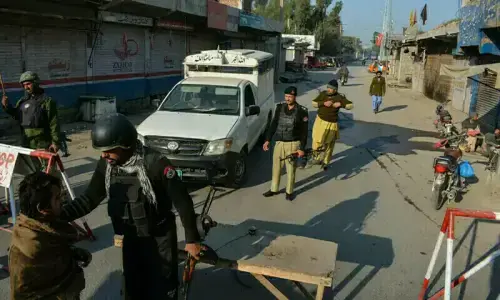
Ten car bombs were detonated in the greater Baghdad area on Friday, killing at least 15 people and wounding almost 90, in a brazen display of the militants’ ability to strike at will.
Over the past several weeks, as discussions over the government dragged on and the optimism created by January’s election faded, insurgents have stepped up their two-year campaign of violence, increasingly targeting Iraqi forces.
America’s top general said this week the insurgency was just as strong now as it was a year ago, with up to 60 attacks a day.
An audio tape released on Friday purportedly carried the voice of Abu Musab al-Zarqawi, the Jordanian leader of Al Qaeda in Iraq, calling for more suicide attacks on US forces and vowing not to let President Bush enjoy “peace of mind”.
The hope is that as US forces train up the Iraqi army, police and other security units, these will gradually be able to take over the fight against the insurgency. But there is little evidence so far that they are up to such a huge task.
Toby Dodge, an Iraq expert at Queen Mary College in London and author of a new report “Iraq’s Future: The aftermath of regime change”, believes the greatest challenge is building a functioning state and then seeing if it can control violence.—Reuters