0
0

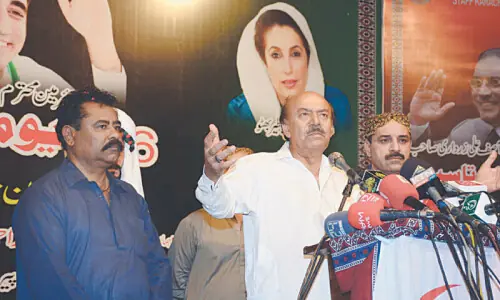
KARACHI, April 3: Sardar Ataullah Khan Mengal, founder of the Balochistan National Party (BNP) and a prominent politician, has said that the March 17 attack by armed forces on the Nawab Akbar Bugti’s residence was a pre-planned move aimed at suppressing all kinds of resistance against the government. He made it clear that although a truce between the government and Bugti tribesmen had been agreed upon following the recent talks on the incidents in Sui and Dera Bugti areas, the issues agitating Balochistan people were yet to be resolved.
Talking to Dawn, Sardar Mengal said that the issues being raised by Balochistan people were equally significant for the people of other federating units and must be sorted out as soon as possible.
He dispelled the impression that by holding separate talks, the government had weakened the unity of nationalist forces. Rather, he said, there was now a greater unity among them because of the impact of the recent events.
According to him, the Balochistan issue is still alive and there will be no compromise on it. He identified provincial autonomy as the core issue of Balochistan which was also related to other provinces.
Explaining his idea of autonomy, Sardar Mengal said: “We want the federal government to retain only three subjects — defence, foreign affairs and currency — and devolve all the other subjects to the provinces.”
He was of the view that the Council of Common Interests (CCI) should look after matters such as communications, water, gas and electricity and take any decision with the consent of federating units. The CCI should have equal representation of all provinces and its chairman should be appointed on a rotation basis for a term to be decided by the council members. The federal government should have no command over the CCI, he emphasized.
Commenting on the March 17 incident and the aftermath, Sardar Mengal said it was not unexpected in view of the tense situation that prevailed in the whole area following the incident in Sui. Forces of both the sides happened to be close to each other, he pointed out.
According to him, his apprehensions that the government wanted to hold talks at gunpoint appeared true. He said that his party had withdrawn from the negotiating table because of the ‘colonial’ attitude of the federal government towards the problems of Balochistan.
Referring to the Dr Shazia rape incident and its aftermath in Sui, Sardar Mengal said that PML chief Chaudhry Shujaat who wanted to resume the talks had come to his residence. “I had told him to settle the issue with Nawab Bugti as far as the Sui incident is concerned,” he added.
However, Mr Mengal recalled, as the Nawab had refused to hold talks at that time, the government had resorted to starting military build-up and deliberately creating a situation that could have led to an armed conflict. Such a conflict had never been unexpected amid the tense situation, he added.
Asked what could be the motive behind
the attack on Nawab Bugti’s residence, Sardar Mengal said maybe the government wanted to harm the Nawab physically or pressure him into negotiations. The government was compelled to initiate talks with him because the issue had hit headlines in national and international press, he claimed.
Consequently, he said, Chaudhry Shujaat rushed to Dera Bugti for talks with the Nawab and worked out a truce. How long it would hold, depends on the outcome of the continuing dialogue, according to him.
The BNP leader could not comment on the progress made so far in the talks, saying neither side was divulging any details. He, however, appeared optimistic about a positive outcome.
When asked why nationalists could not react the way they had done in the rape incident, he said the March 3 incident came like a ‘sudden shock’ and by the time, the people had come to know the clashes had ceased.
He said the protests against Dr Shazia’s rape went on for many days because the government had complicated the matter by trying to defend an accused who belonged to a ‘sacred’ institution. He deplored that the government had failed to expose the culprit. Instead, he added, the victim had been forced to leave the country.
In reply to a question, he said: “We are ready to help the Nawab in the ongoing negotiations aimed at defusing tension in Sui if he desires so.”
He also dispelled the impression that Baloch people’s struggle for national rights was confined to three Sardars, saying that had it been so, the government would not have been worried.
In reply to another question, the BNP leader said that because of the geo-political situation of the Gwadar, some foreign countries like the US, China, Gulf and India, had been taking interest in Balochistan.
More importantly, he said it was the domestic aspect which was a matter of concern. “Foreign countries may not be interested in occupying our land by settling their people in Balochistan,” he contended.
Sardar Mengal alleged that the rulers wanted to colonize Balochistan by settling people from other parts of the country in Gwadar. “If this happens, the population of Gwadar city would become greater than the whole of Balochistan. We will not accept demographic changes in the name of development that may turn the majority of this province into minority.”
The matter, he said, could be resolved by granting autonomy to the province and handing over its development projects, including the mega projects in Gwadar, to the provincial government.
He demanded that the provincial government be empowered to make necessary legislation for issuing work permits to non-local workers who would have the right to earn, but not to vote.