0
0

UN in search of a definition
MR Kofi Annan has urged the world body to agree on a universal definition of terrorism which would stress that no cause or grievance, no matter how legitimate, would justify the targeting of civilians (Dawn, March 21). To start with, this raises an academic problem: wasn’t the centuries-old definition of terrorism available in dictionaries universally accepted? Has not, for the first time, the UN taken over the responsibility of defining a phenomenon? What if not all states agree to incorporate the UN definition in their books?
Even if terrorists are bracketed into a definition, won’t they remain lawless and engaged in their activities? The UN approach appears to be dealing with punishment — a narrow approach for a big problem. A wider approach is needed. In 1966, while Nelson Mandela was in jail, the British prime minister called his African National Congress a “typical terrorist movement”.
Yasser Arafat was a terrorist to the US for seven decades. One day he was invited to the White House as a guest.
9/11 has created psychological pressures on the Bush administration and also among the anti-terror alliance rulers. It appears that the pressure has become the prime mover of their thoughts, actions and even policies. The foremost problem is the possibility of targeted civilian casualties, and not by terrorists alone. “At least 3,767 Afghan civilians were killed by American targeted air bombing between Oct 7 and Dec 10, 2001”, according to a finding of the University of Hampshire in the US, to quote one case only.
Strengthening the UN’s anti-terror department should represent many shades of opinion. While dealing with the problem of terrorism, the UN ought to know that the US reaction to 9/11 was the result of America’s policies. There can be rarely any final solution to human affairs.
Z. A. KAZMI
Karachi
Quaid’s birthplace
IN the ongoing Sindh Assembly session, in reply to my question, Sindh Education Minister Dr Hamida Khuhro has acknowledged that the Quaid-i-Azam was born in Jherruk, Thatta, which is right. Dr Khuhro informed the Sindh Assembly that prior to the establishment of the Sindh Textbook Board (STB) in1970, it was mentioned in the textbooks that the founder of Pakistan was born in Jherruk, though in March 1962 the “ Sindhi Reader Book-II” had mentioned the place of birth of the Quaid as Karachi. This is the only book of the STB that carried the said version in its further publications.
In this regard I seek the Sindh government’s version and ask that on what grounds and based on what facts the STB made this historical change.
A visit to the site, meetings with the locals, and documentary evidence from revenue officials including books, periodical, old newspapers and pre-partition records have showed that the Quaid was born in Jherruk, Thatta, and at that time (1876) the Wazir Mansion did not exist.
One wonders why historical facts have been obscured and made controversial and why concrete evidences are ignored while settling this issue. It is not an issue of contention, but history has to be corrected, and in the light of the statement of the provincial minister, relevant authorities should correct history.
HUMERA ALWANI
MPA, Sindh Thatta
Allotment of Clifton beach
THIS is with reference to two letters on “Allotment of Clifton beach” (March 27). The correspondents appear to have lost sight of objectivity. The vision to transform Seaview water front into a model beach of international stature is one thing and the water scarcity and deteriorating civic infrastructure in some of the localities of the DHA another.
The DHA is aware of the hardships being faced by the residents due to these twin problems and is contemplating effective measures to solve these. A desalination plant is being set up and the entire water supply line in the DHA is being re-laid to ensure uninterrupted flow of water.
The provision of civic amenities in the area is the responsibility of the Clifton Cantonment Board (CCB), which gets all the taxes from the residents. The DHA, however, is ever ready to augment the CCB’s efforts in this regard.
The DHA has recently started a project to revamp the worn-out civic infrastructure in the old phases of Defence at an estimated cost of Rs1.2 billion. The DHA will bear the entire cost.
LT-COL (retd) RAFAT NAQVI
PRO, DHA Karachi
‘Jurisdiction dilemma’
MR ALI Dayan Hasan writes in his article: “The jurisdiction dilemma” (March 21) that “while the denial of justice to Mukhtar Mai is appalling, the release and re-arrest of the four convicts (rapists) and the events surrounding the progress of the case raise yet larger questions about the sorry state of Pakistan’s legal system”.
Why can’t our judiciary decide which of its several parts is empowered to sentence rapists? Why was the anti-terrorism court in Dera Ghazi Khan in the first place allowed to try Mukhtar Mai’s case if it was not competent enough? It should be noted that the Multan bench of the Lahore High Court cancelled the ATC’s sentence and ordered the release of the alleged rapists.
Then, the Federal Shariat Court suspended the LHC’s verdict as it thinks the high courts have no jurisdiction to hear appeals in cases pertaining to Hudood laws. Now will would the Supreme Court do and will the Shariat Court accept the supremacy of the Supreme Court in case of Hudood law cases?
In a Muslim society justice should play a pivotal role. It should be a part of our religion.
S. M. KAZIM NAQVI
Karachi
Traffic congestion
THE problem of traffic congestion in our area continues to grow. T he SMHCS road adjoining Tariq Road at one side and Sharea Faisal at the other is one of the busiest roads of the city. There’s always a traffic jam in the morning as well as in the evening till early night.
Three days back I had to pick my nephew from his school located on main Sharea Faisal that is hardly 10 minutes’ drive from the Sindhi Muslim Society.
The road was completely packed with endless rows of vehicles that didn’t move a single inch for the next 15 minutes, after which the signal turned green, but by the time I reached the middle of the road, the signal turned red once again. The total duration of our green signal was hardly one-and-a-half minutes and to my utter disappointment I was there for a next session of 15 minutes.
I wonder how would an ambulance make way out through such a crowded road. I request the authorities to look into timing of this traffic signal.
AISHA MASOOD
Karachi
‘The Black Book’
MR Malik Mubashir A. Majoka (March 21) has hinted at, without naming, those who should adorn the Black Book. He has left it to the readers to guess the names.
He has, intentionally or unintentionally, omitted to hint at the person who signed the 1973 Constitution in the morning and almost scrapped it the same day by draconian amendments, usurping basic rights by appointing himself the first civilian martial law administrator in history.
If and when the lamentable history of backstage manoeuvres of one political party against the other is written, one would be surprised to find that the civilians outnumbered the uniformed. The reason is that our political stage has always been dominated by feudals and sardars and the privileged who are devoid of any ethical principles.
F. HASAN
Karachi
‘Soft image’
THANKS to Mr Ardeshir Cowasjee for his column “Soft image?” (March 27).
The hoarding that was in the process of being installed next to our building has been removed.
Why are the people of this city being harassed by the nazims? First, they give a “no objection certificate” for the hoarding to be put up without consulting or asking all those who would be adversely affected, and then they order it to be removed because they have received many complaints from the affected.
Why cannot a system be laid down that before permission is given for a hoarding to be put anywhere in this city, “objections” are publicly invited?
ABA HUSSAIN AGAR
Karachi
A mother’s wish
THIS refers to the visit of Begum Zarin Musharraf, the mother of President Gen Pervez Mushrarraf, to Naharwali Haveli in Delhi, India. The photograph of Begum Zarin (Dawn, March18) showing her receiving gifts at the haveli from the natives made my mind travel back to the early 90s when my mother, suffering from Parkinson’s disease and on a wheelchair, desperately wanted to visit her old house, Aftab Manzil in Meerut, India, where she had spent her childhood and the most memorable days of her life.
But my mother’s desire to visit the place where as a child she had played with her sister with dolls, where every morning flowers of her choice were presented to her by the gardener, where her first child was born, could never be fulfilled because of the strict visa restrictions by both India and Pakistan.
Some years back when one of my sisters visited India, she also visited our ancestral place and was surprised and deeply moved by the touching reception she received from the children and the grandchildren of the domestic servants of my father and mother. They inquired about all the family members and on knowing about the demise of some of them their eyes got wet as if they had lost some of their own near and dear ones.
The feelings and sentiments on both sides of the great divide always have been the same; a feeling of love and affection, a sense of warm attachment. But unfortunately the political leaders of both countries have created hate, hostility and aversion in the minds of the innocent peoples of India and Pakistan, who always want to visit and refresh their childhood memories, who have always loved each other.
My mother was not the only one who could not get to see her birthplace (her lost paradise) again. There are uncounted mothers like mine on both sides of the divide with a last wish to be at the place where their childhood is buried. But visa restrictions imposed by both the countries have made it impossible for them to make their wish come true.
The government of President Gen Pervez Mushraf has definitely moved many steps ahead in bringing Indo-Pakistan relations to normal and the Indian government has also reciprocated in a positive way, but still a lot has to be done. I congratulate Begum Musharraf on her visit to the haveli and other places, and request through these columns the governments of India and Pakistan to facilitate all citizens of both sides, especially those who have their roots in Pakistan or India, in getting visit visas easily.
I remember when a few years back I had visited Delhi in connection with a technical seminar how desperately I had wanted to visit Meerut, the city of my ancestors, but could not get a visa for the place where my father and mother and their parents had lived.
Like many Pakistanis and Indians I hope that both governments will seriously work on developing some modalities for granting visas, especially to those who have no relatives on either side but still are anxious to visit the graves of their ancestors and the places they have heard of since their birth.
Let’s forget the bitter past and look towards a brighter future, a future of love and peace, a future in which no mother dies with the only wish of stepping into the house of her childhood days, a future in which no son has to cry because he was unable to fulfil the greatest wish of his beloved mother.
AAMIR AQIL
Lahore
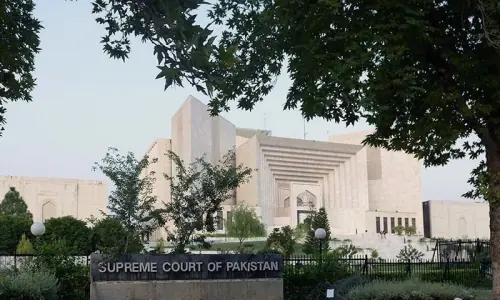
SBP on Indus Bank case
THIS is with reference to the news item (April 1) regarding the hearing in the Supreme Court on March 31 of the appeals relating to the erstwhile Indus Bank under the heading “Indus Bank case: SBP counsel’s continuing absence annoys SC”.
The news item may have created an impression that the State Bank was avoiding a hearing of the appeals on merits. In fact, the appeals are to be heard by a three-member SC bench but on March 31 the appeals came up for hearing before only two judges, namely, Chief Justice Nazim Hussain Siddiqui and Mr Justice Javed Iqbal. This aspect was commented upon by the chief justice himself, i.e., that the appeals could not proceed on that date in any case.
Also, the counsel for the State Bank had gone for Umra and before doing so he had applied for a general adjournment of all his cases. This was granted by the chief justice, and the appeals could not have been heard for this reason as well. The counsel for the Indus Bank was also informed of this in advance.
SYED WASIMUDDIN
Chief spokesman, SBP, Karachi
Civic problems
GULISTAN-i-JAUHAR is fast turning into a very important area of Karachi. With the speed at which construction is going on in the area, it is estimated that it will soon be accommodate a sizable portion of Karachi’s population.
Despite this increase in numbers, the various blocks of Jauhar are not provided with proper facilities.
Water shortage is one such problem that various areas are facing these days. Another factor is the transport. From Jauhar Chowrangi, there are just the Metro buses 9B and 9B-Express, a mini bus V-3 and the recently-started Green bus.
The buses don’t have any timetable. Sometimes, people have to wait for as long as 30 to 40 minutes to find that the Metro bus has no room or that the V-3 is jampacked.
The Green buses also comes very late and very often they do not stop near the roundabout.
SANA REHMAN
Karachi
F-16 aircraft
THE US government has announced that it will sell the latest models of the F-16 aircraft to Pakistan. At the same time, the US claims it is combating terrorism and willing to establish democracy in the world.
The US itself is creating an imbalance in power in the region and promoting an arms race.
Earlier, US Secretary of State Condoleezza Rice paid a visit to both countries. On the one hand, the US stresses the need to resolve the Kashmir issue and the Baglihar Dam issue through negotiation and dialogue and, on the other, it creates tension on both sides by selling arms.
MUHAMMAD YASIR
Karachi
A road in disrepair
I WANT to draw the attention of the Karachi nazim and other relevant authorities towards the state of utter disrepair of the road from Sakhi Hassan to People’s Chowrangi in North Nazimabad.
The carpeting is completely worn off, making the surface uneven. There has been a lot of digging and one comes across big ditches all along the road. What used to be a five-minute drive now stretches to about an hour.
Half of the road has been repaired by the Karachi Water Supply Board while the other half has been left in poor condition. The KWSB says it is the responsibility of the city government while the CDGK argues that heavy tankers have damaged the road and, therefore, the KWSB must repair it. Because of this unresolved conflict, car drivers suffer traffic jams, particularly during peak times.
HIRA ANWAR
Karachi
Leishmaniasis cases
LEISHMANIASIS cases have been reported in Thari Mir Wah and the Nara taluka of Khairpur district. The affected people suffer in the absence of proper medical facilities, as taluka hospitals are not well-equipped with skin specialists and medicines. Private practitioners are robbing with both hands, treating it as a normal skin disorder and providing some cortisone and anti-allergic drugs. Poor patients have to travel miles to consult the sole skin specialist working in the civil hospital at Khairpur. No specific medicines and injections are available even in the civil hospital and poor patients are compelled to buy medicines from their meagre resources.
The health department should take notice of such irregularities and provide sufficient medicine stocks. Teams of mobile skin specialists be constituted and people should be educated regarding how this disease spreads.
PERVEZ AHMED SHAR
Khairpur
Tree felling
RECENTLY a tree was cut down in Karachi’s Sindh Muslim Society near Tariq Road. It was the oldest tree in the locality and being the oldest, also the biggest in the area.
After a few days a big advertising board was set up in place of that tree. Advertising is necessary but that it should at the cost of the destruction of nature defies logic.
At present there are more than 15 billboards just on the SMCHS roundabout. The problem does not lie with the advertising but with authorities allowing a board to be set up anywhere the companies want.
For the sake of a little profit and the payment of the required amount the authorities grant permission for hoardings to be placed anywhere. At a time of so much pollution, trees are so necessary and yet they get destroyed. If there will be no trees to protect us from pollution, then what use will advertisements be if no one is left to see them?
SAMREEN RAZI
Karachi
Cattle farm
THE residents of Salma Gardens, Hussainabad, Hyderabad, have been suffering from the unhygienic conditions created and spread by cattle farms situated nearby. Various diseases have been reported in the locality. We request the authorities concerned to shift these farms to some other place.
DR BASHIR A. LASHARI
Hyderabad
EOBI
THERE is an EOBI pensioner in my locality, an ex-employee of a private institute, a senior citizen who started receiving Rs425 a month in 1998 and he is still receiving only Rs700 a month because there has been no increment for years. Will the government intervene and also protect the rights of the civilian workers of Pakistan?
SOCIAL WORKER
Karachi