0
0

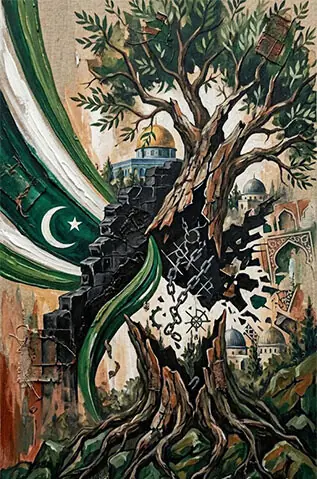
East Al Quds and Israel’s designs
IN the US-backed roadmap there is little reference to Al Quds. It simply states that Al Quds will be addressed during final status negotiations. The truth is that Israel has never recognized east Al Quds as “occupied territory”. As a result, Israelis refer to the colonies in and around east Al Quds as Jewish “neighbourhoods” and not illegal settlements built over the Green Line.
According to Diana Buttu, the PLO’s legal adviser, colony expansion soared since the signing of the Israeli-Palestinian Declaration of Principles (DOP) in 1993. The most established fact is that beyond the municipal boundaries of east Al Quds, which Israel refers to as “Greater Jerusalem”, there are at least 31 illegal colonies housing about 220,000 Jewish settlers. The colonies cover an area of 440 square kilometres, of which only 25 per cent lies in west Al Quds. In east Al Quds there are three major colony blocs: Gush Etzion in the south, Adumim in the east, and the Binyamin in the north. The Palestinian side argues that Israel’s plan to expel as many Palestinians as possible while holding on to as much of their land as possible is “starkly” clear in east Al Quds.
With the three major colony blocs and other projects that connect these blocs, Israel has cut off Palestinian areas from all sides in an attempt to confine them within as little area as possible. The Adumim bloc consists of six colonies and an industrial area. It has a planning area of 69,500 dunums (17,375 acres) and the capacity to expand 15 times its developed size. It lies 4.5 kilometres east of the Israeli-expanded municipal borders of east Al Quds. One of the six colonies in the bloc is the Ma’ale Adumim colony (with 30,000 settlers), which has a planning area of 47 square kilometres — only three kilometres less than the municipal borders of Tel Aviv.
Israel wants the Hamas to guarantee the security of Israel after it alienated and destroyed the Palestinian Authority, but it does not want to end the occupation which created a security problem with the Authority, the Hamas as well as others. Israel destroys the very Palestinian security institutions that it has been asking the Palestinians to use to ensure its own safety. Terrorism is addressed as an isolated phenomenon that has no objective political or economic causes. Arab countries talk about reform and fight reformists.
The Washington ‘Mideast roadmap trajectory’ is negotiating with the Palestinian Authority to control the opposition for the sake of Israel, and in return Israel will end its war against the Authority and the opposition and anyone moving on Palestinian territories. Israel, in its turn, is negotiating with the US against the Authority and the opposition and Palestine altogether. The US and Israel don’t recognize the Hamas and the Jihad and want to dismantle them, but they demand their commitment to stop suicide missions as a first step towards their dismantlement.
The logic of the illogic is on the war against terrorism: the lack of security is being addressed through additional procedures that helped create terrorism in the first place. Had the US — apparently an ardent advocate of the Quartet whose fate is yet hemmed in by ambiguities and pre-conditional ties — been ingrained in sincere notions to make the roadmap as workable and viable, there is no reason why Ariel Sharon would have so ungrudgingly indoctrinated his vicious Gaza plan.
Thanks to the sinuosity and legerdemain of Sharon that he has not yet withdrawn from his ‘Gaza gambit’ but just modified it. The currently held London Conference on forwarding progress to the so called Mideast roadmap seems not to be personifying beyond the status of peace rhetoric.
S. Q. AFAZL RIZVI
Karachi
Strategy to improve varsity education
I READ with interest Mr A. H. Nayyar’s letter, “Strategy to improve varsity education” (March 30). He says, “Prof Attaur Rehman is also wrong in asserting that there is no faculty member with 30 PhD students registered under his/her supervision. Should he check only at the QAU, he would find more than one faculty member with over 30 students registered for PhD under him/her.”
If this statement is correct, then one will have little respect for the quality of PhD degrees. There is no way a person will be able to supervise even half that number of students, unless he/she is a super genius with a dozen Nobel prizes under his/her belt. No wonder, the HEC and the universities in Pakistan can boast of highly unrealistic numbers of PhDs being awarded per year. If I had a child interested in a PhD in any field, I will advise him/her to not even think of a university in Pakistan for doing research with.
Education and research in Pakistan have been badly neglected over the decades. Let us work hard so that a foundation is laid for high quality research and education. Ten high quality PhDs per year will be better than 1,500 poor quality degrees. I am proud of the 14 PhD degree students I was privileged to advise and supervise during my entire academic career of almost 40 years. With those degrees they have become accomplished professors and researchers with highly reputed universities and research institutions the world over.
PROF (DR) JAMAL KHAN
Detroit, USA
I WAS amazed to read the letter by Mr A. H. Nayyer that professors in Pakistani universities supervise 30 or more PhD students simultaneously. How do they do it?
They must have an infinite amount of time and knowledge at their disposal. How come, no institution from the West has discovered these geniuses with such tremendous qualifications? If they are doing it, these professors and their respective universities should be listed in the Guinness Book of World Records.
Alternately, are these PhDs even worth the paper they are written on? Are the high officials of these universities ignorant of the fact that these professors are producing worthless PhDs? Don’t they realize that it is the quality and not the quantity of PhDs that is important? From Mr Nayyer’s letter I got the impression as if this is something to be proud of.
If supervision of 30 or more PhD students per professor is true, then this makes the PhD programmes at these universities a joke. Dr Ataur Rahman of the HEC is quite right in stating that there is no university in Pakistan enjoying standards remotely approaching those of any international university.
Someone suggested that the so-called established universities cannot be reformed to any respectable levels of academic and research (PhD) standards, even if tons of resources are invested in them. The past 57-year history is witness to this fact. Perhaps the HEC may consider establishing a few new universities with fresh blood and see to it that they maintain a standard of education and research of international standards. As things stand, I will never be able to recommend anyone to enrol in a PhD or research programme in any of the existing universities of Pakistan.
PROF (DR) A. H. KHAN California, USA
Parade rehearsals and VVIPs
I APPRECIATE the article by Alieen Qaiser, “Parade rehearsals and VVIP movements” (Dawn, March 22) which takes note of the irrationality of holding the March 23 parade on Jinnah Avenue in front of Parliament House in the federal capital.
The feature more than rebutted the state-run PTV’s programme telecast just on the eve of the parade featuring school children, taxi drivers, commuters and office goers singing hymns for ‘inducing patriotism’ in people. The programme sought to convince us that all over the world such parades are held in the capital cities.
The Race Course ground in Rawalpindi previously used for the parade was not suitable as it became muddy during rains, a military spokesman said. A federal minister and the military spokesman reminded us that the decision to shift the venue from Rawalpindi to Islamabad was first taken by the then prime minister Benazir Bhutto.
When the parade was not held for the past several years due to security concerns, it did not make the people less patriotic. And when the capital city was halved into two incommunicable parts for several days only to overawe one’s own countrymen with a show of power it did not make people any more patriotic. Whether such parades are also held in the capitals of other countries is also not the point; the point is how they are held.
In which other country of the world is a parade held right in the middle of the capital city and right on the main road dividing the city into two parts for all the six days of rehearsal? In which other country is it held right in front of Parliament House, which is in session? In which other country parliament members are turned away from attending parliamentary session because a show at public expense must take precedence over legislation?
Benazir Bhutto’s government had agreed in 1989 to the decision by the then supreme commander of the armed forces Ghulam Ishaq Khan that the parade be held in Islamabad. But how? It was agreed on the condition that it will be on an experimental basis and that, except the full dress rehearsal, no rehearsals (there were no less than six this year) will be held on the main road in front of Parliament House.
SENATOR FARHATULLAH BABAR
Islamabad
PTCL’s ‘spring offer’
A BIG advertisement campaign is being run by the PTCL announcing that one can get a phone connection within 24 hours by just calling their hotline. The reality is something else.
I applied for a second phone connection for my residence because the existing one is out of order every couple of weeks and the line is so noisy that I have to make at least a dozen calls to just log on the net to check my e-mail. My application has been with the PTCL since Oct 2004 and, according to the PTCL rules, I am on their top priority list.
Then came the “Great PTCL Spring Offer” to which I subscribed and a PTCL lineman appeared on March 18 at my place to install a new telephone connection. He fastened a wire from my flat to the PTCL box and promised that my connection would be operational within 24 hours. Nothing has happened in last 10 days despite repeated phone calls and a visit to the exchange. After meeting the divisional engineer (DE), the relevant sub-divisional officer (SDO) and the billing officer, I discovered that my phone was sanctioned on March 1. I have been allotted a phone number (5220955) and the billing department has been advised to bill me for this virtual connection from that date. In the PTCL books, one more connection has been added to inflate their figures for the “Spring Offer” and earn more profits for their shareholders. But, even after a month the PTCL has failed to provide me with a connection.
It appears that for the PTCL a piece of hanging wire and allotting a phone number in their register means a phone connection. I would request the PTCL management not to make such claims unless they are prepared to provide good service.
DR ABDUL HAMEED
Karachi
‘Educated Punjab’
IT is heartening to learn from TV and newspaper ads that the Punjab government is working on a very large scale (under a big plan) to educate its people. But the frequency with which the ads are appearing on
TV gives one a feeling that the big “mansooba” is aimed somewhere else also, probably to counter some good works done by the Sharif brothers whose home-coming is in the air.
If this whole exercise is not restricted to advertisements only and efforts are really being made in the field of education, it is appreciable. But even then, one wonders why money is being spent on ads? Surprisingly, no one is questioning this. At least the Punjab Assembly should ask for financial accountability of the expenditure being incurred in this highly overplayed campaign.
MUHAMMAD RAFI
Karachi
World Water Day
WORLD Water Day is officially recognized each year on March 22. The goal is to inspire worldwide political and community action and encourage greater global understanding of the need for more responsible water use and conservation. World Water Day for 2005 is guided by the new water decade’s theme “Water for Life”, the starting day for the new International Decade on Water 2005-2015.
The amount of water in the world is finite. The number of people is growing fast and their water use is growing even faster. A third of the world’s population lives in water-stressed countries now. By 2025, this is expected to rise to two-thirds. The UN recommends that people need a minimum of 50 litres of water a day for drinking, washing, cooking and sanitation.
According to a study by the UK’s Keele University, Pakistan stands at sixth position in the world as regards water scarcity. The UN says more than 1.1 billion people around the world lack safe water and 2.4 billion have no access to sanitation — leading to over three million deaths every year. Almost one-fifth of all children lack even the bare minimum of the safe water they need to live. Problems such as steep drops in the size of Asia’s Aral Sea, Africa’s Lake Chad and Iraq’s Marshlands, the deterioration of coral reefs and the rise of coastal waters because of climate changes have led to present water scarcity.
Pakistan’s per capita water availability has declined from 5,600 cubic metres at the time of independence to 1,200 cubic metres in 2005. It is expected to reach the threshold level of 1,000 cubic metres before 2010, or even 2007.
The city of Karachi and its vicinity have been facing water shortages very frequently in the last one decade and the situation is growing worse. It is estimated that by 2010-2012, there could be a severe water shortage. According to an official estimate, the total requirement for Karachi is 700-800 million gallon per day but it is getting 435 MGD only.
There is no second opinion other than the installation of desalination plant for the city of Karachi. Desalinating seawater now costs far less than in the past. It may be recalled that China, early this year, repeated its offer of making low-cost desalination technology available to Pakistan. The offer was made in a communication addressed to the Pakistan embassy in Beijing for transmission to Islamabad. The government should lose no time in accepting the offer given the fact that the desalination technology developed by China is one of the cheapest in the world, with a cost equivalent to 65 US cents per 1,000 gallons of water.
RASHID ASHRAF
Karachi
Railway land
THE Pakistan Railways has advertised for disposal of land by way of sale for 99 years’ lease and for joint venture. The land includes the railway stadium on I.I. Chundrigar Road, Karachi.
I believe that the lands were entrusted to the railway authorities by the then government for the purpose of providing railway facilities to the commuters and the use of the land was restricted to this.
The use of the land for any other purpose should be illegal. However, if the land is no more required for the original purpose, then it should be surrendered to Board of Revenue, Sindh.
The Pakistan Railways has no right to sell it or use it for any other purpose. I request the government to take some positive measures to stop the sale of the land as Karachi requires space for basic amenities.
HASEEN FEROZ SHAMSI
Karachi
Mai Kolachi bypass
THE quality of construction on Karachi’s Mai Kolachi bypass, which is being widened these days, can be gauged from the fact that five or six craters have appeared on the side that was recently carpeted.
One expected that the builders of this road would have taken into consideration the fact that the road sees a lot of heavy traffic, especially during peak rush hours.
Due allowance should have been made for this in the construction of the road which is bound to break up if nothing is done soon to repair and strengthen it.
NASEEM ASIM
Karachi
Sale of F-16s
THOSE who are rejoicing over the US decision to “sell” F-16s to Pakistan as a reward for helping combat terrorism should hold their breath and try to know what goodies have been offered to India, though it is another matter why even then India is making a lot of hue and cry.
So let’s see what India gains and what Pakistan gets: Washington has agreed to sell F-16s to Pakistan. At the same time it is offering India a wider array of weapons systems and more importantly the option to produce them indigenously; allowing Indian companies to bid for the Indian Air Force contract on the acquisition of 126 multi-role combat aircraft. Lockheed Martin that produces the F-16 and Boeing that makes the F-15 and F-18 are expected to join the bidding. The US is proposing a major change in its non-proliferation policy by offering cooperation with India in the area of commercial atomic energy generation for the first time in three decades and also offering a joint working group on space cooperation.
SHAH AFFAN
Toronto, Canada
‘Soft image?’
THIS refers to Mr Ardeshir Cowasjee’s column “Soft image” (March 27). Mr Cowasjee tells the story of a poor widow who came to him along with 15 men, begging for help in the middle of night.
Our objection is basically to that part of the article wherein he states that a man living in Datari Villas # 30 (where the signboard was hoisted) bribed the police to let him install the signboard. We, the residents of the house, were taken aback when we read the column and when people started calling us up asking all kinds of questions.
Being a religious and honourable family living in this locality for 11 years and having an unblemished record too, we were taken aback and started to think where we went wrong when we rented a small part of our house to a registered company (and not some “gang” as Mr Cowasjee stated) who had paid their taxes and had all the legal documents, including an NOC from the government.
If the residents of the building next to our house had any problem with the signboard, it was none of their concern. It was simply a matter between the company and the residents of our building. Mr Cowasjee has no right to violate anyone’s prestige and honour. He should at least admit that he was misinformed about the facts.
RESIDENTS OF DATARI
VILLAS # 30 Karachi
Commentary
THIS refers to Dr Talha M. Siddiqui’s letter, “Commentary over PTV” (March 24). I agree with his views on the substandard level of cricket analysis done by the PTV compere during the Indo-Pakistan cricket series. The way he conducts the programme is indeed irritating. His knowledge of cricket seems limited though he argues with respected former players who are present there as experts. Overall, the programme is unrefined and mediocre.
DR M. A.A. MUGHNI
Karachi