0
0

Revenue deficit
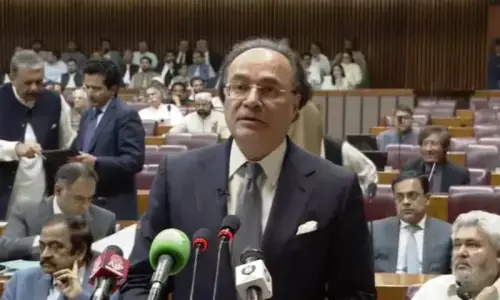
THE Fiscal Responsibility and Debt Limitation Bill passed by the National Assembly aiming to help eliminate revenue deficit and reduce the public debt is an important initiative that should be supported by all. The prime minister rightly points out that the bill is designed to curtail unnecessary borrowing (Dawn, March 5). Through this bill the supremacy of parliament in fiscal management stands ensured. Indeed, it is an important initiative that would give positive signals to investors, more so to foreign investors, on yet another step towards sound macro-economic and fiscal management.
The prime minister is, however, cautioned against optimism that the bill will put the country on the road to progress and economic development. In isolation it will be entirely insufficient. Mechanisms to check misallocation of scarce financial resources remain at best on paper.
Leakages (corruption and malpractices) are high and rising. Uncertainties continue to cause serious concern in the external sector. The surge in oil prices, raising the import bill, is already impacting all sectors and activities. In the export sector, we have yet to check our preparedness in the post multi-fibre agreement era. We have also not been able to attract any foreign investment of significance in manufacturing and industry.
Foreign direct investment (FDI), besides sound macro-economic fundamentals and policies that are transparent and predictable, is also contingent upon: 1) ownership titles, 2) dispute settlement mechanisms, 3) accounting and auditing rules and practices, 4) regulatory bodies that are independent, participative and transparent, 5) one-window policy, and 6) a human resource base — well trained, suitably educated and professionally qualified.
Further, we also need to closely examine as how to attract and even retain FDI owing to the continued infrastructural bottlenecks, law and order, and issues related to governance.
This is not at all a tall order. Countries in the region have done it and those competing are doing it. The prime minister is urged to look into these matters and constitute an inter-ministerial committee for coordination and better synergies.
DR SABUR GHAYUR
Singapore
Change of guard in Sindh?
NEWS that a third person is being considered for the post of Sindh chief minister is welcome.
As things stand, the standoff between the CM and his former minister for revenue, Imtiaz Shaikh, has resulted in the Sindh government grinding to a halt.
Most important decisions are being postponed. Many senior officials, particularly those related to the revenue department, are absent from their posts for fear of being involved under the ongoing tussle.
The biggest sufferers in this are the people who are being turned away from many government offices on the grounds that the “sahib” has not come to work. Files are lying unattended and people are being denied basic government services, particularly in the Sindh Secretariat where it is rumoured that intelligence officials are closely watching the activities of most senior bureaucrats.
Sindh has been particularly unlucky in its choice of CMs in the past. We have had all sorts of characters whose sole aim was to perpetuate their rule.
It is my appeal to the powers that be to please give us someone dynamic and with a vision. Otherwise, the slogan of good governance will continue to taunt us in the coming years.
IRSHAD SHORO
Hyderabad
Disposal of radioactive waste
AT the Nuclear Oncology and Radiation Institute (NORI) operated by the Pakistan Atomic Energy Commission (PAEC) in Islamabad, proper arrangements are lacking to dispose of the radioactive waste generated.
Contaminated syringes, cotton and radio-iodine used in everyday treatment are casually disposed of as normal trash and radioactive fluid is spilt in the sewerage system as casually as ordinary solid and liquid waste. This practice is injurious to public health. One fails to understand why the Pakistan Nuclear Safety Regulatory Authority does not take a serious view of the situation.
The same is true for Kanupp, where low-level radioactive waste is either discharged into the atmosphere through the chimney (in gaseous form) or into the sea (in liquid form).
Nuclear power is said to be most unfriendly to the environment. Which is why in the US no new nuclear power plants have been given licence to operate since 1992.
The world has yet to decide how to safely dispose of medium and high- level liquid and solid waste, especially spent fuel that is going to cause pollution for millions of years.
Besides being not environmentally unacceptable nuclear power plants are unsafe for public life and property and are constructed away from population centres.
Any significant establishment within a radius of 50 miles from inhabitation is viewed with a raised eyebrow.
ARIF QAMAR KHAN
Islamabad
University golds — and blues
THIS refers to Mr Shamsur Rehman’s letter “University golds - and blues” (March 6). I must appreciate how perfectly he has presented his side of the story regarding the affairs of the Karachi University. Regarding the news story headlined “KU unable to arrange gold medals” published in Dawn Metropolitan, Karachi, (March 4), I’d like to point out that the headline contradicts your report in the issue of March 6, which mentions the number and names of the students awarded gold medals.
I wonder when Mr Shamsur Rehman’s “one visit” to the campus took place, in which he was able to observe a variety of things which he has referred to in his letter. In his “one visit” he was able to deduce that the university is overstaffed.
Strangely, if he was able to notice all these things, how come he missed seeing the new projects which the KU has undertaken. The under-construction botanical gardens near the Silver Jubilee gate is one such example.
Mr Shamsur Rehman has also highlighted the problems faced by students due to the inefficiency of the non-teaching staff. I’d like to ask him to name one government-run institution, in any field, where people don’t face problems in getting their work done smoothly.
One-sided criticism is very unjust. No Pakistani can doubt the role played by Karachi University in producing talented and dominating personnel in every field.
ALI MEHDI
Karachi
Cricket selection
REPLACING Younis Khan as vice-captain is not understandable. Yousuf Youhana was outstanding as a caretaker captain in Australia and was appreciated by Ian Chappell. He was energetic and right on the button. He is a gifted player and has all the abilities of a leader.
On the other hand, it was Inzamamul Haq’s wrong decision in the VB series that led to defeat. He made no change in the top order in spite of its persistent failure. For instance, Hafeez and Kamran Akmal were faltering, but they were forced to play at the top.
The selection committee has not been able to pick talent. They are picking batsmen on the runs that they score in domestic cricket. They neither consider technique nor temperament.
They haven’t been able to recognize the talent of technically strong players like Kamran Sajjad. Sialkot’s Safyan Munir reminds me of Mark Waugh. The way he flicks the ball off his pad shows his class. Abdul Razzaq struggles in Test matches against quality spinners like Shane Warne. And if Pakistan plays Razzaq again, he is not going to score many against Kumble and Harbhajan Singh on turning tracks. Also his bowling is not up to the Test level.
Last but not least, Pakistan needs a rotation policy in the fast bowling department. It will enhance competition, reduce injury and produce more bowlers.
MUNAWAR HUSSAIN
Lahore
Denationalization
IN Punjab, eight primary and secondary schools owned and managed by the Sadar Anjuman Ahmadiya, Rabwah, were nationalized by the government in 1972.
In 1996, a gazette notification was issued by the Punjab government which gave the owners of the nationalized educational institutions the option to take back their institutions after fulfilling certain terms and conditions.
The Sadar Anjuman Ahmadiya wanted to avail of this offer and contacted the department concerned. All the terms and conditions were complied with and a sum equal to the emoluments and allowances of the staff for up to one year was deposited in the government treasury.
Again in July 2002, a scheme for the return of nationalized educational institutions to previous managements was issued. But to-date no action has been taken by the Punjab government.
The authorities are requested to look into the matter as soon as possible.
SYED TAHIR AHMAD Rabwah
Higher education
THE debate in Dawn over Prof Pervez Hoodbhoy’s article on the Higher Education Commission (HEC) gives one the occasion to point out another problem. The foreign faculty programme initiated by the HEC is becoming another futile exercise to improve higher education. Bearing in mind that most of the so-called foreign faculty is not really foreign but of Pakistani origin working in western countries, it is not clear what significant contribution they can make here in research.
The fact is that Pakistani people who have worked as professors in the United States and other countries have rarely done significant research that could be counted internationally. We have some exceptions, but the majority, including those appointed by the HEC as foreign faculty here, have not even had any publication to their credit.
Most of these professors are incapable of conducting any intensive research here and seem merely to take advantage of the lucrative packages offered to them for a year or so. By contrast, the local faculty is struggling to have nominal increments in their salaries and living mostly hand-to-mouth.
Our universities require the continuous presence of resident local supervisors. Many research students were refused enrolment because they had selected supervisors outside the vicinity. Now, how can foreign faculty supervise a PhD research here? And if not then what is their legitimacy or significance?
The fundamental approach should be to specify research projects first and then select foreign faculty for this purpose, and take the local faculty into confidence before seeing professors from abroad
In an overall perspective, it seems that our social scientists are rarely consulted before implementation of educational policies. The result is that we have a lot of statistics going on above without really understanding the nature of our institutions. What we need is never worked out thoroughly by our well-wishers. In matters of higher education such haste will create more confusion.
DR ZAHOOR BABER
Karachi
(II)
AS a public sector institution teacher doing PhD, I have been reading with great concern the on-going campaign against some of the initiatives taken by the HEC. It appears that people who reach the top want to retain their privileged position and dislike the opening up of doors for the ordinary people born in the towns and villages of “the rest of Pakistan”.
The way a recent forum held at Islamabad has been reported in Dawn (March 1) leads to questioning the wisdom of the speaker. The heading and intro of the report “HEC reforms initiatives, waste of resources” and “HEC under criticism for deterioration of ethical, cultural and physical environment in HE institutions” read with the detailed proceedings and listing of so many positive aspects of the HEC reforms (provision of internet and digital library, taking lack of faculty seriously for the first time, encouraging foreign faculty and good salaries, supporting local and foreign PhD by students/teachers) is more than enough to prove the contradictions between realities, perceptions and reflections. The HEC in this report has been criticized for social and cultural problems that are neither of its making nor in its domain to be fully addressed.
The speaker has himself listed a number of steps in the right direction conceived and being undertaken for the first time to address physical problems and resource constraints. But terming the “expansion of universities in places where academic potential is non-existent” a wrong step is a reflection of the metropolitan psyche. May I dare to point out that Islamabad where such forums are held was built from scratch? There was no academic or any other special potential in the area where the “university receiving the largest funding by the government” is now functioning.
RANA ZAHEER AHMAD KHAN
Via email
Railways ticketing system
ONE wishes to draw the attention of the Pakistan Railways chairman towards the unorganized ticketing system.
It is usual process is to make a long queue to reach a booking window where one has to first check the availability of seats/berths in a particular train for a particular day. After this one often comes to learn that seats/berths are not available for the desired date and train. This lengthy and unpredictable process exists because of the absence of a proper computerized ticketing system.
An electronic computerized board must be placed at all big city stations in the country displaying train names and day-wise availability of seats/berths. With this arrangement people will greatly benefit by just reviewing the board and not having to stand in long queues and wasting time in buying their tickets.
MUHAMMAD ARIF KHAN
Karachi
Lights that bother
IT seems someone is making millions in a deal relating to the installation of over a hundred traffic lights at various intersections in a prestigious housing authority in Karachi.
The powers that be need to investigate why traffic lights are being installed at intersections where only a simple “Stop” sign would have sufficed.
On one street, where traffic is minimal, over four signals were installed this month. Most are ignored by motorists, creating more traffic chaos.
While someone goes home happy, hundreds of motorists are fuming over these uncalled-for traffic lights.
SHAHID KHAN MASOOD Karachi
Cowasjee’s column
THIS is with reference to Mr Ardeshir Cowasjee’s article (March 6) on the average intelligence of nations. The article is well researched but in the end while trying to make fun of Dr Attaur Rehman he has given as an example the scholarship by a Pakistani for research on inclusion of Quranic thought in the syllabus of each master’s level course.
Mr Cowasjee should read the Quranic verses about the stages of development of the human embryo and compare them with what modern science says about it.
Belittling of the Pakistani nation and Islam has become a regular feature of Mr Cowasjee’s articles. His articles are becoming more and more unbalanced.
KAMRAN VARDAG
Karachi
Police threat
THIS is with reference to the police action some months ago in Lahore’s Race Course Park on the instructions of Mr Tariq Saleem Dogar, DIG. It was aimed at catching young couples who seemed to be romancing there.
It has provided the police with a new pretext to extort money and exploit the people. The police catch a couple leaving the park and threaten them with detention.
They take Rs3,000 to Rs 5,000 to let people go. I would like the authorities to take note of the matter.
AN AFFECTED PERSON
Lahore
FM’s visit to Japan
ONE day before leaving on an official tour of Japan, our foreign minister informed reporters in Lahore: “This visit is very important for Pakistan” (Feb 20).
In Tokyo, according to Ambassador Kamran Niaz, the foreign minister voiced support for Japan’s goal of getting a permanent seat on the UN Security Council (Feb 23). However, this was denied the very next day by a foreign office spokesman in Islamabad. Meanwhile, Mr Kasuri has returned quietly from Tokyo and, contrary to normal practice, has apparently issued no statement about what was accomplished during the sojourn.
The nation ought to be informed about the significance of his pre-departure statement and what he actually told the Japanese regarding their UNSC aspirations?
KHALID CHAUDHRY
Karachi
Child beggars
IT is very disturbing to see three or four-year-old children begging on the roads in Karachi while their mothers beg separately. As male beggars are afraid that they would be picked up by the police, they have pushed their women-
folk and children to go begg-ing.
The persistence of these children and women is very embarrassing for the shoppers. In the evening some women beggars are seen visiting shopkeepers to exchange coins for currency notes.
Officials are requested to take note of this and make a plan to provide living and accommodation facilities to these people to make the country proud of them, rather than letting them live without any hope.
M. SHAFIQUE AHMED Karachi
Amazing claim
THE representative of a multinational pharmaceutical company has made the amaz-ing claim that Pakistani drugs are better in quality than those manufactured in India and
Iran and hence they are
more expensive (Dawn, March 9).
If that is the case, I beg the government to allow free import of pharmaceuticals from India, Iran and China so that we, who have been forced to buy drugs at exorbitant rates, can make the choice for ourselves.
As in the case in a number of other imported products, give us the option to decide whether we want to purchase Drug “X” priced at Rs250 and packaged by a multinational in Pakistan or the same drug at Rs50 imported from India, Iran or China.
ALIYA ISRAR
Lahore