0
0

Training birth attendants
The editorial on "Training birth attendants" (Nov 17) has pointed out one aspect of extremely poor healthcare facilities accessible to Karachi, the largest city of the country.
It has also rightly referred to the unimaginable miseries a majority of the people living in the far-flung rural areas of the country are suffering due to the non-availability of such services; besides lack of essential necessities, e.g., proper sanitation, potable water, electricity, gas and roads.
Compared to this, the progress accomplished by India during the last 57 years in the field of medical sciences is amazing. A journalist, who very recently happened to be on a tour of the neighbouring country, has specifically examined Indian health services. The facts and figures he has revealed while visiting the Indian Institute of Medical Sciences (IIMS) are simply astounding.
In this complex of IIMS, 11,000 doctors and workers (including 450 specialists) provide services day and night to patients. There are 40 departments, with 40 beds each. In each department there are five specialists working.
A professor draws Rs100,000 per month along with a well-furnished house or Rs20,000 a month allowance. The working days of the professor are divided: one day for operations, one day for teaching and three days for research work as he has to produce at least two papers in a year.
The process of selection is transparent and on merit. The trainees who are selected, through tests for six years training are given a stipend of Rs30,000 a month. After completion of a three-year course, their emoluments are raised to Rs40,000.
After completion of the course their degree is recognized in Europe and Britain. The government bears all expenses incurred on visits of specialists on attending seminars, conferences and workshops in foreign countries.
There is no political intervention in service matters. There is only one incident worth mentioning from 1954 till to date when a dean was retired before attaining super annuation.
Although in our country, in big cities like Karachi, Lahore and Islamabad, during the last two decades a few hospitals equipped with the most modern facilities have sprung up, their services are available mostly to the privileged class.
The facilities offered in the public sector are hopelessly inadequate. The hospitals lack trained staff as has been rightly pointed out in the editorial. The doctors are not only without up-to-date knowledge in the respective field but are extremely underpaid. The medicines provided are either substandard or spurious. The sanitary condition in the hospitals is so unhygienic that even healthy people fall sick.
We need to address this humanitarian problem on a priority basis by providing sufficient funds in the budget so that the proper infrastructure can be built with latest equipment, modern training facilities, and the doctors and paramedicals should also be paid market-based salaries so that they can concentrate on their job and do not yearn for private practice.
ALTAMASH MANZOOR H. KURESHI
Karachi
'Divided States of America'
Mr F.S. Aijazuddin's writings have an appeal as much for their scintillating syntax as for their lucidity and logic. But this time ('Divided States of America', Nov 14), there was a clean departure from tradition.
It was perhaps 'accidental' that the title of his essay coincided with the phrase in the opening sentence of Simon Schama's article in The Guardian on Nov 5: "In the wee hours of November 3, 2004, a new country appeared on the map of the modern world: the DSA, the Divided States of America," Schama observed. And paragraphs three to six of Mr Aijazuddin's article appear to be rewrites of Schama's paragraphs two, three and part of four. After defining the divided states as "Godly America" and "Worldly America," Schama wrote: "Even territorially (with the exception of Florida) the two Americas are topographically coherent and almost contiguous.
One of those Americas is a perimeter, lying on the oceans or athwart the fuzzy boundary with the Canadian lakes, and is necessarily porous and outward looking. The other America, whether montagnard or prairie, is solidly continental and landlocked, its tap roots of obstinate self-belief buried deep beneath the bluegrass and the high corn....
"Worldly America... faces ... the world on its Pacific and Atlantic coasts and freely engages, commercially and culturally, with Asia and Europe.... "Godly America... stretched out just as far as it pleases in Dubya's deeply drilled Texas, turns its back on that dangerous, promiscuous, impure world and proclaims to high heaven the indestructible endurance of the American Difference...."
The next baffling question is: what relevance did the title of the article (Divided Sates of America) have with Afghanistan and Pakistan?
S.G. JILANEE
Karachi
Remembering Arafat
In 1948 the UN had allocated 67 per cent of the land of Palestine to Arabs and 33 per cent to Israel. In effect the percentage was reversed and Arabs got 33 per cent and Israel got and occupied 67 per cent, thanks to US, British and French help.
Now death has separated Arafat from Palestine. Palestinians say he is not dead. He is still there in their hearts and in minds. No sooner did the news of Arafat's death break on Nov 11, just two days short of the 11th anniversary of the historic 'handshake' between Arafat and Yitzhak Rabin in Camp David, that I was reminded of his address to the UN General Assembly in November 1974 when he declared: "I have come bearing an olive branch and a freedom-fighter's gun. Do not let the olive branch fall from my hand."
Israelis promptly hurled the olive branch to the ground. It was a mistake as all Jews and even some Israelis admit. They asay Israel was forced to do so, because the state was threatened, and since its birth in 1948 it had fought three bloody wars, its athletes were massacred at the Munich Olympics in 1972, its airliners were hijacked and blown up in Amman and Cairo.
They say Arafat made mistakes too. After the Camp David handshake, he took up the gun instead of choosing the path of diplomacy and negotiations. His other blunder, which affected his popularity, was to support Saddam Hussein in the invasion of Kuwait. But in today's world gone mad, who does not make mistakes? Haven't Bush and Tony Blair invaded Afghanistan and Iraq?
S.M. KAZIM NAQVI
Karachi
Transfer of medical students
A tug of war is going on between Karachi University and the Dow University of Medical Sciences regarding transfer of students of the Dow Medical College and the Sindh Medical College.
One wonders why Dow University wants the transfer of the students already registered with Karachi University. It will be only fair to seek the opinion of the students in this respect.
Dow University should learn from the stand taken by the students of the King Edward Medical College, Lahore, and the Fatima Jinnah Medical College, who refused to be affiliated with the Lahore University of Health Sciences and continued their affiliation with Punjab University because its degrees are recognized the world over. The Supreme Court gave its decision in favour of the students.
On its establishment, the National University of Science and Technology (NUST) enrolled first-year MBBS students of the Army Medical College but did not seek transfer of all students of the college from the Quaid-i-Azam University in the larger interest of medical students.
Dow University should learn from these examples and not insist on transfer of the students of the Dow and Sindh medical colleges. It should enrol only first-year MBBS students, and the remaining students should continue to be registered with Karachi University. Transfer of students from Karachi University to any other university in midstream cannot be justified.
It is hoped that better sense will prevail on the authorities concerned of the two universities in the larger interest of medical students.
AFFECTED STUDENT
Karachi
'Eid brings no joy'
This is with reference to the news report "Eid brings no joy to many families" (Nov 14). No one can possibly gauge the intensity of pain and grief experienced by the near and dear ones of those who lost their lives in the May bomb blasts in Karachi in which bout 100 families were affected in emotional, social and financial respects.
I am sure many eyes would have filled with tears and hearts with sorrow while reading about the miseries faced by the innocent children and other family members of the victims. The government has simply failed to protect the lives of citizens, says the widow of a victim.
Those gone cannot return; however, the government can take a fresh start in protecting the lives, property and honour of citizens. Such attempts must address the preventive and curative aspects of the menace.
Slow investigations into the tragic incidents and the authorities' failure to catch the culprits and their accomplices are immediate concerns which must be addressed on a priority basis.
We must begin a dialogue among different trajectories of the religion. Sane elements from all sects who constitute a majority have a collective responsibility to come together.
Mutually agreed safety arrangements must be made at all places of worship as a starting point. Unless serious efforts towards initiating intersectarian dialogue are made, obscurantists will continue to brainwash common people to achieve their vested interests.
NOMAN AHMED
Karachi
A question on Kashmir
With reference to Anu Soman's letter (Nov 17), I would like to say that the United States withdrew from South Vietnam (in effect handing over that territory to North Vietnam) while the militarily strong Soviet Union broke up into several countries about 15 years ago. Indonesia also allowed a referendum which resulted in the birth of a new country (East Timor).
The question in Kashmir is not of handing it over to Pakistan, but to let its people decide their own future, whether it is to join Pakistan, remain with India or become an independent country.
SHAKIR LAKHANI
Karachi
Karachi development budgets
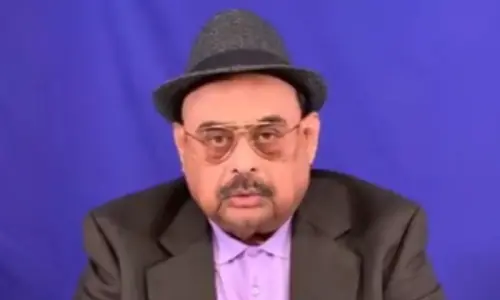
During his recent visit to New Delhi, Mr Altaf Hussain was asked in an interview with The Hindustan Times: "Would you, in retrospect, say that the subcontinent's partition was mistake?" His reply published in all leading Indian newspapers was: "Had I been around then, I would have voted against it."
These are the views of a man who heads a party which is a component of Pakistan's federal coalition government. He lambasted both Benazir Bhutto and Nawaz Sharif, one for being a feudal, the other for being an industrialist.
In his address to a seminar, he called for converting the LoC in Kashmir into a temporary international border. He chose to present his version of the persecution of Urdu-speaking Muhajirs living in Karachi instead of condemning the atrocious human rights violations committed against innocent Kashmiri Muslims by the 700,000 strong para-military and regular Indian troops stationed there.
Mr Hussain needs to know that the annual development budget and grants given from time to time for Karachi exceeds the annual budget of Balochistan and the NWFP put together. KESC alone has received grants of Rs20 billion to compensate for line losses.
In some areas of Karachi, the line losses are as high as 95 per cent, which in plain language means that bills are not paid and there is large scale theft of electricity.
The budget allocated for building much needed roads, bridges, flyovers, etc., in Karachi far exceeds the budget for the rest of Sindh. In spite of these huge budget allocations, we hear that a major part of the flyover connecting Drigh Road to Rashid Minhas Road collapsed within six months of its completion.
The government has recently allocated more than $1 billion for a water desalination plant and the Karachi Mass Circular Railway. Does Mr Hussain know that over 70 per cent of the population of Pakistan does not have access to clean drinking water? The people of Karachi and their local government need to self-asses their own performance and governance.
Karachi, which was once a city of peace in which all citizens lived in harmony, has been downgraded to a city with the worst law and order situation. Time magazine termed it as the crime capital of Asia. Can I ask who Mr Hussain blames all this on?
Karachi is a metropolitan city, with various ethnic communities living there. It is part of Sindh and part of Pakistan. It is home for all those who live there, not for those who on their own accord have chosen to seek a foreign nationality.
The Bhuttos had been residing there long before Mr Altaf Hussain migrated. It is his home as much as it is a home for all those who live in Pakistan's only true metropolitan city. Let us all work to build Pakistan and all its cities, including Karachi, Kohat, Sukkur, Quetta, Nawabshah and Sheikhupura.
GULL ZEE
Paris, France
Massacre in Fallujah
Your editorial ('Massacre in Fallujah', Nov 18) rightly points out the horrifying situation in Fallujah. Watching the drama on CNN and Fox News, it appears that the resistance fighters were, in fact, on a suicide mission.
They sat in bungalows and apartments waiting for the US army to come and kill them. The American general leading the marines commented that the "insurgents want to die and we are going to oblige them".
Obviously, this did not happen. A guerrilla force never holds ground. The fighters disappeared even before the Americans arrived. What were left were a few motivated individuals and those who had nowhere to go and intended to surrender to the "liberators".
After the first day they found out that the invaders were going to kill them anyway. Therefore, on the first day the Americans had an easy fight, capturing 70 per cent of the city. Later when the residents saw the massacre and knew that they were dead men, they decided to die taking their executioners with them.
The marines no doubt consider Fallujah a great victory, but everyone knows the defendants had no arms, missiles, aircraft or tanks. The victory is unlikely to create any respect or goodwill for the Americans or their camp-followers. The path of peace is the only path to follow and the earlier it is realized by the Americans the quicker peace will follow.
SHAFQAT RANA
Karachi
Transport system
Mr Ardeshir Cowasjee's Nov 21 column "Karachi under the Raj 1843-1947" points to problems facing urban planners in Karachi today. The need for a rapid transit system to replace minibuses and the newer long buses is acute.
Congested urban areas in Karachi cannot accommodate trains. The circular railway does not cover the major travelled routes. An elevated or underground railway metro is an option but is expensive and cannot follow road routes.
Goa's (India) skybus provides the same capacity as railway trains and is adaptable to existing roads. With the skybus, Karachiites can look forward to an easier, pollution-free office commute and enjoy haleem in Nazimabad, delicious falooda on Tariq Road, etc., on weekends.
ARUN KHANNA
Indianapolis, IN., USA
'Triumph of justice'
Every self-exiled Pakistani politician who believes that Asif Ali Zardari's release is a triumph of justice must return to the country immediately and face the courts to make justice more victorious.
M. RAFIQUE ZAKARIA
Karachi
'Peace and the bottom line'
This refers to Mr Irfan Husain's article "Peace and the bottom line" (Nov 13). He has shown a bias against army officers. The question is: if the real estate prices have escalated astronomically, how come army officers are responsible for this?
Consider this example: an officer was allotted a plot measuring 500 square yards in Morgah Scheme No. 1 - of course, through balloting - in 1991, not at a throwaway price but after the payment of Rs340,000 in instalments. In 2004, after 13 years, if the price of the plot shot up to Rs4 million or more, how can one blame that officer for this rise?
There was a time when nobody was ready to buy a plot in Morgah Scheme No. 1 for Rs150,000. All posh Defence societies are inhabited by wealthy civilians - probably five to 10 per cent armed force officers live there. Why then is this grudge only against armed forces' officers?
The ultimate winners are civilians who buy plots from armed forces' officers at any cost. The logic is simple: civilians are wealthier than those serving in the armed forces. The capital city of Pakistan has virtually been invaded and owned by civil bureaucrats ever since it came into being. The poor army was but an onlooker.
COL. SAFIR
Karachi
Beggars in DHA
These days beggars have swarmed Karachi and quite a lot of them take shelter at night on vacant plots. I can pinpoint the presence of one such shelter on Street 34 joining Ittehad in the DHA.
As soon as one enters this street from Ittehad, one can see cloth coverings stretched across bushes to provide shelter, with women, children, toddlers and men crowding under it. I am sure there must be many more such shelters in other places and it is for the DHA inspectors to find them out and make the trespassers leave the area.
DHA RESIDENT
Karachi
Islamiat syllabus
I fully endorse the views of Mr Arslan (Nov 18) on the subject. He has rightly highlighted the difficulties being faced by students in memorizing big Suras of the Holy Quran.
Since students do not know which part of a Sura they will be asked to translate in the examination hall, they are forced to learn the whole Sura by heart. How can the authorities concerned expect students to translate them without rote learning?
NAVEEDA JAVAID
Karachi