0
0

Source of worry
A continuing source of worry for all well-wishers of democracy in Pakistan is the on-going confrontation between the government and the opposition in parliament. Normally, disagreements on policies and issues of national importance are the essence of democracy. Without dissent, there can be no democracy: the more the debate, the greater the gain for democracy, for it is only through criticism and the resulting compromise that a consensus is achieved.
The highest forum for debate is, of course, parliament. But in our case parliament has ceased to be a forum for meaningful debate and discussion. Instead, the government and the opposition seem locked in a deadlock on procedural matters rather than on policies and issues of national importance. Neither seems to realize that they have to develop a working relationship that would keep the legislative business going in spite of the differences that divide them. Regrettably, both appear to be indifferent to the need for building democratic institutions and strengthening constitutionalism.
The government often accuses the opposition of irresponsible conduct by pointing to the frequent walkouts by the ARD and MMA. The opposition, the treasury benches say, should sit in the National Assembly and push forward the legislative agenda. There may be a grain of truth in this remark, for the opposition has resorted to walkouts all too often. But the government forgets that it itself has done little to strengthen parliamentary traditions and create an atmosphere conducive to harmony in the house. Often, it resorts to arbitrary methods to bulldoze laws.
On Tuesday, for instance, it chose to set up a committee to persuade the opposition to end its boycott but not before it had already dismissed 40 bills and resolutions moved by the opposition. Commanding a majority, the government could have easily done so after bringing in the opposition. Also, Chaudhri Amir Husain's rulings have not conformed to what many believe to be the norms one expects of a speaker. A no-confidence move is now being planned against him for partisan behaviour.
There is no surprise if MNAs from both sides have shown a lack of interest in strengthening parliamentary values and practices. Because of repeated military interventions, democracy has yet to strike root in Pakistan. Elections are manipulated, and parliaments that come into being as a result, work under the shadow of the military. Gen Ziaul Haq held just one election in his 11-year rule, but political parties were barred from taking part in it.
The assembly that came into being in 1985 was thus largely symbolic. The assemblies between 1988 and 1999 were led by leaders and parties lacking in political acumen and were involved in mutual bickering and tussles. Neither Ms Benazir Bhutto nor Mr Nawaz Sharif ever thought in terms of promoting and consolidating democratic values and institutions.
The last election was manipulated and the government that has come into being as a result is controlled by the generals. No wonder, the parliamentarians themselves do not attach much importance to parliament. Perhaps, the government and the opposition should think in terms of turning a new leaf by beginning to lay the foundations of constitutionalism by being more democratic and less partisan in spirit and approach.
Sliding rupee
The rise of the US dollar this week has resulted in the Pakistani currency reaching a 32-month low. Crossing the psychologically important barrier of Rs60 to the dollar shows that the rupee has weakened beyond the expectations of the country's economic managers. The rise in dollar buying can be ascribed to a number of reasons. The slide of the rupee against the dollar means that dollar inflows have not kept pace with outflows.
Foreign exchange reserves have dropped $59 million to $12.3 billion since the start of October. Between July and September 2004, the State Bank of Pakistan sold over $400 million to support the rupee but it is clear that this strategy has not been able to stem the rupee's slide. What we have seen instead is a slow depreciation against major foreign currencies.
This may be good news for exporters as it makes their products more competitive in the international markets but is bad news for other sectors as imports become dearer, which in turn puts pressure on prices.
The trend cannot be ignored for long. A widening trade deficit is due to expensive oil imports, rising inflation as well as a rise in other imports. These are the main factors behind the higher than anticipated dollar outflows in the month. It is estimated that the trade deficit in the current fiscal year will rise to five billion dollars as compared to $3.2 billion in the previous year and this year's target of three billion dollars. Non-food and non-oil imports have risen by 38 per cent in the first quarter (July-September) of the current fiscal year.
Despite the rise in the inflow of remittances by 8.4 per cent in the first quarter, overall foreign exchange inflows remain largely stagnant. The government cannot continue to rely on its foreign exchange reserves to keep the rupee at certain levels. More needs to be done to reduce outflows and, at the same time, boost inflows so that the trade deficit can be reduced in the long run.
Conduct inhuman
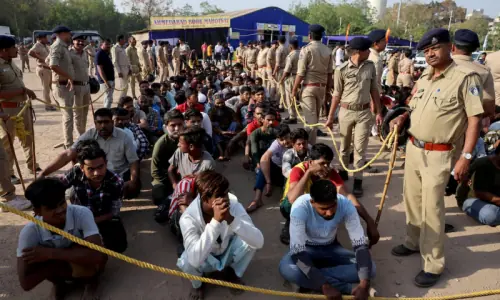
A photograph carried in this newspaper the other day showed the Karachi police taking several men accused of violating the Ehtehramul Ramazan ordinance to court. The law is promulgated every year with the advent of the holy month and prescribes punishments for anyone found eating in public. It also prohibits eating establishments from serving food during the fasting hours to any customer.
The intention is to preserve the sanctity of Ramazan and also not to offend the sensitivities of those fasting. However, as the photograph showed, the police seem to think that violation of this law amounts to a grave criminal offence, for why else would they have the offenders bound hand and foot by ropes while taking them to court? If the reason is a shortage of handcuffs then the police should obtain enough of these so that violators of laws do not have to suffer the ignominy of being taken to court like animals on the leash.
In a wider sense, the photograph reflects an increasing tendency towards sanctimonious behaviour among some in our society. For a start, one would like to see the police acting with equal zeal to arrest those who violate other laws of the land - for instance, those who kill in the name of honour, those who rape women, those who embezzle taxpayers' money or play with people's lives by selling spurious medicines or adulterated food.
There are many Muslim countries, particularly in the Middle East and North Africa, where the force of law is not used to coerce people into a display of piety. In fact, until the mid-'70s, in this very country too, serving food during fasting hours, discreetly and with shades down, was the norm for eating establishments. All that changed with Ziaul Haq and now we have to bear with scenes of men being humiliatingly roped and taken to court like animals, because they ate or drank in public.