0
0

At last the government, which has been claiming of having sufficient wheat stocks for the current year (2004-05) despite reservation of independent analysts, has decided to import one million tones of the commodity to meet the estimated requirement of the country during the year.
The high hopes of the government for having good wheat crop this season have dashed to the ground due to early and bit severe summer and later unexpected rains in Punjab - the major wheat growing area of the country.
According to the official figures, the total requirement of wheat of the country for 2004-05 will be 20.25 million tonnes. This includes 10.55 million tonnes for Punjab, 4.31 million tonnes for Sindh, 2.97 million tonnes for NWFP, 0.97 million tonnes for Balochistan, 1.0 million tonnes for seed, feed, etc., and 0.45 million tonnes for other miscellaneous purposes.
The expected official wheat output of the country during the year 2003-04 has been calculated as 19.75 million tonnes which comprise 15.85 million tonnes from Punjab and 2.1, 1.1 and 0.7 million tonnes from Sindh, NWFP and Balochistan respectively.
However, keeping in view the lowest ever carryover stock (160,000 tonnes) in the history of the country, it was being feared that the government will not only miss its extremely optimistic targeted output by a fairly wide margin but would not even be able to procure enough wheat to maintain the strategic reserves for food security of the country.
Independent observers have warned that the crop looks insufficient to underwrite post-harvest losses, seed retained for the next cultivation and wide scale purchases by the private sector.
They also mentioned another important factor that due to lack of proper storage facilities and techniques available with the private sector, a sizable stock retained by the private sector is likely to be lost in case of early monsoon season and humid climate which would be a national loss at the end.
Agriculture in Pakistan has been subjected to high degree of government influence and intervention since long. Because of the importance of wheat, there has been strong government involvement in the wheat sector since the late 1950s.
Ban on inter-provincial and inter-district wheat trading by the private sector on the start of harvesting season has become an annual routine in order to facilitate government procurement of wheat from surplus production areas.
The provincial governments' decision to enforce the ban on wheat movement in certain districts of Punjab and Sindh not only denies its previous claims of level playing fields to all the stakeholders but it also kicks out the private sector from the ongoing wheat procurement drive in the affected areas.
It would be worth mentioning here that while announcing the wheat procurement policy, the government had ruled out the inter-district or inter-provincial ban on wheat movement during the procurement drive.
A combination of sector specific trade and micro economic policies in our country are said to be used in an effort to maintain low consumer prices, achieve price stability for farmers and support the agricultural processing industries.
As a matter of fact wheat prices in the country have always remained low relative to import prices. Therefore much of the benefit of cheap wheat is received by foreign producers and floor millers rather then consumers.
The Agricultural Prices Commission recommends the support price of all major agricultural commodities (wheat, rice, cotton, suga cane, gram, non-traditional oil seeds, potatoes and onions) each year before the planting season.
The intention, no doubt, is to encourage production and protect farmers from cost increases. But certain loopholes in the policy and mismanagement on the part of concerned agencies have not yielded the desired results.
The perception behind the support price idea is that increase in wheat support price will encourage higher investment in wheat production and promote agricultural productivity thereby benefiting the majority of the population which lives in rural areas and to safeguard the interests of consumers by making supplies available at reasonable prices.
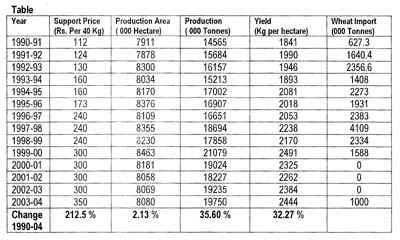
But the objective of the government to encourage farming community for higher production on the mere basis of support price increase has never been achieved as yet. The table does not show any significant impact on either yield or area whenever support price was increased.
The decision of farmer to grow more wheat depends upon over-all prices of all cropping pattern available before him. It does not depend just on relative price of wheat compared to other crops but depend upon relative price of inputs of wheat relative to other crops.
The farmer does not look at one price but he calculates the relative prices of various crops that he can grow and also the expected profit margin. So it will be wrong if one assumes that the decision of farmers to grow any crop depends upon support price.
Further, the support price is intended to be minimum guarantee at which the government would purchase the commodity in case private sector doesn't. The support price, in any case, is not a fixed or controlled rate at which the growers are liable to sell their produce, either to the government or the private sector.
No doubt that in most of cases farmers sell their produce to government at harvest as they have little storage capacity and do not want to take risk of spoilage. But it does not happen all times, as the case during current year is. The low carry-over stocks and uncertainty about stocks and supplies have pushed the commodity price quite high to that of support price.
Therefore wheat farmers are preferring private sector rather than government agencies for selling the harvest to maximize gains on their produce. Despite reduction in wheat rates in recent days, private sector parties still offer Rs 360-370 per 40-kg of wheat to the growers against government offer of Rs. 350. It is the basic right of a grower to sell his produce to whoever offers a good price.
Pakistan needs at least 5.3 million tonnes of wheat to maintain the strategic reserves for ensuring food supply of the provinces. Provincial food departments and PASSCO have so far been able to achieve half of this target and are facing problems in wheat procurement despite of using all sort of unjustified administrative measures as the private sector offers attractive price as well as better incentives to the growers.
What needs to be understood by our policy makers is that the prolongation of such non-farmer friendly policies bodes well neither for the farming sector,nor for inter-provincial harmony nor for the well-being of the common man.
The answer of a vital question that why Pakistan has not sustained wheat self-sufficiency with such a strong agricultural background lies in the failure of government's wheat policy whose sole objective is an assured food supply and provision of cheap flour.
The government has neither achieved food security nor the protection of the common people from paying high price for wheat/flour. It is estimated that the government will have to spend next year over Rs 5 billion on subsidy for importing one million tones of wheat.
Instead, the government should take concrete steps to bring down input costs of agricultural produce, timely unveil farmer friendly policies and cut official levies on seed, fertilizer and pesticides to facilitate the farming community.