0
0

Army's 'tail and teeth'
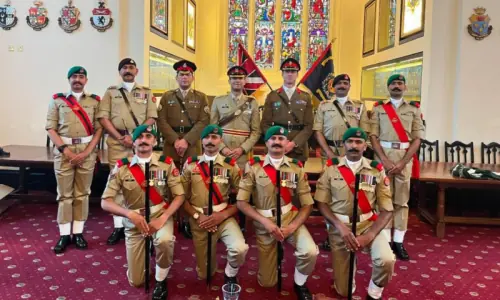
This is with reference to the news item (April 28) that the Pakistan Army is planning to reduce its operational strength by 50,000 troops, as decided at the formation commanders meeting held on April 27.
This move is aimed to "shed the long tail" and sharpen the "teeth" of the army. Time and again it has been said that western powers want a lot more from the improving relations between Pakistan and India than just peace and tranquillity in the region.
They will then pressure Pakistan to shed its "long tailed" army as a threat from India would have been neutralized and Pakistan would, therefore, no longer need to have a strike force. It would then be an ideal moment to coerce Pakistan into surrendering its nuclear programme which would then be seen as redundant and dangerous.
I hope it is just a coincidence that this decision comes at a time when the usual flirting between Pakistan and India seems to be taking a serious turn for good at the behest of more powerful nations for their own vested interests.
Peace or war, it should be very well understood that the Pakistan Army is the true custodian of Pakistan's ideological and geographical boundaries and at present is the biggest deterrent for our enemies.
Already India enjoys a 2:1 ratio against Pakistan in terms of troop strength and an even greater difference as far as military hardware, equipment and conventional weapons are concerned.
Instead of shedding the tail by reducing troop strength, the teeth should be sharpened by acquiring modern and state-of- the-art equipment and by improving the operational and strike capabilities of our armed forces.
ALTAMASH J. LONE
Karachi
(2)
I have read the interesting news that the army is being reduced by 50,000 troops. Although the number looks quite big in terms of savings which will eventually accrue to the national exchequer, its effectiveness will greatly be hampered if it is done purely for the sake of downsizing the army and pleasing certain quarters.
It is a well-known fact that 'the army of brigadiers and full four-star generals' in Pakistan is the one of the world's most privileged in terms of their remuneration, retirement benefits, allocation of residential and industrial plots and agricultural lands, to name a few perks.
It is also a fact that the size of this "generals' army" is 10 times bigger than what we had in 1965, including the then East Pakistan. If you reduce the number of generals, it would be cost effective and strategic effectiveness would also be achieved.
We need an efficient, effective, economical and deterrent defence force which could protect the borders of the country in a meaningful manner. Bringing down the huge pay packages of generals and reducing their number would bring more results that sending 50,000 soldiers home.
N.M. ABBASI
Lusaka, Zambia
America's Big Brother role
This is with reference to the letter by Ms Natasha Kamal (April 15) on the above subject. The world did not become an unsafe and violent place all of a sudden after 9/11. It had been unsafe and violent throughout the 20th century. And it could have been lot more worse if the United States had not taken a stand against the rise of fascism in Europe and the spread of communism after World War II.
It is not the United States bullying other nations; it is us bullying ourselves by blatantly ignoring reality when we use phrases like "so-called terrorists" and "so-called war on terrorism". There is nothing so-called here. These are the real threats of the 21st century. And once again the US is determined to take a leading role to fight them off.
Ms Kamal says: "(America) is struggling to maintain its position as the world superpower. It does not care whether the majority of the people support its stance or not; all the Americans know is how to keep their heads above the murky waters of economic decline, one way or another, by hook or by crook.
The US has always loved playing the role of 'Big Brother Watching...' and has destroyed many nations in the process. Its hold on the United Nations and the Security Council is unprecedented. No one has the guts to go against the US, as their foreign aid and their lives will very conveniently be cut off."
How does one respond to this generalization except to say that none of this is true. Why does she say that? Under what condition(s) are these arguments true? If it is about Iraq, then let me say the US saw Iraq as a serious threat to world peace and that's why they invaded Iraq.
This stand of the US is debatable, but the point is they did not invade Iraq because they were struggling to maintain their position or they didn't care about majority opinion or that something is wrong with the economy.
If the US hold on the UN Security Council is unprecedented and no one has the guts to go against the US, then how come France and Germany did not join the invasion of Iraq?
The media in the West is indeed independent. If some news channels' reports/programmes are biased, it is because they have their own agenda and not because they have special instructions from the government. Where there is biased reporting, there is also equally unbiased and honest reporting as well.
KHURRAM HANEEF
New Jersey, USA
'Who is the greatest Bengali?'
Mr Anwer Mooraj considers Satyajit Ray as the greatest Bengali of all times, in his article "Who is the greatest Bengali?" (April 26). Satyajit Ray was not only the greatest filmmaker India has ever produced; he continued his grandfather's and father's tradition of writing children's stories in Bengali. These writings - short stories, detective stories and science fiction - are still immensely popular in West Bengal.
Ray's humorous detective stories became so popular that his main income was from the sale of books containing these stories while his films earned him little money. Even today, 12 years after his death, his books are at the top of the best sellers' list in Bengal.
As Mr Mooraj pointed out, his genius was multifaceted. He wrote the screenplay, did the editing and scored the music in most of his films. However, his superb films demand that the viewers should be culturally literate and sensitive.
I saw Ray's "Home and the world" in New York City where 90 per cent of the viewers were Americans. This is in contrast to Hindi films shown in the US, where all viewers are South Asians.
However, I will consider Rabindranath Tagore the greatest Bengali of all times because, with his poems, songs, essays, short stories, novels, plays and letters, he single-handedly elevated Bengalis to a higher level of life. He showed us beauty, ethics, love, rationality and spirituality. There is no educated Bengali in Bangladesh or West Bengal who does not know a few of his songs.
SHYAMAL PAIN
Kolkata, India
Banning jirga system
Sanity has finally prevailed; Justice Rehmat Hussain Jaffery of the Sindh High Court has banned in Sindh all trials under the jirga system under which judgments have been given that have shocked the nation and the global community.
Ordering the killing of a mature couple for having married without the consent of their families, authorizing the public gang-rape of a girl because her minor brother was suspected of having an affair with a girl in Punjab, forcibly giving away in "marriage" young girls as compensation for the murder committed by a male member of a family, killing men and women just because they were talking to one another and labelling them karo-kari were decisions which made us hang our heads in shame.
The all-male jirgas where women have no say work against the interest of women and their decisions are mostly made by the jirga head who receives a hefty bribe from men to give a decision in their favour.
Tribal chieftains sitting in jirgas do not know the laws contained in the Constitution, the Holy Quran and Sunnah. According to our Constitution and Islam, any adult couple can marry without the permission of the family, but, according to the jirga system, they dare not.
It has taken us 56 years to realize that the two judicial systems - the jirga system and the official legal system - cannot coexist in our Islamic Republic.
DR ZARINA KHAN
Islamabad
Safe blood donation practices
This refers to your editorial "Infected blood" (April 24). Your efforts to promote safe blood transfusion services in the country are highly appreciated. However, your recommendation of taking blood from patients' relatives is not appropriate. According to principles of medical science, only blood which is voluntarily donated and is properly screened is considered safe.
Numerous research studies conducted around the world, including Pakistan, suggest that blood donated by family donors is not as safe as blood donated by voluntary donors. However, the blood donated by professional donors is the worst.
As family donors mostly donate blood under family pressure, they are often reluctant to disclose their background. Verbal screening is also necessary, along with laboratory tests, to ensure the safety of blood in order to avoid transfusion of blood with pathogens in incubation period.
Currently, in Pakistan about 1.5 million units of blood are transfused annually both in public and private sectors. Only 20 per cent of blood comes from voluntary blood donors, 60 per cent from family donors and 20 per cent from professional blood donors.
Coordinated serious efforts are needed to increase voluntary blood donation to 100 per cent, which will solve the problems of blood safety to a great extent.
DR SHARAF ALI SHAH
Karachi
Iraq under US occupation
This refers to the letter by Mr Siddique Malik (April 28) in which he has tried to defend the US occupation of Iraq by stating that now the Iraqi people are "free" to criticize the government and to perform their religious rituals, something that was unavailable during Saddam's era. He has every right to condemn the dictatorial practices of Saddam Hussein, but making this a justification for the forcible US occupation of Iraq does not make sense as two wrongs don't make a right.
One is surprised to know that the Iraqi people are free to criticize the government, but what about the daily killing of scores of Iraqi civilians for demanding self rule which, I am sure, Mr Malik will agree is their birth right?
If the US is sincere in getting the people their democratic rights, why does it continue to support many undemocratic rulers in the Middle East and other regions of the world?
M. HUSSAIN SHAH
Hyderabad
US diplomat's statements
In the history of diplomacy it is hard to find an instance of an envoy voicing an opinion that is grossly in conflict with the policy of his own government. Such an envoy is the US ambassador to Afghanistan, Dr Zalmay Khalilzad.
So far there has not been any direct criticism of the envoy by the US government, but subsequent statements by the secretaries of state and defence lauding the role of Pakistan in combating terrorism are a covert hint to Mr Khalilzad not to issue statements maligning a valuable ally.
Dr Khalilzad's first statement was an open threat to Pakistan in which he had accused Pakistan of being a sanctuary for the Taliban "for planning and training and then coming back with weapons to attack".
He went to the extent of saying that in case Pakistan did not act, his country would act, meaning plainly that a military operation would be carried out on Pakistani soil.
Before reaction to this threat could abate, he came forward with another volley that Pakistan was not doing enough to stop intrusion of insurgents into Afghanistan.
Peace can return to Afghanistan only if the current administration is more efficient and receives more effective help from the international security force. Much of the turmoil is because of warlords and tribal dissidents who have nothing to do with Pakistan. If the trouble is coming from the remnants of the Taliban, Dr Khalilzad should use his own influence to contain them.
We know that he was working as a Taliban lobbyist in the late 1990s. He had been negotiating with them when he was a consultant to Unocal Corporation in connection with a proposed gas pipeline passing through Afghanistan.
He was also advocating recognition of the Taliban regime. He was, of course, promoting the interest of Unocal Corporation but the fact is that he pressed the US administration to engage with the Taliban.
In one of his articles appearing in The Washington Post, he had clearly stated that "we should be willing to offer recognition and humanitarian assistance to promote international economic reconstruction".
He had also said that "it is time for the United States to reengage the Afghan regime". It was only in 1998 that he changed his position. Maybe he has not totally broken off from his old friends. If this is so, he may use his contacts with them to contain the militants.
The news is that Pakistan has lodged a protest with the US on Dr Khalilzad's statements. A better course will be to approach the US administration, explain to it that the irresponsible statements of the envoy are unauthorized and hurting its national interest.
PROF MUKHTAR ALI NAQVI
Orlando, Fl., USA
Kuala Lumpur moot
This refers to "US: Israel may keep some of Arab land" (Dawn, April 14). The decision which has been universally criticized may get a few Jewish votes for Mr Bush but it is bound to further erode whatever goodwill is left for America in the Muslim world.
America is trying to rid the world of 'terrorism' but, on the other, its anti-Muslim decisions are creating favourable conditions for 'suicide bombers' and 'terrorists' to breed unhampered. America ought to realize and understand that the masses in the Muslim countries continue to condemn anti-Islam policies and are struggling to free themselves of the quislings who are toeing its line.
All eyes are now focused on Kuala Lumpur, where the Islamic conference is scheduled to meet in early May. Will it be the usual social get-together or will the leaders do some soul-searching?
AHMED SIDDIQUI
Karachi
Reference address
The Reference address given by me (Dawn, April 27) has created a wrong impression. The relevant part of the address is as under:
"The occasion for holding such reference did not arise as they were deprived of the honour to lay down their robes according to the normal practice on account of imposition of one-man constitution in the shape of the Legal Framework Order and the degrading manner in which the said chapter was closed, in so far as the judges were concerned, in the shape of the 17th Amendment. I assure all concerned that we held the four Hon'ble Judges in high esteem."
ABDUL HAFEEZ LAKHO
President, Sindh High Court Bar Association, Karachi
Dow Medical University
With the recent passage of the Dow University of Health Sciences Bill (Dawn, April 27), a new medical and health sciences university has entered the national arena of higher education. Indeed it is a step in the right direction and a move forward from the purely clinical to more universal health sciences and research.
The Punjab University of Medical and Health Sciences is another example where much precious time and energy were wasted on politicking both before and after its establishment to the point where the president had to step in. It was a very sad reflection on the medical community.
The critical test of the new VC will lie in building a strong and skilled academic team with strong globally acceptable academic credentials.
DR SYED MOHAMMAD
Karachi
Improving public transport
Karachi is the most modern metropolitan city of Pakistan, where public transport is widely used. The majority of commuters are students going to schools, colleges and universities. Unfortunately, the number of buses and coaches is small and public transport cannot cater to the needs of the people.
As the population is increasing fast, more people require an efficient public transport system so as to travel cheaply and safely. People going from Landhi and Malir areas towards the Super Highway, Gulshan-i-Iqbal and Gulistan-i-Jauhar, as well as those transiting through Malir Cantonment, face great hardship due to a shortage of buses.
The relevant authorities are requested to increase the number of metro buses and maintain their efficiency. They should also ensure on a priority basis that the commuters have a better transport system.
AFSHAN ZIA
Karachi
Zia's laws
This refers to Mr Usmani's letter of April 26 on the above subject. I fully endorse his contention that never before General Ziaul Haq had anyone used religion so hypocritically for the advancement of his political agenda and that his ordinances have brought about nothing but injustice.
I propose that all the ordinances promulgated during Zia's regime should be reviewed and if found repugnant to the Holy Quran and Sunnah, they should be repealed.
NAEEM AHMAD KHAN
Karachi
Currency notes
The government recently announced that currency notes that have marks or writing on the picture of the Quaid-i-Azam shall not be acceptable as legal tender. I propose that the government should also ban the use of staples which are a cause of early wear and tear by making holes in the notes.
Unfortunately the banks are responsible for putting staple pins. Rubber bands or paper bands can be used instead of staples.
T. JAFFER
Karachi