0
0

KARACHI, April 7: Civil society organizations have an impressive history of substantial contribution to the socio-economic and political development in the country and there are new opportunities evolving gradually for NGOs.
Pakistan has also an excellent record of civil society organizations' contributions to the country's social, economic and political development.
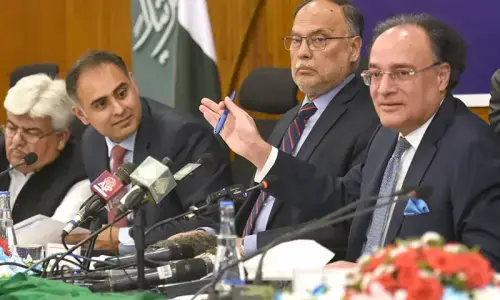
These observations were made by the Consul General of the United States in Karachi, Douglas C. Rohn, while speaking at a launching workshop of the NGO Institutional Management and Certification Programme (IMCP) held here on Wednesday.
The two-year programme is being implemented by the NGO Resource Centre (NGORC) with technical support from the Aga Khan Foundation (AKF) and funded jointly by the US Agency for International Development (USAID) and the AKF, USA chapter.
The US envoy highlighted the role of NGOs in the development of society organizations and said many NGOs had gained local and international recognition because of their commendable work in different sectors.
Yet, he added, a few organizations needed support to enhance their management capacities for an optimum utilization of resources as well as service delivery to the marginalized sections of society.
He appreciated efforts by the Aga Khan Foundation for civil society strengthening and socio-economic development in Pakistan. He also hoped that many NGOs would get benefit from this programme through different interventions of NGORC.
Appreciating the role of NGOs in development, Mr Rohn mentioned the contribution and acknowledgement of civil society organizations and NGOs in the recent poverty reduction strategy paper.
Convener of the Aga Khan Development Network (AKDN) for Pakistan Akbarali Abdul Aziz Pesnani highlighted the role and programmes of the AKDN in socio-economic development of Pakistan.
He spoke about the size and challenges for the NGO sector. He said that according to recent study, there were approximately 45,000 active non-profit organizations in Pakistan. However, these required a lot of improvement to achieve the objectives.
Most of the NGOs are small and community-based organizations. However, a significant number of them are graduating to a higher level of professionalism. They are not only realizing the need for institutionalizing processes and systems, but also making remarkable stride in their organizational development and management process.
Deputy Director of the NGORC Qadeer Baig highlighted salient features and objectives of the IMCP and the role of NGOs in the socio-economic development. Representatives of 40 NGOs from Sindh and Balochistan attended the workshop.
The participants shared their views on the programme and its features. They also expressed their willingness to establish a long-term institutional partnership with the programme. -APP