0
0

The export challenge
Pakistan's mixed performance on the export front in the past few months has led planners to worry about how to sustain export growth on the one hand and contain the foreign trade deficit on the other.
A sharp drop of 17.5 per cent in exports in February 2004 as compared to January has raised the target for the next three months to $1.2 billion. Exports in February came down to $902.52 million from $1.09 billion in January.
This was in contrast with the pattern during the first six months of fiscal 2003-04, when exports maintained a growth rate of 13 per cent to $5.8 billion as compared to $5.197 billion in the corresponding period of 2002-03. However, in November 2003, a drop of about 15 per cent to $860 million over the figure for the preceding month set the alarm bells ringing.
In addition, the country's foreign trade deficit rose to $974.17 million during the first seven months of fiscal 2003-04 over the corresponding period of the previous year. It was the rise in imports by 16.2 per cent to $7.9 billion in the same period that widened the trade gap.
The increase in imports has offset some of the achievements in the export sector which has benefited from exploiting non-traditional areas and better utilization of quotas.
While higher imports indicate a degree of resurgence of the national economy, Pakistan should take care not to make the mistakes it has made several times in the past of allowing unhindered imports at the cost of the local industry and export trade.
Over the past few years, the emphasis in Pakistan's exports has gradually moved from the export of raw cotton to more value added products. The textile industry increased its exports by 40 per cent during the last four years, and this includes the period when there was a global economic recession following the events of September 11, 2001.
A more ambitious target before the textile industry is to boost exports to $13 billion by 2005-06 when the tariff-free regime comes to be in place. These are achievable targets but only if the government continues to maintain consistency in its policies and be pro-active.
The decision by the European Commission to impose a 13.1 per cent definitive anti-dumping duty on bed linen imports from Pakistan with immediate effect is bound to affect exports. This needs to be tackled.
It is time for the government and exporters to look ahead and seriously chalk out a plan of action as there are two major developments in the offing that will have a direct impact on the balance of trade, particularly exports, in the coming few years.
As the WTO regime goes into operation in about a year from now, the country will be exposed to free market competition. For Pakistan to be competitive in the international market, it needs to ensure that locally made products are attractive internationally.
Quality and price need to be kept under strict scrutiny because of this. Also, with deliberations taking place to reduce tariffs between member states under the South Asia Free Trade Agreement (SAFTA), regional trade is expected to increase.
Trade between India and Pakistan will rise as a consequence and Pakistan has to be in a position to offer a wide variety of traditional and non-traditional items to India in return for a large variety of goods which that country would like to sell to us.
State terrorism won't do
As if the killing of the Hamas founder-leader Sheikh Ahmed Yassin were not enough criminal conduct, Israel's cabinet has now approved a hit-list of Palestinian leaders.
This policy of state terrorism is aimed at scuttling the 'roadmap to peace' plan, which is seen by all but Mr Sharon and his extreme rightwing colleagues as the last hope for peace in the Middle East. Israeli cabinet's decision, if allowed to be implemented by the Quartet - US, EU, UN and Russia - that pieced together the roadmap and that has the moral responsibility to see it through to its logical end, risks plunging the whole region into turmoil. Washington's muted response to the killing of the Hamas leader on Monday, simply advising both sides to refrain from violence, is indeed ominous.
It makes one wonder if the US is being handicapped by its own long-standing policy of blind support for the Jewish state; or is it simply a case of Mr Sharon taking advantage of the election-year politics in America? Regardless of what it is, there is no reason for the rest of the world to sit back and watch Israel put in action its premeditated and publicized policy of state terrorism.
By its actions Israel has shown time and again that no amount of global condemnation of its mad policies would deter it from implementing them. It is time the EU, UN, Russia and representatives of civil society within the Jewish state itself brought pressure to bear on Mr Sharon.
Since the beginning of the second Intifada in September 2000, over 3,000, mostly Palestinian, lives have been consumed by violence. The Israeli death toll has been no less than 900, and despite its oppressive policies, Tel Aviv has failed to stop suicide bombings against Jewish targets.
This should tell the proponents of violence in the Holy Land that there can be no military or unilateral solution to the Middle East crisis. A negotiated settlement based on the formula of 'land for peace' and the creation of an independent Palestinian state, as enunciated in the roadmap plan, are the only way to achieve peace that everyone can live with.
Slum dwellers' plight
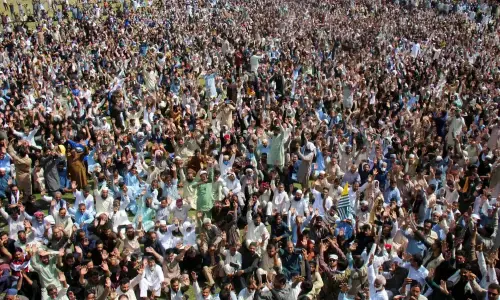
A recent demonstration, staged by the slum dwellers of Islamabad and Rawalpindi against the slow implementation of the 2001 National Policy on Katchi Abadis, reflects the growing despair of 30 per cent of the population that continues to suffer under substandard living conditions and the constant threat of eviction.
The protest march was organized by the All Pakistan Alliance for Katchi Abadis (APAKA) which, earlier in the year, had warned that slum dwellers would hold regular demonstrations against the Capital Development Authority until the government took steps to enact the provisions of the Katchi Abadi policy.
These include a halt to forced evictions, granting of ownership rights or resettlement of slum dwellers and the provision of basic facilities like gas, electricity and water.
Unfortunately, in Islamabad, as elsewhere in the country, the government has been slow to take appropriate measures to ameliorate the lot of slum dwellers living in the capital's numerous squatter settlements.
Summary evictions have not been stopped and many families have no choice but to leave their home of decades without being given alternative accommodation by the authorities. Still others are waiting to be granted their housing rights, a delay that continues to hinder their access to better living facilities.
In this scenario, the government's apathy is most galling. Even though specific measures have been prescribed to ensure more secure and habitable conditions for slum dwellers, there has been little attempt to adhere to these.
In fact, the authorities have actually had a hand in increasing the misery of the slum dwellers, and as such, stand accused not only of overriding regulations but also of harbouring vested interests that do not allow for betterment.
One therefore fully sympathizes with the protest tactics employed by the slum dwellers, who have been left with no other means of drawing attention to their tragic plight.