0
0

KARACHI, March 7: The federal minister for health on Sunday lamented the growing commercialization in the medical field. He urged the specialists to play their due role for providing cost-effective health care to the poor.
M. Nasir Khan was speaking at the inauguration ceremony of the joint conference of the College of Physicians and Surgeons Pakistan (CPSP) and Bangladesh College of Physicians and Surgeons (BCPS). The three-day event is being largely attended by doctors from the two countries.
The minister asked the specialists to follow the ethics of their profession. He observed that the poor, who could not afford to pay high fees, deserved attention as much as the rich. "The primary need is to set personal examples and invite others to emulate them," he explained.
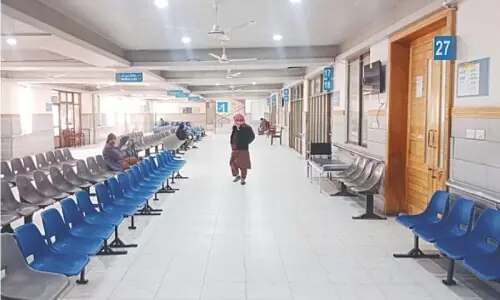
The government was fully aware that most of the public-sector hospitals lacked basic equipment and supplies and thus provided little support to the under-privileged, he observed. However, the government had initiated some urgent reforms to set things in order.
The minister also emphasized the need for standardizing post-graduate education in the country so that the Pakistani degrees were universally recognized. The standard of teaching and training at the post-graduate level should be such that the name of the Pakistani doctors becomes synonymous with quality.
Mr Khan said there was a dire need to update the medical education programmes both at the under-graduate and post-graduate levels by making full use of information technology.
Speaking on the occasion President of the BCPS, Prof M. A. Hadi, said his country had made considerable progress. "We are now self-sufficient in staple food and fertility rate has come down from 3.8 per cent to 1.3 per cent," he said.
In Bangladesh, he said, the child mortality rate had also come down from 120 per 1,000 children to 57. The main focus of the government was now poverty, education, health and development of infrastructure.
President of the CPSP, Prof Sultan Farooqui, said the ongoing conference marked the Silver Jubilee of the Department of Medical Education. During the moot approximately 200 scientific papers would be presented at different sessions on medicine, surgery, orthopaedics and trauma, dentistry, radiology, cardiology, gynaecology and obstetrics, paediatrics, anaesthesia, intensive care, ENT, ophthalmology, neuroscience, pulmonology, urology, transplant surgery, and family and community medicine.
Later, the federal health minister inaugurated an exhibition organized by various pharmaceutical companies and went to each stall. During the day, various lectures and programmes were held.
The first state-of-the-art lecture was delivered on "Thyroid Surgery: Triumph and Tragedy". Prof M. A. Majid was the main speaker and Prof M. A. Hadi was the chairman.
The second state-of-the-art Siddiqui Memorial Lecture, on "Challenges in Urology/Nephrology Transplantation in Children" was delivered by Prof Adibul Hasan Rizvi. Prof Ahsanullah chaired the session.
Prof Rizvi said that until four years back, children were treated as 'small adults' at the Sindh Institute of Urology and Transplantation. Today, however, fully fledged wards had been established there which dealt with Paediatric Nephrology, Urology, etc.
The children were often presented at the SIUT so late that it was impossible, in 55 per cent of the cases, to make satisfactory diagnosis, said the professor. "This figure contrasts sharply with the figures from North America, where diagnosis cannot be made in only five per cent of the cases."
He concluded by asserting that separate and fully equipped hospitals or health units were needed to handle kidney-related problems among children. "These units should have facilities for dialysis, transplantation and other surgical operations."
Many such units are needed because more than 50 per cent of the population is made up of children. There is also a shortage of professionals trained in Paediatric Nephrology and Urology.