0
0

Living off the future
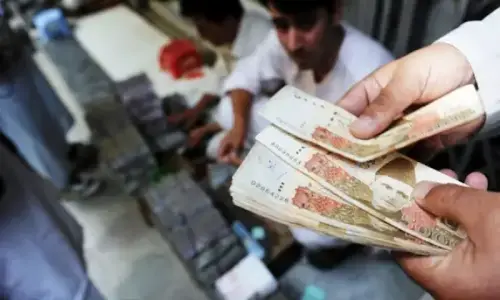
MR M. A. Ghaffar’s letter (Dec 4) is the first expression of concern in the print media on the ill-advised “borrowing culture”, espoused by some in the corridors of power, which is adding another destructive feature to our plethora of distorted priorities.
Having already lost half a century in the economic race due to confused, misdirected, distorted and kickback-driven investment decisions, we are now knocking at the wrong door to boost our falling fortunes.
The borrowing-based surge in demand will, for a time, bring ostensible prosperity in a small non-vital and privileged sector of economy, automobiles and consumer durables. But after the next two/three years when instalment defaults start because of burgeoning unemployment and declining incomes, a race will start for recovery or, for the lucky and influential ones, waivers and write-offs. In this process, innumerable families and many banks will regret their hasty and easy-looking decisions, and will face painful outcome therefrom.
It is inevitable that indiscriminate and unwise loans ultimately end up as a charge on the country’s budget. Defaults cause increased interest rates, falling investments and decline in general profitability and government revenues, leading to higher public and private borrowings with a spiralling effect on inflation, cost increases and liquidity squeeze.
Formation of a large pool of national invertible resources and streams of cash flow need consistent saving patterns. Look at India which has a high saving culture where 15-20 per cent of incomes is saved. For the first several decades, our neighbours lived frugally. With savings and wise investment in education, scientific and technological institutes, engineering industry and basic infra-structure, as well as with an emphasis on public convenience and needs, India has built a very sound economic base which has catapulted it into a fast-developing country with international recognition.
With comparable resources, we have withered and continue with a begging bowl. We have a lot to learn from our neighbours if we have the courage to acknowledge and emulate good performance.
We must have an entirely new, practical and people-based (instead of an elite-based) philosophy of economic restructuring and do away with repeating our decades-old ostentatious habits of high living and low thinking, and achieve some economic muscle based on our own inherent strengths and resources to safeguard our independence and national solidarity.
Following advanced countries’ tools of periodic demand boosts, without a basic functioning economy having its own momentum, would only create more distortions in our case and further lower our meagre savings propensity.
S.H. TEHSIN
Karachi
Israel’s security misperception
THIS refers to the article by Eric S. Margolis, titled “A realistic peace accord” (Dec 10).
Jimmy Carter in his article to The Los Angles Times wrote: “Do we want permanent peace with all our neighbours, or do we want to retain our colonies in the occupied territories of the Palestinians? America’s worst betrayal of Israel would be to support the second choice.”
To address the challenge of peace in the Arab-Israel conflict, the US has been and will be the key player both overtly (the US central command) and covertly (the US diplomacy).
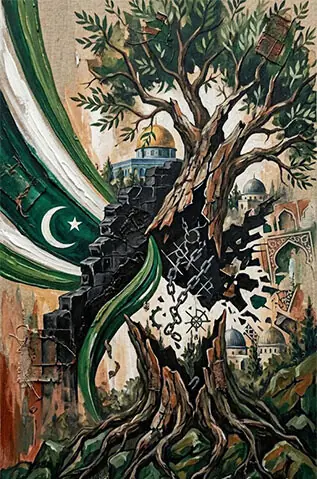
The Geneva document of Dec 1 envisages a possible return to “status quo ante-bellum” of pre-1967 war; hence authoring a future Palestinian state comprising the Gaza strip and 98 per cent of the West Bank, with provision for a divided sovereignty over Al Quds. The plan is, thus, seen by both the “neo-cons and the Likud’s advocates” as a wrong international move by the moderate Israelis and Palestinians, because of its being an anti-thesis to their close-fisted thinking of the Palestinian solution.
Yet one must recall that the UN resolution 242 on the question of “inadmissibility of acquisition of territory by war” could not provide for return to the 1967 boundaries for the so-called good reason that those “boundaries were bad boundaries for a permanent frontier”.
But the UN resolution 681 passed on Dec 20, 1991, by the UNSC envisages Arab-Israel resettlement of disputes regarding the issues of self-determination of Palestinians, Arab refugees and the active protection of the Palestinians in occupied areas against brazen violations of the Geneva conventions by Israel. Who can deny that the only country that can pressure Israel to accept this is the US as it regulates an annual aid of more than three billion dollars to Israel? Jerusalem is the nucleus of differences in the Quartet agreement. Israel persists in endeavours to annex Jerusalem and continue building the concrete encirclement of the whole city — a naked violation of international law which virtually rules out any moving forward prospects of Quartet agreement of April 30.
Tel Aviv’s presumptuous belief that the legitimate security or sovereignty of Israel may only come from gabbling and holding a neighbouring territory, and from dominations of arms, forts, outposts and fences, is a most dangerous deception.
Irrefutably, peace can only be achieved from a gateway to agreement that would guarantee withdrawal by Israel from Palestinian territories; and yet a lasting peace in the region still remains a distant illusion given Israel’s intransigence and the Arabs and Palestinians’ weak position in the present situation.
S. Q. AFZAL RIZVI
Karachi
Recreation resorts for Karachi
OUR city needs many things. A Disneyland-type project at Clifton is not one of them. While our rulers mutter the mantra “good governance” in their sleep like the name of a dead lover, most citizens of Karachi have yet to see much tangible benefits in the quality of their lives, improvement in infrastructure, a responsive administration or, for that matter, basic civic services and amenities.
Our city government, the KBCA and numerous other agencies have been quick to exploit the lucrative commercial opportunities presented by rezoning open spaces, allowing billboards and “regularizing” blatantly illegal and anti-social constructions of unspeakable ugliness. In their zeal to cash in on the bonanza while power lasts, permanent damage is done to the quality of life, health and mental well-being of city dwellers.
Greed and corruption have bypassed all principles of metropolitan planning and development and the expert, well-meaning advice provided to the KDA since the ’50s.
Old Clifton is one of our most important “heritage” locations. It defines our port metropolis and should be preserved. Why can’t Karachi’s Clifton beach be more like that in Sydney, Vancouver and San Francisco or for that matter in Algiers? We are on the same planet.
My advice to the city government is: forget these vulgar commercial ventures which blight the city, create more noise and pollution and put additional pressure on the crumbling infrastructure.
What is needed, instead, to balance the present urban blight are green open spaces, parks and botanical gardens, where citizens can stroll, recoup from the toils and frustrations of the day and reflect upon their battered lives.
Disney-type adventure park? I think not. The daily dance with death, the Russian roulette on the roads and the struggle to survive is adventure enough.
S. OMAR AHSAN
Karachi
Lessons we should learn
TOMORROW, on Dec 16, we will again remember the dismemberment of Pakistan and the creation of Bangladesh. The print and electronic media will have talk shows and discussions on causes of the break-up. There will be “finger-pointing” sessions wherein “experts” will elaborate on factual accounts and analysis about what happened and who was responsible for this national tragedy.
It is all very well to examine, diagnose and dissect the tragedy more than 30 years later, but if we don’t learn any lessons from the foibles of the past, we are likely to repeat the same mistakes.
We, the citizens of Pakistan, need to be aware that the menace of sectarianism and ethnicity can bring about another debacle in our lives. We have to be impartial, judicious and honest in our ordinary day-to-day dealings. The impetus has to come from the grassroots’ level, because our politicians are certainly not going to change overnight, to become statesmen that we can look up to. For the politicians we are all expendable. The generals and the politicians were running the country when Dhaka fell, and the generals and politicians are running the country now.
Don’t get me wrong. I have great respect and admiration for Gen Musharraf and some of his “experts”. However, statements like “put Pakistan first” are mere slogans if they are not backed by sincerity and honesty.
The Biharis — the stranded Pakistanis in Bangladesh — also put “Pakistan first”. Look where it got them.
SALMA SHAKIR
Dhahran, Saudi Arabia
Ordeal of a retired govt employee
THIS is with reference to the letter “Ordeal of a retired government employee” (Oct 31) by Muhammad Farooq regarding the problem faced by one of his uncles, a retired government employee, in getting his pension settled by the relevant accounts department.
The ordeal faced by retired government employees in getting their pensions and GP funds is not a new phenomenon. They invariably face great hardship in getting their pensions and provided funds.
A retired grade-21 government is also facing difficulties in getting monetary help on account of reimbursement of medical expenses, to which he is entitled as per the law.
He retired from service about 23 years ago and is an extremely sick and weak person now. He is suffering from a number of ailments, including angina, vertigo and high blood pressure. However, the ministry of law and justice, in which he worked for more than 11 years, has not cared even to acknowledge receipt of letters by him on the subject. The man is dying and the ministry is not concerned. What a pity!
The law secretary and the chief justices of the Supreme Court and the High Court of Sindh are requested to get appropriate medical treatment for this old person to show commitment to the welfare of old citizens.
CHANDIO MUNIR AHMAD
Thatta
PCB chief’s plain talk
I AM very pleased with the following statement recently made by the new chief of the Pakistan Cricket Board:
“When we are responsible for the security of the visitors, and we can provide it anywhere in Pakistan, it would be inappropriate that visitors decide whether to play at any particular centre.”
Enough is enough. How can a visitor be a dictator, and cities like Karachi, Hyderabad, Quetta and Peshawar be ignored so royally?
I am glad with the statement Mr Shaharyar made on the BBC that security is a country’s responsibility. I am sure people of these cities will be of great help to the government in maintaining security in the country.
M. ABID
Burr Ridge, Illinois, USA
Of supreme national interests
PRESIDENT Gen Pervez Musharraf has rightly stated, while discussing the current water issue, that national interests must be kept supreme, ensuring justice to all provinces. “The judicious use of water is of critical importance to sustainable development and prosperity of Pakistan, therefore, all issues related to water should be approached objectively by all concerned and resolved in an amicable manner,” says a Dawn report quoting the president (Dec 10).
Surely, the above criterion of decision-making, i.e. national interest and justice, should be the underlying factors in all our decision-making processes at all levels. Among the many contentious issues like the NFC, job quotas and the budgetary allocation for the welfare of the armed forces vis-a-vis civilians also need to be decided on the basis of the above-stated criterion.
NAZIM F. HAJI
Karachi
Questions for FO
I FULLY agree with the remarks of Dr Omer Kiani (Dec 11) in which he has complained about the visa policies of the GCC member-countries with regard to Pakistan.
Every year, almost 100 billion dollars are added to the coffers of India by the Indian labourers working in these countries. If such a huge amount was coming to Pakistan, all our foreign debts would be cleared. But it seems our brothers in the Gulf are least bothered about that.
Why doesn’t the Foreign Office see this side of the picture? Why do authorities in the FO forget that they should be making policies for the betterment of Pakistan, not for pleasing others. This is a practice that the GCC countries are using, what is holding Pakistan up?
MUHAMMAD AQDAS
Stockholm, Sweden
Power supply suspension
THREE buildings on Sharea Faisal has been without power supply since 4pm of Dec 8, due to a conflict between the builders and the KESC.
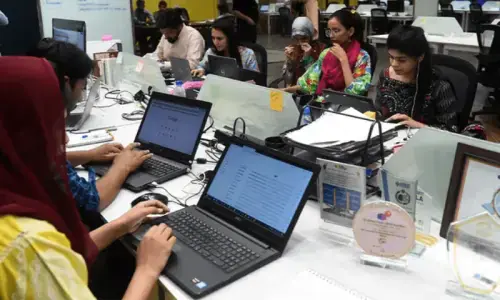
None of these buildings was issued any notice of this disconnection of power by the KESC. The builders have no more interest as they have already sold out offices in these buildings. These buildings house software houses, call centres and banks which are supposed to run round the lock to meet their targets but are suffering badly.
The higher authorities, when contacted after several attempts, are neither accepting nor rejecting this matter, as referred to by the KESC complaint centre of this area.
SHAHID LAKHANI
Karachi
Tribute to Maulana Noorani
Maulana Shah Ahmad Noorani had been a great inspiration and guide to many worldwide in the field of Islam. I, for one, will always cherish the memory of his friendship, the times he spent with me and my family, and the many tours we did together in Guyana, Trinidad, London, the United States of America and Canada.
He was indeed a genuine ambassador for the cause of Islam worldwide. I can say with no doubt that not only Pakistan has lost a great son, but also the entire Muslim world will feel his loss.
KHAKAN A. RAMZAN
Baldwin, NY, USA
Watercourses in Sindh
FOR many years about 40 per cent of the watercourses
in Sindh have been in bad shape for lack of maintenance. This results in reduced
water supply to agriculturists. Even annual clearance and maintenance is not carried out.
Shallow watercourses also result in floods and breaches of canals. The canals that used to be 15 to 35 feet deep are
at present only eight feet deep. Farmers at the ends of the canals do not get water owing to these shallow watercourses.
After coming to power, the government immediately took up canal cleaning work in Punjab and the effort has produced good results there. It must also do the same in Sindh, the second major agricultural province of Pakistan.
RAJA ABDUL HAMEED
KHASKHELI Khairpur Mirs
Bus-stand
IT is astonishing to see that upcountry buses are parked on the bridge of Banares Chowk near the Peerabad police station in Karachi. A nearby main road is also illegally occupied by these buses, but no one in the Karachi city district government tries to remove these encroachments, which are causing great hardship to the motorists and pedestrians.
MURTUZA KHAN
Karachi
Benazir has the right to be called Bhutto
WITH reference to the complaint and response of Sardar Mumtaz Ali Bhutto (Dec 9) to the letters by Mr Ashraf Khan and Mr Sarmad Palijo, I protest against the narrow-mindedness expressed by an unenlightened but educated politician from Sindh. This mentality shows how our feudal politicians take a woman of their family who has earned a name, and married the person of her choice from outside her clan.
In most Sindhi feudal families, it is an ingrained notion that a woman who marries outside her family is no more a part of her clan; she becomes an outsider herself. Such outsiders are referred to as “dharias” (non-relatives), especially when there are suitable matches available in the family. Notwithstanding Islamic principles and commandments, social taboos and dogmas base the normative system of the feudal lords.
If having the husband’s name as the second name is a social practice, as opposite to the Islamic principle, this is more important for a feudal like Sardar Sahib. If this criterion is to be adopted, retaining the barbarous practice of karo-kari will also prevail in our society, as will other similar practices.
I wonder what the stance of Sardar Mumtaz would have been if Benazir Bhutto, with the same reputation, had been married to a Bhutto cousin. Surely, the sympathies of the whole caste must have been with her, and maybe her exile would not have been allowed by this powerful clan, by putting some pressure on the government or perhaps by not being part of the conspiracy against her.
I am no supporter of Ms Bhutto as a politician, but, as a woman, I can’t tolerate an addendum of further taboos against women in our society, thereby causing more troubles for already suffering Pakistani women, be they Sindhis, Punjabis, Pathans or Baloch.
This is not a question of how Benazir’s Bhutto suffix is affecting the repute of the Bhutto tribe, this is all about the women and society, and the honour being attached to women alone. And being venerable is claimed by all: the Bhuttos, Shahs, Soomros, Mahars, Jamalis, Sheikhs, Lagharis, Lasharis, Orakzais, Bugtis — all are or consider themselves revered kin. What role Ms Bhutto has played is a totally different debate, which needs serious contemplation and saner arguments, not rhetoric like the one expressed by Sardar Sahib.
I hope Sardar Sahib does not mind my being a Sindhi woman from the same rural background, living very much inside the country. But let it be known to him that the name Ms “Bhutto” is as much and as strongly associated with the name of Benazir Bhutto as is Mr Bhutto with that of Zulfikar Ali Bhutto.
Finally, it would be no less a great service on the part of Sardar Sahib (and the likes) if he abandons his parochial and patriarchal thinking because enlightenment is what our downtrodden people need the most. Bread surely comes after that. Full stomachs and narrow brains are no answer to the suffering of millions of Pakistanis.
SANAM NOOR PECHUHO
Karachi