0
0

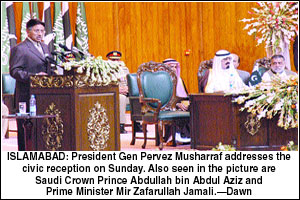 ISLAMABAD, Oct 19: Saudi foreign minister Prince Saud al-Faisal said here on Sunday that Indo-Israel military cooperation was a “worrying element” which could unleash instability and arms race in the region.
Speaking at a joint news conference with his Pakistani counterpart Khurshid Mehmood Kasuri here, he also broached the subject of sending troops to Iraq, saying Riyadh would wait for a request from the Iraqi nation before taking a decision on this matter. Mr Kasuri expressed identical views.
On being asked to comment on the recently concluded armament agreement in Delhi among India, Israel and Russia, Prince Saud said: “Indeed what we are hearing of this cooperation (Indo-Israel deal) is that it is aimed not at the good of the region, but to inflame the region, to further add to the arms race in the region.”
In the same context, he recalled how some Israeli think tanks demonstrate similar sinister designs in the Middle East concerning the “security of Israel”.
He observed: “It is a country of four million or so people that believes its security extends from the Indus River to the Atlantic Ocean.”
“What kind of nonsense is that — and it is a worrying element, it is another element of instability and insecurity and the countries of Asia should take account of that, we believe,” he added.
About the proposed Indo-Israel arms deal, he said “We have heard about making submarines capable of delivering atomic weapons. This certainly should worry rather than comfort India or any country of Asia.”
The Saudi foreign minister accused Israel of working since its inception against the stability and wellbeing of the region it is situated in.
“A case in point is its (Israel’s) history in the Middle East among Arab countries, spreading to its other parts of the world, Asia, will bring the same instability,” he cautioned.
Prince Saud al-Faisal commended “the wise” leadership of President Gen Pervez Musharraf in seeking a peaceful settlement of Kashmir with India as, he added, it was the right way to go about it.
Riyadh also recognized the Kashmir dispute as “chief problem”, and assured that the kingdom would do everything possible to help bring about a peaceful settlement of the dispute.
On the issue of sending troops to Iraq, both the foreign ministers said that Islamabad and Riyadh would wait for a request from the Iraqi nation on this matter.
Foreign minister Kasuri said: “If the people of Iraq ask for help, Pakistan as brotherly country will do what it can. But we will wait for that to happen.”
He said the people of Pakistan “have to perceive that the Iraqi people themselves are requesting for that.”
The Saudi foreign minister joined his Pakistani counterpart in emphasizing the need to further strengthen and consolidate their bilateral relations.
They pointed out that evolving a methodology to execute a plan of action for all-round development of Islamic countries would depend more on their commitment and will, since that was more important in any programme of development.
Agencies add: Both Pakistan and Saudi Arabia want to do “what is helpful to Iraq and the people of Iraq,” Prince Saud said.
But he said the needs for Iraq were “too large for us to meet individually.”
“If the Iraqi people express their desire (for troops) it will have to be from the Muslim Ummah all together,” he said.
“But this expressed opinion from the Iraqi people has not been shown to us and until that time, we will not send troops,” the Saudi foreign minister said.
Mr Kasuri said Saudi Crown Prince Abudullah bin Abdul Aziz held “in-depth talks” with President Pervez Musharraf after arriving here Saturday and there was “a great degree of consensus” between the two countries on key regional and international issues including the problems faced by Muslim world.