0
0

KARACHI, Aug 25: American unilateralism, its doctrine of unilateralism, quest for regime change by force, control of the world’s economic and strategic resources and its nexus with Israel came under scrutiny on the first day of a two-day international seminar here on Monday.
The seminar — entitled “External Power Politics in the Middle East and Regional Responses” — is being organized by the department of international relations, University of Karachi, in collaboration with the Hanns Seidel Foundation.
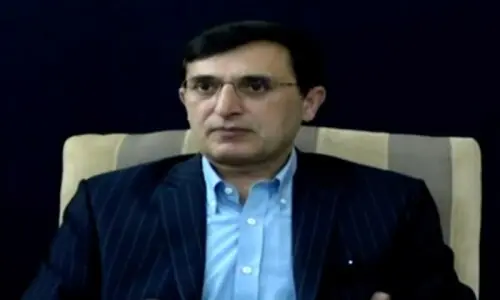
In his keynote address, Mushahid Hussain opposed the recognition of Israel until the establishment of a Palestinian state.
He said according recognition to Tel Aviv at this stage would weaken the Pakistani case on Kashmir.
He also opposed the deployment of the Pakistani troops in Iraq. He was nevertheless supportive of Gen Pervez Musharraf’s about-turn on Afghanistan.
He urged the Muslim countries, particularly in the Middle East, to empower their people because the problems facing them were mainly internal.
Tracing the American track record vis-a-vis regime change since 1953 when Dr Mossadeq of Iran was ousted, he expressed his dismay that under the American foreign policy people were being judged today according to their religions.
American policy-makers were again resorting to tactics aimed at changing regimes in an effort to politically reshape the Middle East, using issues such as oil, geopolitics, Islam, and anti-Americanism, he said.
Regarding geopolitics in the Middle East, American foreign policy was now driven more by considerations regarding Israel whose neo-conservative zealots had forged a coalition with the Christian fundamentalists dominating the ideological worldview and vision of the Bush administration, claimed Mr Mushahid.
Taking direct charge of the Middle Eastern countries’ destinies was one factor which had assumed permanency in their polity and this was what made regime change of today different from that of the past. In fact, the centre of gravity for the US strategy in the so-called War on Terror was the tilt towards Israel despite wide support to Washington’s policies after September 11, said Mr Mushahid.
He said the region must accept the fact that rise in ‘extremism’ had largely been due to three factors: the repression in the Muslim societies and the absence of egalitarian values of wealth- and power-sharing; Israel’s brutal suppression of the Palestinian movement; and, the policies of the United States.
The revival of the OIC as an institution which could speak for the 1.2 billion Muslims was also emphasized by him. He also suggested building coalitions.
Mr Mushahid said the Muslim World was facing the challenge of waging a ‘battle of ideas’ which the Middle East countries had failed to do so far. Instead of either capitulation, the preferred path of the Muslim regimes, or confrontation, the preferred path of the militants, there was a need for coming up with a considered, well thought out strategy among the regional countries so that they could preserve their sovereignty, protect natural resources, and promote their people’s aspirations for a better tomorrow.
He said Pakistan had already gone the extra mile in cooperating with the US in the ‘War on Terror’ and it need not place its own security interests and lives of its servicemen at risk for a cause that almost the entire international community held as wrong, immoral and illegal.
In the first session, Dr Ijaz Hussain of the Quaid-i-Azam University dealt with the influence of the neo-conservatives in shaping American foreign policy, especially since September 11. The primary aim of this group was to prevent the rise of a nation that could challenge the supremacy of the United States.
He dealt at length with the neo-conservative’s philosophy whose aim, he said, was to establish bases within and beyond Western Europe and Northeast Asia. The attack on the twin towers on 9/11 provided them with an excellent opportunity to do so.
Paul Wolfowitz and other American officials pressured President Bush to attack Iraq which he did on the spurious ground of possession of weapons of mass destruction and links with the outfits like the Al-Qaeda. This group would like Bush to turn to Iran next, following it with Syria, he said.
Dr Shireen Mazari, Director General of the Institute of Strategic Studies, made a presentation on “Paving the way for the Iraqi Invasion: Pretexts and Pressure Tactics”. She highlighted the nexus between the neo-conservatives and oil lobby.
She also dealt with the Bush Administration’s propaganda campaign against the Saddam’s regime to pave the way for a military action against Iraq. The Blair government’s posturing, as it moved closer to the US position, was also examined.
She also discussed the incentives promised and the pressures used to try and gain international and UN Security Council support for the military invasion of Iraq.
Dr Mazari was of the view that legally US and Britain could be subjected to sanctions for violating Articles 41 and 42 of the UN Charter.
She was critical of the anti-Islam and anti-Muslim bias in the Western media while dealing with terrorism.
Criticizing the Western double standards, she asked why the media there did not talk of Christian fundamentalists and why they regularly ignored certain groups in Ireland. She was also critical of the West’s vilification campaign against the madressahs and pointed out that none of the characters involved in the 9/11 attacks were educated at a madressah.
Dr Farooq Hasnat of the University of Punjab spoke about the Israel’s handling of the Oslo and other agreements. The Oslo Agreement was based on the principle of “Land for Security” and that by itself had become the biggest hurdle in the peacemaking efforts.
The crux of the Palestinian problem, he said, was that the peace process which had started in 1993 had been delayed for too long. The situation was further complicated by the coming in power of such warmongers as Sharon, he said.
As a consequence, by the end of 2000 the growing frustrations had pushed both sides to take opposite policy positions.
Prof Massoud Daher of the Lebanese University, Beirut, dealt with the evolution of the Palestinian National Authority from 1993 to the Second Intifada and historically traced the events that had shaped the Middle East.
Because of the Second Intifada, in September 2001, the Israeli forces occupied some Palestinian Authority areas which they were still occupying, he pointed out.
Ammara Durrani spoke about the Sharon government’s strategy and the escalation of violence in the Middle East. She maintained that since the coming to power of Sharon, the violence in the occupied Palestinian territories and Israel itself had become only one part of the Arab-Israeli conflict.
The events of September 11, 2001, followed by Gulf War II in 2003 as the most violent manifestation of America’s ‘War Against Terror’, had created several new aspects in the protracted Arab-Israeli conflict in which the Sharon government had played a crucial role.
In this context the use of high-tech weapons systems for killing Palestinians in populated areas was also mentioned, which incidentally, was not termed as an act of terrorism by the Americans.
Prof Shameem Akhtar’s presentation was on the “American Quest for Controlling the Middle Eastern Oil Resources”. His thesis was that the prime reason for the American aggression against Iraq was the 112-billion-barrel oil reserve in Iraq’s control which had been taken over by the Baathist government. The concessions to Russian, French, Algerian, Chinese, Vietnamese and Indian companies for the exploration of untapped oil reserves was also a factor.
After the American occupation of Iraq, a couple of American companies were the joint recipients of a no-bid two-year contract amounting to $7billion for extinguishing oil-well fires.
Similarly the USAID awarded eight contracts to favoured companies by side-stepping public tenders on the pretext of security. This blatant malpractice is in flagrant violation of the Fourth Geneva Convention.
Mr Akhtar said the US occupation of Iraq was aimed at weakening the OPEC by forcing Baghdad to quit the organization and flood the market with oil without any quota restrictions. As a result, therefore, the oil prices would come down, causing loss of revenue to the OPEC countries. This also meant cheap oil for America.
Dr Shaista Tabassum’s paper was on water as a source of regional conflict. In this context she pointed out that Middle East was facing crucial challenges due to the scarcity of water resources. The most volatile areas where water might trigger a war is the Jordan catchment area, shared by Israel, Syria and Jordan, she said.
Javed A. Ansari dealt with globalization as a challenge for the regional States.