0
0

 PESHAWAR, Aug 10: Mechanic’s assistant Tariq wipes his hand on the greasy rags that clothe him and sighs as he contemplates his weekly wage of 78 cents.
“What else can I do? I’m the only breadwinner in my family,” the 11-year-old says.
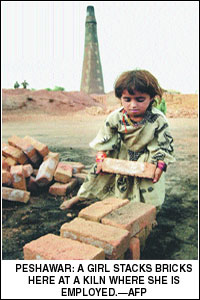
Tariq’s pitiful wage is typical of an estimated 35,000 Pakistani children toiling at over 5,500 auto workshops, brick kilns, carpet-weaving centres, furniture shops, sweatshops and shoe factories in this ancient north-west city.
They can also be found working in Peshawar’s tiny hotels, tea stalls and winding bazars.
Across the country, eight million children under 14 are locked into similar fates, according to the United Nations children’s agency Unicef.
“I know I am getting low wages but the day is not far when I will earn more,” says Tariq.
There’s not much to look forward to, if average adult wages are anything to go by.
Some 48 per cent of rural workers in the province — where illiteracy is estimated at 62.7 per cent — earn 30 cents a day or less, according to NWFP Senior Minister Sirajul Haq.
The last government survey of child labour in 1996 found 1.1 million children aged five to 14 years working in the NWFP.
Haseeb, 14, works in a small tea house. He came to Peshawar at the age of six to find work and feed his family in the border tribal district of Mohmand.
“I’m working also to collect money for my marriage because according to the customs of my area I must marry between 14 and 16,” he said, underlining the complexity of factors propelling children out of the classroom and into barely-rewarded workplace.
Imran, 9, is working in a carpet workshop because he has to feed his three little brothers and two sisters.
“I put my son to work in workshop because I cannot afford to send him to school,” his mother said.
Imran says he’d rather be working anyway.
“I want to be an auto mechanic just like my teacher,” he said.
Employers hiring children said they were pressed by parents to teach their offspring skills, noting the poor employment rates of graduates.
“We don’t force the children to work here. Their elders bring them here,” auto mechanic Shakoor Khan said.
“You tell me what these children will do after getting education? The government should provide jobs to educated youth first before talking about rehabilitation of working children.
“They should be grateful to us because we are teaching skills to children free of cost.”
The levels of school enrolment suggest many see it as futile.
In the NWFP, 55 per cent of boys and 38 per cent of girls are enrolled in primary school, compared to 58 and 48 per cent, respectively, nationwide.
The NWFP government has constituted a commission to review child labour, Law Minister Zafar Azam Khan said.—AFP