0
0

BASRA: Oil smuggling is flourishing in post-war southern Iraq. As the country’s mainstay hydrocarbon industry production and exports get underway, black marketers and smugglers are having a heyday with the same commodity according to British forces within the coalition’s Multinational Division (Southeast), Iraq.
The smugglers are using the same routes and methods used to break the pre-war United Nations sanctions under the Saddam Hussein regime, but now, more than just a privileged few are participating.
“They are doing it in broad daylight. We think that between 2,000 and 2,500 tons per day of different fuels are being lost to smuggling in the south,” said British Royal Navy Lieutenant Commander Richard Walters.
Mainly crude oil, diesel, and gasoline are being skimmed off the state’s industry to a tune of $200,000 per day in volume, “which would translate into $36,000 per day that normally would have been profit for the state,” said Walters.
The precious commodity is being taken overland by tanker trucks, or aboard barges and other vessels down the Shatt al-Arab waterway that flows through Basra, and out to the Persian Gulf.
At least one barge laden with an estimated 250 tons of stolen and smuggled oil slips down the Shatt al-Arab waterway daily, said Walters.
Along the attractive waterfront in Basra, the ancillary welding trade aboard barges and ships, necessary for oil smuggling, is also flourishing.
Dozens of diesel generators feeding arc welders are wheeled up next to barges and ships whose fuel tanks and hulls are being reconfigured, presumably to carry smuggled oil.
“We are welding bigger tanks on the ships so they can carry oil down the canal, to sell it,” said one welder, Ali, who was working on a 52-metre grey barge. “The ships would carry oil, gasoline, or diesel, down the Shatt and sell it on the high sea to larger ships,” he said, adding that his welding business aboard the vessels had picked up considerably since the fall of Saddam Hussein.
A newly installed Iraqi police force and a new 500-member Iraqi river police unit are working to curb the illegal oil trade, but the forces need more training, equipment, and patrol boats.
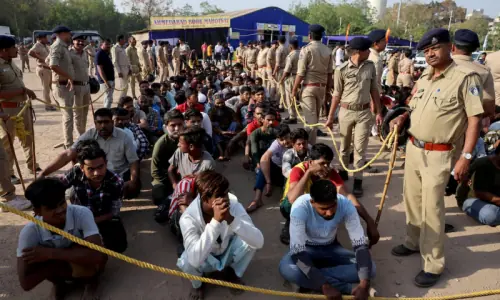
Walters said that coalition forces and Iraqi police had recently impounded 50 tanker trucks of stolen fuel near Basra and made several arrests. But 35 of those trucks were returned and those arrested were released either on bail, or asked to reappear in court sometime in the far future.
“They could go back and smuggle if they were so inclined,” said Walters. Smugglers are tapping into unguarded pipelines, a task which requires the proper industry technical know-how and tools.
“They even know how to plug the line and revisit it to steal another day,” added the British Navy commander. Points of delivery for the oil remain unknown to the Coalition Public Authority (CPA) officials in Basra, but they suspect that much is being sold to ships in the Persian Gulf.
A US Navy-led Maritime Interception Force (MIF) stationed in Bahrain were originally deployed to hunt ships laden with Iraqi oil, which were breaking UN sanctions. But with sanctions lifted, their duties have scaled back and the legal jurisdiction for those caught smuggling Iraqi oil in international waters is now in debate, Gulf shipping sources said.
Where would the Navy send the vessels and crews caught, asked one trader.—dpa