



 0
0

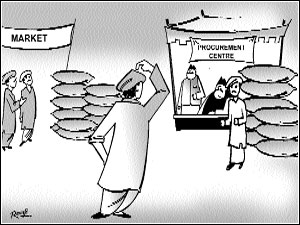 In an article entitled “APCom Survey Demolishes Wheat Support Policy” published in the EBR weekly (June 2-8,03), Syed Shahid Husain has highlighted the results of survey data published in the report “Economics of Wheat Production Results From Field Surveys in Punjab and Sindh.”
He has raised a number of issues relating to the selling of wheat by various groups of farmers at the government procurement centres, prices received at various sale points, cost of production estimates etc. He has criticized the APCom for espousing the cause of support price policy for agriculture.
His observations are reproduced below and then commented upon.
Sale points:
i) “Interesting part of the survey is that a very small percentage of farmers sell their marketable surplus of wheat at the procurement centres (PCs), established by the Government to buy at the support price.”
ii) “Eighty-one per cent large Punjab farmers and 84 per cent Sindh farmers used the PCs. This negates the claim on behalf of the APCom that the support price helps the poor or the vulnerable.”
iii) “In terms of land tenure (owner, owner-cum-tenant and tenant) no tenant sold wheat at PCs. Owner-cum-tenant used the PCs the most, i.e. 85 per cent; 37 per cent owners sold wheat at the PCs. So much for the poor farmers purporting to be supported with price ‘fixation’.”
iv) “Similar results of support price bias in favour of the big landowners are manifest in the farm size.”
Prices received:
v) “The farmer got a higher price both at village and the mandi outlets than he received at the PCs. That he received precise amount of the support price at the PCs is a myth, which only APCom would like to believe.”
vi) “Another interesting feature that emerges from the analysis is the prices. Farmers received more prices at village and,’mandi’ market than at the PCs.”
vii) “The survey perpetuates the myth that the farmer receives the exact support price at the PCs. A smaller survey in 1999 conducted by APCom as well as the anecdotal evidence strongly suggests that the farmer gets a much lower than the support price.”
viii) “The three prices for village, ‘mandi’ and PCs were Rs241, 251 and Rs240 respectively. It suggests that the village and ‘mandi’ market in Sindh is not as well developed as in Punjab and is therefore exploitative of the farmer.”
Farmers’ loss:
ix) “Ironically APCom has concluded that the farmer in Punjab incurred a loss of Rs9 at 40 kgs by selling wheat at the PCs in view of his higher cost of production. Incidentally the basis of calculating cost is heavily loaded with an intrinsic bias of the APCom in trying to sustain a failed policy of price ‘fixation’.”
Conclusions:
x) “Interesting conclusion yielded by the survey and printed by APCom without noticing the irony in its support of procurement price is that ‘selling of wheat at support prices was not an economic proposition as farmers were unable to recoup their cost of production’.
Similarly, farmers selling wheat in the market were, by and large, able to recover their cost of production and marketing. APCom has drawn a totally illogical and untenable inference. Rather than admitting the failure of its policy it recommends ‘farmers must recover the variable cost in order to continue in business’.”
Let me define the rationale for government intervention in commodity markets and support price concept first to put things in proper perspective before responding to the points raised.
Government intervention: The prices of farm commodities are known to exhibit wide fluctuations due to low price elasticity of demand, biological and seasonal nature of production involving time lag in adjustments. The prices which are depressed at harvest time tend to rise in off season when farmers have sold their produce.
Farmers in general and small ones in particular producing under investment constraints, are obliged to sell their produce at harvest time at low prices, involving distress sales, so as to meet their urgent needs of liquidity.
The price fluctuations add to the risk and uncertainty which are the hall marks of agricultural production. To promote development and farm investments for sustainable increase in agricultural production farmers need to be protected against undue fall in prices especially at the harvest time. Accordingly, the governments all over the world have been intervening in commodity markets in one or the other form.
Support price:
The government annually reviews and announces the support prices of wheat. The support price is meant to set a floor for the market but guaranteed prices during the harvest season. The designated agencies are supposed to buy all the produce offered for sale by the growers at the announced price. The sale of the produce at the support prices by the growers to the designated agencies is voluntary. In case market prices rule higher farmers are under no obligation to sell their produce to Government agencies at the support price and are free to sell their surplus through whatever channels they choose.
Now comments on the issues raised by Syed Shahid Hussain.
Comments:
Whether small farmers sell their surplus at PCs or through private sector is immaterial. The important point in this context is that if government intervention moves the market price to a higher level then whether farmers (small or large), selling at the government centres or through private channels benefit and the objective of intervention is achieved. The Government centres cannot handle all the surplus produce and must not be asked to do so. Anyone recommending otherwise must come to grief.
The commission since its establishment in 1981 has never supported the monopoly in procurement of wheat: neither of, Government nor of any other organization, and all along pointed out the need for private sector’s participation in wheat marketing. In this context, the commission has time and again recommended to the Government not to impose restrictions on wheat movements. It has also pointed out the limitations of uniform issue price, not covering various costs involved in wheat purchases and storage which consequently discourage private sector in wheat marketing.
The year(s) for which wheat marketing and prices data in the survey report were analysed happened to be wheat deficit years as Pakistan imported 2 to 4 million tonnes of wheat annually. No wonder private channels both formal and informal were active in wheat market and in view of ‘demand supply situation, farmers selling wheat though private channels got prices higher than the support price. Under such price, supply situation why should we expect small farmers to throng to the government centres beats comprehension.
That farmers received precise amount of support price at PCs is a myth. Let me draw his kind attention to the miscellaneous expenses incurred by the farmers in selling wheat at PCs as well as the deductions suffered in the name of quality. The PCs functionaries are obviously obliged to pay the farmers the support price.
Their practice of exploiting farmers is, inter alia, through quality deductions on one pretext or the other, underweighment, non- payment of delivery charges largely at their discretion as well as on miscellaneous counts. These charges amounting to Rs4.32 in Punjab and Rs5.69 per 40 kg in Sindh at PCs are clearly brought out in the report but have escaped the author’s attention. Nevertheless, these are the results of survey as reported by the farmers and possibilities of respondents’ bias cannot be ruled out.
The prices received by farmers in the open market to a very large extent are determined not only by the demand and supply situation but also by the manipulation of various powerful interests, as the markets are neither perfect nor completely integrated.
The imposition of various restrictions on the movements of the commodity, by fragmenting the market compounds the situation further. In years of bumper harvest, like the 1999-00 crop, referred to in the article, when the market forces had failed, and market collapsed farmers were under great stress to sell their produce and the functionaries of Food Departments and other agencies exploited the poor farmers under the garb of inferior quality, subjecting them to arbitrarily imposed, higher quality/packing standards, etc.
The situation was further complicated by the Punjab government’s restrictions on the commodity movement and discouraging the private sector in wheat market which also discouraged investment in wheat marketing and storage in view of pan territorial and uniform issue price which did not cover the cost of the produce.
However, to compare the situation of a record crop year with years of short crop, characterized by huge imports would be unfair to say the least. The situation in the current year provides some good lessons as well as support to the analysis presented in the report.
In the wake of large carry over stocks, the government has done away with the uniform issue pricing of wheat and adopted a cascading policy in this place. The banking sector has also been encouraged by SBP to advance cash credit to the private sector for wheat marketing. In view of these developments, the private sector has offered higher prices than those available at the govt. centres and purchased large quantities of wheat. Accordingly, the procurement activity by the govt. centres which used to drag out upto July is almost coming to a close in the Ist week of June.
As regards the exploitation of farmers whether in Sindh or Punjab for want of development of village and mandi markets is concerned, the price policy though not a panacea for all the ills afflicting the marketing system, aims to address some of these shortcomings. To what extent it achieves the avowed objectives is a function of the implementation and commitment of the authorities to the programme.
Cost bias:
As regards the allegation about the calculation of cost of production by APCom loaded with intrinsic bias to sustain a failed policy of price fixation is concerned, we are still open and receptive to suggestions. Here, I may add that farmers have often alleged that APCom underestimates their cost of production but people who have never sullied their hands with soil and the industrial lobby accuse the Commission of the opposite.
Conclusion:
The author has confused the support price for a given crop with the support price policy as a programme. In the situation under reference it needs to be explained that for the 1997-98 crop, the government had maintained the price announced for the 1996-97 crop while as a result of rise in the inputs cost, farmers’ cost of production had increased and was higher than the government announced support price.
Thus farmers’ selling wheat at PCs suffered a loss as their total cost of production was not recouped. However, as the prices realized by the farmers in the open market were higher for the reason explained earlier they were by and large able to cover their cost. It is argued that to remain in the business variable costs needs to be recovered.
At this stage of its development with fragmented and imperfect commodity markets, dominated by powerful vested interests, Pakistan can ill- afford the unbridled policies of free market economy, without adequate checks and balances in general and in marketing of agricultural commodities in particular.
The support price which sets a floor to the market prices is not meant to replace the market mechanism but to correct the shortcomings and failures of the market system.
But mere announcement of support prices without - adequate institutional arrangements and logistic support for their implementation will adversely affect the growth of agriculture with serious implications for the economy and well-being of the farmers and rural poverty.
It is imperative to devise a long-term policy for agricultural development, including the provision of incentive producer prices backed with adequate institutional resources to arrest the sharp fall in market prices during harvest season.





























